







US President Donald Trump has ordered the military to “shoot and kill” Iranian small boats choking the Strait of Hormuz.
In a social media post Thursday morning, he said the military is intensifying its mine clearing efforts in the critical waterway. The move intensified the US-Iran standoff in the Persian Gulf and raised questions about efforts to end the war.
Later Thursday, Trump said Israel and Lebanon agreed to extend a ceasefire between Israel and Hezbollah by three weeks after talks at the White House. The meeting Thursday was the second high-level negotiation between the two countries since last week. The initial 10-day ceasefire, which took effect last Friday, had been due to expire Monday.
Hostilities between Hezbollah and Israel reignited on 2 March, when the group opened fire in support of Iran in the regional war. The ceasefire in Lebanon emerged separately from Washington’s efforts to resolve its conflict with Tehran, though Iran had called for Lebanon to be included in any broader truce.
Nearly 2,500 people have been killed in Lebanon since Israel went on the offensive.
Israel is occupying a belt of the south that extends 5 to 10 km into Lebanon, saying it aims to shield northern Israel from attacks by Hezbollah, which has fired hundreds of rockets during the war. Israel’s military reiterated a warning to residents of south Lebanon not to cross into the area.
Meanwhile, the US military said it seized another tanker Thursday associated with smuggling Iranian oil, the Majestic X, in the Indian Ocean, deepening confusion over efforts to end the war. The seizure comes after a day after Iran attacked three cargo ships in the Strait of Hormuz, capturing two of them. Ship-tracking data showed the Majestic X in the Indian Ocean between Sri Lanka and Indonesia.
The standoff between the US and Iran has effectively choked off nearly all exports through the Strait of Hormuz, where 20 percent of the world’s traded oil passes in peacetime, with no end in sight.
West Asia war | Live updates
4.15 pm: EU warns Iran deal may be ‘weaker’ than the 2015 one
European Union foreign policy chief Kaja Kallas said peace negotiations between the US and Iran were at risk of forging a “weaker” agreement than one struck a decade ago.
“If the talks are only about the nuclear (issue) and there are no nuclear experts around the table, then we will end up with an agreement that is weaker than the JCPoA was,” Kallas said Friday in Cyprus.
JCPoA, or the Joint Comprehensive Plan of Action, was the 2015 deal struck during the Obama administration that Trump pulled the US out of in 2018.
Kallas said if negotiators do not table Iran’s “missile programme, their support to proxies, and also hybrid and cyber activities in Europe”, there is a possibility “we will end up with a more dangerous Iran”.
3.30 pm: Iran’s foreign minister talks with Pakistani officials
Iran’s Foreign Minister Abbas Araghchi spoke with Pakistan’s Foreign Minister Ishaq Dar and Field Marshal Asim Munir, Pakistan’s army chief about the ceasefire with the US and Israel.
Araghchi’s statement said the leaders spoke about “regional developments and issues related to the ceasefire,” without elaborating.
Pakistan did not immediately acknowledge the call. Pakistan has been trying to get American and Iranian officials back to the negotiating table in Islamabad, where they had hoped to have talks earlier this week that didn’t materialise.
2.55 pm: Businesses paying up to $4 million to cross Panama Canal
Businesses have doled out up as much as $4 million to move boats through the Panama Canal with the Strait of Hormuz effectively closed, according to the Panama Canal Authority, in a move that has created a seismic shift in global trade flows.
While passage through the waterway usually comes at a flat rate via reservations, companies without reservations can cross by paying an additional fee in an auction for slots, which are awarded to the highest bidder rather than waiting for days off the coast of Panama City.
That price has ballooned in recent weeks as Iran and the US have bottlenecked the Strait of Hormuz, and demand for those slots has skyrocketed.
“With all the bombings, the missiles, the drones… companies are saying it’s safer and less expensive to cross through the Panama Canal,” said Rodrigo Noriega, said lawyer and analyst in Panama City. “All of this is affecting global supply chains.”
Source: Associated Press
2.30 pm: Pentagon email floats suspending Spain from NATO over Iran rift
An internal Pentagon email outlined options for the US to punish NATO allies it believes failed to support US operations in the war with Iran, including suspending Spain from the alliance and reviewing the US position on Britain’s claim to the Falkland Islands, an American official told Reuters.
The policy options are detailed in a note expressing frustration at some allies’ perceived reluctance or refusal to grant the US access, basing and overflight rights, known as ABO, for the Iran war, said the official, who spoke on condition of anonymity to describe the email.
The email stated that ABO is “just the absolute baseline for NATO”, according to the official, who added that the options were circulating at high levels in the Pentagon.
One option in the email envisions suspending “difficult” countries from important or prestigious positions at NATO, the official said.
President Donald Trump has harshly criticised NATO allies for not sending their navies to help open the Strait of Hormuz, which was closed to global shipping following the start of the air war on 28 February.
He has also declared he is considering withdrawing from the alliance. “Wouldn’t you if you were me?” Trump asked Reuters in a 1 April interview, in response to a question about whether the US pulling out of NATO was a possibility.
But the email does not suggest that the US do so, the official said. It also does not propose closing bases in Europe. The official declined to say whether the options included a widely expected U.S. drawdown of some forces from Europe, however.
Asked for comment on the email, Pentagon Press Secretary Kingsley Wilson responded: “As President Trump has said, despite everything that the United States has done for our NATO allies, they were not there for us.
“The War Department will ensure that the President has credible options to ensure that our allies are no longer a paper tiger and instead do their part. We have no further comment on any internal deliberations to that effect,” Wilson said.
The U.S.-Israeli war with Iran has raised serious questions about the future of the 76-year-old bloc and provoked unprecedented concern that the U.S. might not come to the aid of European allies should they be attacked, analysts and diplomats say.
Britain, France and others say that joining the US naval blockade would amount to entering the war, but that they would be willing to help keep the Strait open once there was a lasting ceasefire or the conflict ended.
But Trump administration officials have stressed that NATO cannot be a one-way street. They have expressed frustration with Spain, where the Socialist leadership said it would not allow its bases or airspace to be used to attack Iran. The US has two important military bases in Spain: Naval Station Rota and Morón Air Base.
The policy options outlined in the email would be intended to send a strong signal to NATO allies with the goal of “decreasing the sense of entitlement on the part of the Europeans,” the official said, summarising the email.
The option to suspend Spain from the alliance would have a limited effect on US military operations but a significant symbolic impact, the email argues.
The official did not disclose how the United States might pursue suspending Spain from the alliance, and Reuters could not immediately determine whether there was an existing mechanism at NATO to do so.
“We do not work off emails. We work off official documents and government positions, in this case of the United States,” Spanish Prime Minister Sanchez said when asked about the report.
2.10 pm: Preparations still underway in Pak for possible talks
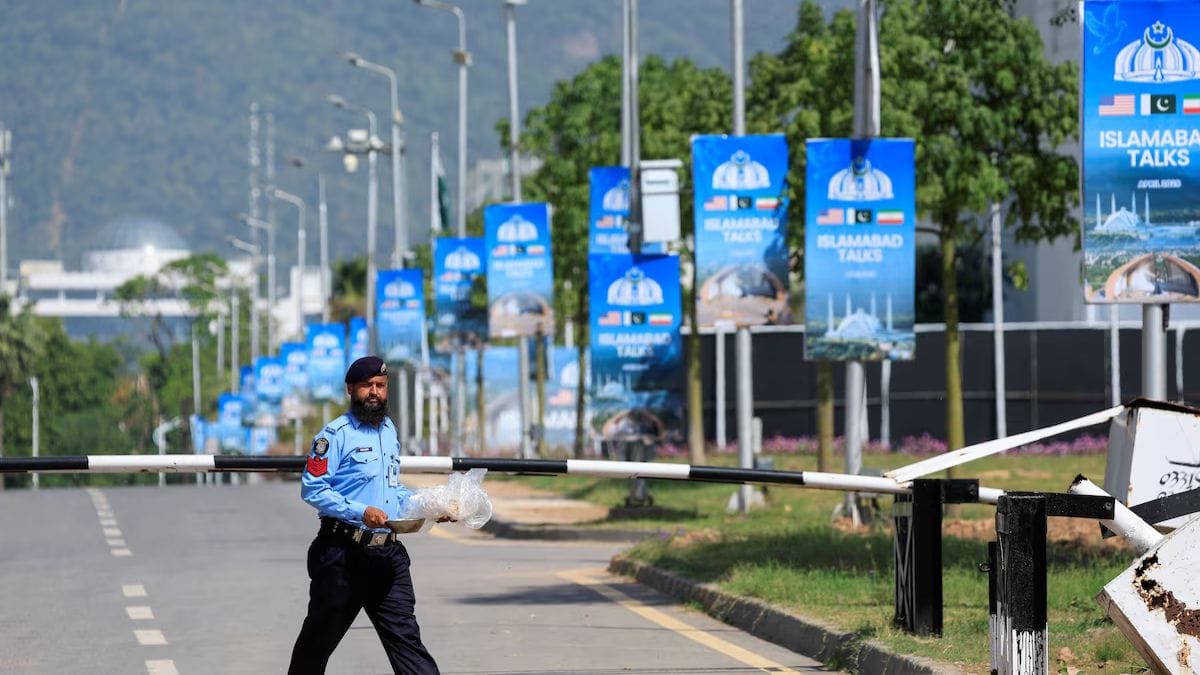
Pakistan’s capital Islamabad continued to remain closed for heavy traffic Friday as authorities await the possible visit of top leaders of the US and Iran for peace talks, which were stalled due to differences on key issues.
The administrations of the twin cities of Islamabad and Rawalpindi had closed all major roads and markets in VVIP movement areas Sunday amid indications that the talks could begin any day during the week. More than 10,000 security personnel have been deployed to maintain law and order.
But there’s no schedule for the arrival of the two countries’ delegations. With uncertainty persisting, district administrations are yet to decide on reopening areas around the Nur Khan Airbase and resuming Metro Bus, electric bus services and goods transportation.
Streets, link roads, markets and banks around the old airport have remained closed over the past five days, confining residents of Shah Faisal Colony, Khalid Colony, Gulzar-e-Quaid, Fazal Town to their homes.
The Metro Bus Service between Rawalpindi and Islamabad, and electric buses on seven routes have been suspended, while goods transport has remained halted since 19 April. Offices in some zones also remain closed, with most of them shifting to work-from-home format.
Movement of heavy traffic has been partly allowed in some parts of Rawalpindi, but Islamabad remains off-limits for trucks and buses. Though schools and colleges are not shut, universities have switched to virtual classes.
There is still no official word on restarting negotiations, the last round of which was held on 11-12 April and did not yield a breakthrough to resolve the West Asia war.
2.00 pm: Lebanon urged to join ICC
Human Rights Watch has called on Lebanon to join the International Criminal Court, two days after Israeli forces killed Lebanese journalist Amal Khalil and wounded her colleague Zainab Faraj in an air strike in the village of al-Tayri in southern Lebanon.
Lebanon’s Deputy Prime Minister Tarek Mitri said Thursday that ministers had discussed joining ICC, a permanent tribunal that prosecutes individuals for war crimes, crimes against humanity and genocide, for “a specific period”.
The move would mark a significant shift for Lebanon, which is not a member of the court. Mitri said the move would enable the ICC to “look into war crimes and humanitarian crimes which were committed on Lebanese territory”. Lebanon has accused Israel of war crimes and and repeated breaches of international law during the latest war with Hezbollah.
1.15 pm: Lebanon says negotiation with Israel is not ‘surrender’
Lebanon Foreign Minister Youssef Raggi has said there is “no shame” negotiating with Israel if the goal is to “end the war” and “recover territory”.
Al Jazeera reported Raggi as telling a local newspaper that Lebanon’s negotiations with Israel did not amount to “surrender”. They were, instead, a tool for “defending national interests”.
Raggi also criticised Hezbollah, which he said was gambling with the lives of locals in Lebanon. “The Lebanese track is now separate from the Iranian track” and that Lebanon’s “interests are no longer hostage to the progress or deadlock of Iranian negotiations, he said.
Separately, Lebanon’s Minister of Information Paul Morcos told BBC that the ceasefire extension was made his country’s request. As part of the ceasefire, Beirut has to take “meaningful steps” to prevent Hezbollah and all other “rogue non-state armed groups” from carrying out attacks against Israeli targets.
12.00 pm: Italy rules out replacing Iran in FIFA World Cup
Italian sports officials said four-time champion Italy was not interested in replacing Iran at the upcoming World Cup following a suggestion to that effect by a Trump administration official.
Iran has not withdrawn from the World Cup, and the team is preparing to play in the US despite the war in West Asia. FIFA has insisted its group stage games near Los Angeles and in Seattle will go ahead as planned in June.
The Financial Times reported that Paolo Zampolli, the US special envoy for global partnerships, had suggested the swap to President Donald Trump and FIFA President Gianni Infantino. In a phone interview with the Associated Press Thursday, Zampolli emphasised that “my request is not a political request”. The ask, which was made to Trump and Infantino Wednesday, was meant as a contingency plan in case Iran could not participate in the football tournament at the last minute.
Italian officials pushed back hard at the suggestion, with Sports Minister Andrea Abodi saying Thursday that “first of all, it’s not possible. Secondly, it’s not a good idea”.
Luciano Buonfiglio, the president of the Italian Olympic Committee, which oversees all sports in Italy, also dismissed the idea. “I would feel offended,” Buonfiglio said. “You need to deserve to go to the World Cup.” Italy’s Finance Minister Giancarlo Giorgetti called the suggested swap “shameful”.
While Iran was among the first teams to qualify for the World Cup, Italy missed out for the third consecutive tournament, resulting in the resignations of its national team coach and football federation president.
The White House did not return a request for comment. Its World Cup task force, housed under the Department of Homeland Security, said it had no comment. FIFA also would not comment.
The Iranian embassy in Rome denounced Zampolli’s remarks in a comment on X. “Football belongs to the people, not to politicians,” the embassy said. An Iranian government spokesperson said Wednesday that the men’s national team is preparing for “proud and successful participation” in its World Cup games in the US.
11.00 am: Air defences in action over Tehran, both sides flex military might
Iran’s capital Thursday night saw air defence systems in action as explosions were heard in the western part of the city. State media said the move was against “hostile targets, “ without any elaboration.
Witnesses said air defence systems were also heard southwest of the city. Some Iranian media said earlier Wednesday that a test of the systems was in process.
Before that, Iran’s judiciary chief, Gholamhossein Mohseni Ejehi, said on X that the country’s armed forces were demonstrating strength in the Strait of Hormuz, citing what he described as a Revolutionary Guard “mosquito fleet” of speedboats and underwater drones, along with action against three ships in the waterway.
He wrote that “the IRGC’s mosquito fleet, with speedboats and drones, lies in wait from the sea caves of Faror Island for the American aggressor warships, ready to saturate their air defences and bring utter ruin upon the invaders”.
He called the display “a source of pride” and warned against US naval presence.
In Israel, the country’s defence minister Israel Katz said Thursday that Tel Aviv is prepared to resume war with Iran and is awaiting a “green light” from the US, according to a statement following a security assessment. “We are waiting for a green light from the United States,” Katz said, adding that the military is ready for both defensive and offensive operations and “targets are marked”.
Source: Associated Press
10.30 am: Oil at $106 a barrel
Oil rose for a fifth day as concerns grew that the US and Iran were making little progress toward resuming talks on de-escalation, keeping the Strait of Hormuz effectively closed.
Brent, the global crude benchmark, rose 0.9 percent to $106 a barrel, taking this year’s gains to about 74 percent. The commodity is set for its biggest weekly gain since the first week of the war as the closure of the Strait disrupts the flow of oil from West Asia to the rest of the world.
Source: Bloomberg
10.15 am: Israeli military says ‘several rockets’ fired towards north
Israeli military said “several rockets” were launched towards Shluhot, in the north of the country, despite extension of the ceasefire, announced Thursday night. It said the launcher that fired the rockets was struck within minutes, and a second launcher was also hit by Israeli forces.
On Friday, Israel carried out new strikes on southern Lebanon, Al Jazeera reported. Two raids targeted the town of Touline, while a separate strike hit Khirbet Selm, the Lebanon 24 news outlet said.
9.45 am: Third US aircraft carrier arrives in West Asia
The aircraft carrier USS George H.W. Bush has now arrived in US Central Command, making the ship the third aircraft carrier to be present in West Asia during a tenuous ceasefire in the Iran war.
The Bush is now in the Indian Ocean, according to a social media post from the military command. The USS Abraham Lincoln is located in the Arabian Sea and the USS Gerald R. Ford is in the Red Sea. The Bush, which left its home port of Norfolk, Va. at the end of March, proceeded to sail across the Atlantic Ocean but then made the unusual choice to turn south and sail around the Horn of Africa before heading north toward the waters of West Asia.
Also Read: Israel-US-Iran war could go many ways for India. The dust needs to settle first
9.35 am: Iran leadership puts up a united front
“In Iran there are no hardliners’ or moderates’. We are all Iranians and revolutionaries,” Iran’s President, and Iran’s parliament speaker wrote in an almost identical statement on their social media. A spokesperson for Iran’s Foreign Ministry called the US president’s claim that there was a leadership rift in Iran “a form of deflection,” with other Iranian officials also claiming on social media that the country was united.
Hours earlier, Trump said that Iran is going through a hard time “figuring out who their leader is! They just don’t know!“
Since the killing of Supreme Leader Ali Khamenei at the beginning of the war, it has been unclear who in Iran wields ultimate authority over its collection of civilian figures and powerful generals who appear to be in charge.
The failure of Israel's terrorist killings is reflected in how Iran's state institutions continue to act with unity, purpose, and discipline.
The battlefield and diplomacy are fully coordinated fronts in the same war.
Iranians are all united, more than ever before.
— Seyed Abbas Araghchi (@araghchi) April 23, 2026
در ایران ما تندرو و میانهرو وجود ندارد؛
همه ما «ایرانی» و «انقلابی» هستیم و با اتحاد آهنین ملت و دولت، با تبعیت کامل از رهبر معظم انقلاب متجاوز جنایتکار را پشیمان خواهیم کرد.یک خدا، یک رهبر، یک ملت، و یک راه؛ آن هم راه پیروزی ایرانِ عزیزتر از جان.
#ایران_ما— محمدباقر قالیباف | MB Ghalibaf (@mb_ghalibaf) April 23, 2026
In Iran there are no "hardliners" or "moderates" We are all Iranians and revolutionaries. With ironclad unity of nation and state and obedience to the Supreme Leader, we will make the aggressor regret. One God, one nation, one leader, one path; victory for Iran, dearer than life
— Masoud Pezeshkian (@drpezeshkian) April 23, 2026
9.30 am: US video of ‘boarding sanctioned ship’
The US Department of Defence (DoD) said in a statement it had carried out a “maritime interdiction” on ship M/T Majestic X carrying sanctioned Iranian crude. The latest interception comes as President Trump ordered the US Navy to “shoot and kill” any boat laying mines in the Strait of Hormuz.
Overnight, U.S. forces carried out a maritime interdiction and right-of-visit boarding of the sanctioned stateless vessel M/T Majestic X transporting oil from Iran, in the Indian Ocean within the INDOPACOM area of responsibility.
We will continue global maritime enforcement to… pic.twitter.com/SWF6Jt9Ci4
— Department of War 🇺🇸 (@DeptofWar) April 23, 2026
9.15 am: Pope Leo urges for US, Iran talks
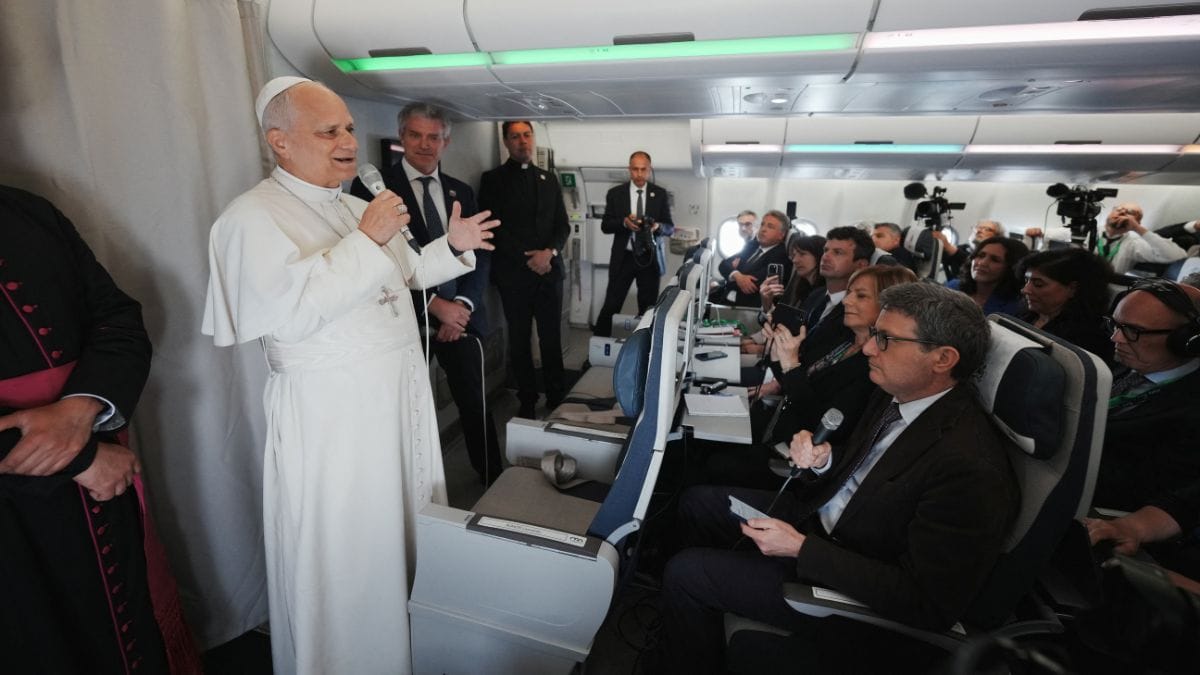
Pope Leo XIV urged the US and Iran to return to talks to end the war Thursday and condemned capital punishment, in a wide-ranging press conference en route home from his trip to Africa. Leo also asserted that countries have the right to control their borders but mustn’t treat migrants worse than “animals,” and lamented that the church’s morality teaching is often reduced to sexual issues.
After a trip that was dominated by the very public back and forth between Leo and US President Donald Trump over the war, Leo urged the United States and Iran to return to negotiations. He called for a new “culture of peace” to replace the recourse to violence whenever conflicts arise.
He said the question wasn’t whether the Iran regime should change or not. “The question should be about how to promote the values we believe in without the deaths of so many innocents.” He revealed that he carries with him the photo of a Muslim Lebanese boy who had been killed in Israel’s recent war with Hezbollah. The boy had been photographed holding a sign welcoming the pope when he visited Lebanon last year.
“As a pastor I cannot be in favour of war,” he told reporters aboard his plane. “I would like to encourage everyone to find responses that come from a culture of peace and not hatred and division.”
Asked if he condemned Iran’s recent executions, Leo said he condemned “all actions that are unjust” and included capital punishment in the list. “I condemn the taking of people’s lives. I condemn capital punishment. I believe human life is to be respected and that all people from conception to natural (death), their lives should be respected and protected.
“So when a regime, when a country takes decisions which take away the lives of other people unjustly, then obviously that is something that should be condemned,” he said. Pope Francis changed the church’s social teaching to declare capital punishment immoral in all cases.
9.00 am: Overnight recap
- ‘Historic moment’: Speaking alongside Trump in the Oval Office, Israeli Ambassador to the US Yechiel Leiter said Israel and Lebanon “have never been next to each other more than today”. Leiter thanked Trump and Vance for a day he said was decades in the making. “We are going to keep going, working for peace. Let’s hope we will get it as soon as possible,” he said. Lebanese Ambassador to the US Nada Hamadeh Moawad thanked Trump for presiding over “this historic moment.” She added: “I think with your help, with your support, we can make Lebanon great again.”
- Iran ‘must’ stop backing Hezbollah: The President reiterated that the US continues to demand that Iran stop it’s backing of proxy groups, including Hezbollah in Lebanon, as part of any deal between Washington and Tehran to end the war on Iran. “Yeah, they’ll have to cut that,” Trump said to a reporter’s question about aiding the group. “That’s a must.
- ‘A kid throwing rocks’: “The people of Lebanon, the people of Israel are neighbors and they want to get along,” said Mike Huckabee, the US envoy to Israel, who was on hand for the White House talks. “They can get along,” he said. “But it’s like neighbours who have a rough little kid living in the neighborhood who keeps throwing rocks at everybody’s window. And if the kid will quit throwing rocks, the neighbours can get along and start actually working together.”
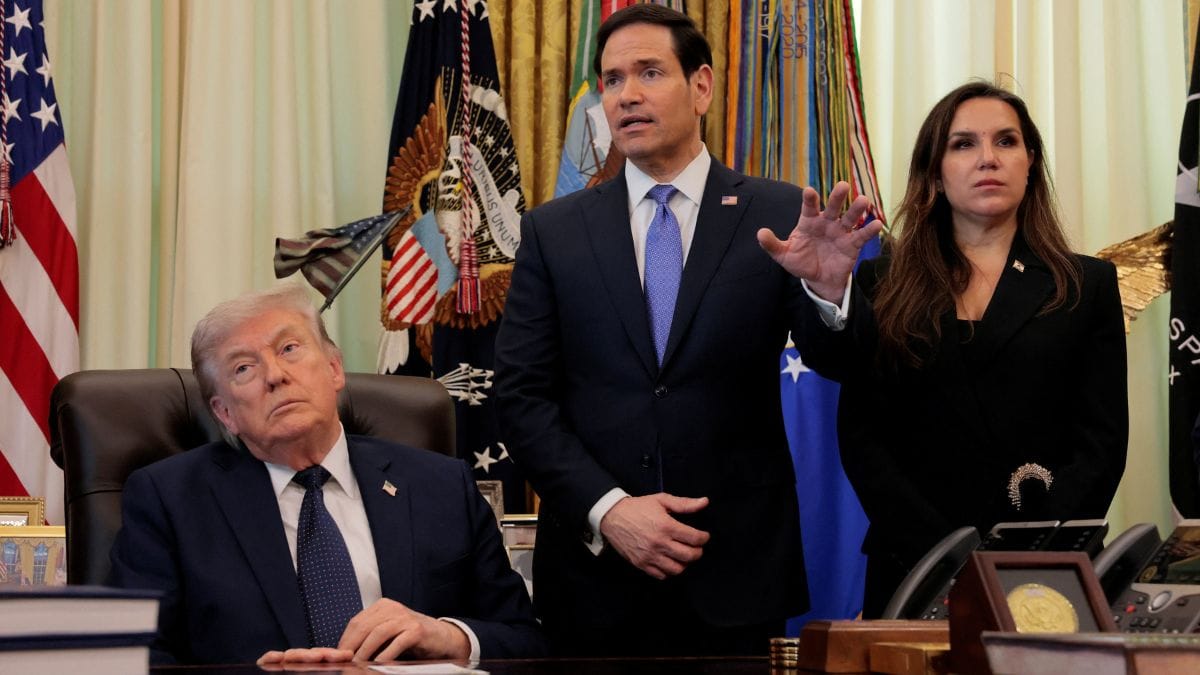
US Secretary of State Marco Rubio, next to President Donald Trump, in Oval Office at the White House | Photo: Reuters
8.45 am: Trump says ‘won’t be rushed’ to end the war
“I don’t want to rush myself,” Trump said, adding that Iran’s leadership is in “turmoil.”
The US President, in an exchange with reporters at the Oval Office, also pushed back against questions that the conflict is exceeding the four-to-six week timeline that he and aides previously set for the war. “I took the country out militarily in the first four weeks. I took it out militarily,” Trump said. “Now all we’re doing is sitting back and seeing what deal (we make). And if they don’t want to make a deal, then I’ll finish it up militarily.”
"I have ordered the United States Navy to shoot and kill any boat, small boats though they may be (Their naval ships are ALL, 159 of them, at the bottom of the sea!), that is putting mines in the waters of the Strait of Hormuz. There is to be no hesitation." – President Donald J.… pic.twitter.com/zRS9PEfUBW
— The White House (@WhiteHouse) April 23, 2026
Trump also said he is not considering using a nuclear weapon against Iran. The President appeared perturbed when asked by a reporter if he’d consider deploying nuclear weapons against the Islamic Republic.
“No, I wouldn’t. We don’t need it. Why do I need it? Why would a stupid question like that be asked?” Trump fumed.
He went on, “Why would I use a nuclear weapon, when we’ve totally, in a very conventional way, decimated them without it. No, I wouldn’t use it. A nuclear weapon should never be allowed to be used by anybody.”
8.30 am: Lebanon to seek Israel withdrawal from its territory
A Lebanese official said Beirut wants a ceasefire extension as a prerequisite for talks to expand beyond the ambassadorial level to the next phase, in which Lebanon would push for an Israeli withdrawal, the return of Lebanese detained in Israel and a delineation of the land border.
Israel says its objectives in the talks with Lebanon include securing the dismantlement of Hezbollah and creating conditions for a peace deal. Israel has sought to make common cause with Lebanon’s government over Hezbollah, which Beirut has been seeking to disarm peacefully for the past year.
8.15 am: In Lebanon, Wednesday was deadliest day since ceasefire
The Israeli military said Thursday that it killed two armed individuals in southern Lebanon after identifying them approaching soldiers and posing what it described as an immediate threat.
It was not immediately clear whether the incident was related to strikes reported earlier in nearby areas by Lebanon’s health ministry, which said an Israeli air strike had killed three people and artillery shelling wounded two others, including a child.
Wednesday was Lebanon’s deadliest day since the ceasefire took effect on 16 April. Those killed by Israeli strikes included Lebanese journalist Amal Khalil, according to a senior Lebanese military official and her employer, Al-Akhbar newspaper.
Hezbollah lawmaker Hassan Fadlallah said the group wanted the ceasefire to continue but “on the basis of full compliance by the Israeli enemy”. At a televised press conference, he reiterated Hezbollah’s objections to the face-to-face talks and urged the government to cancel all forms of direct contact with Israel.
8.00 am: The Lebanon ceasefire
The ceasefire between Lebanon and Israel was extended for three weeks after a high-level meeting at the White House, Trump announced Thursday.
The decision was reached after Trump hosted Israel’s ambassador to Washington Yechiel Leiter and Lebanese ambassador to the US Nada Moawad in the Oval Office for a second round of talks. The day before, Israeli strikes killed at least five people, including a journalist.
“The Meeting went very well! The United States is going to work with Lebanon in order to help it protect itself from Hezbollah,” Trump wrote on Truth Social.
Trump added that he looked forward to hosting Israeli Prime Minister Benjamin Netanyahu and Lebanese President Joseph Aoun in the near future.
The ceasefire, reached after talks between the two nations’ ambassadors to Washington last week and set to expire on Sunday, has yielded a significant reduction in violence. Still, attacks have continued in southern Lebanon, where Israeli troops have seized a self-declared buffer zone.
Iran-backed Hezbollah says it has “the right to resist” occupying forces.
Vice-President J.D. Vance, Secretary of State Marco Rubio, US Ambassador to Israel Mike Huckabee and US Ambassador to Lebanon Michel Issa also attended the meeting.