





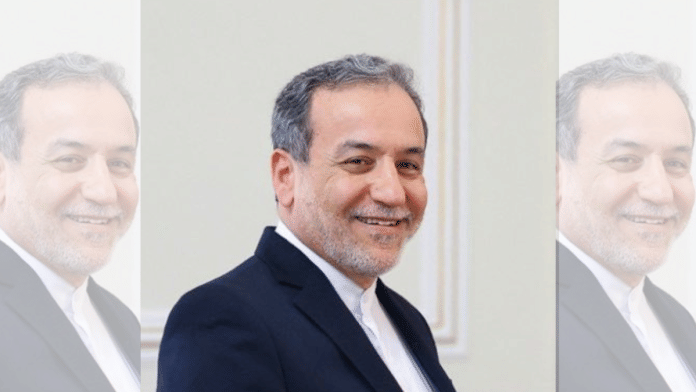


New Delhi: Iran’s Foreign Minister Seyed Abbas Araghchi is unlikely to attend the BRICS Foreign Ministers’ Meeting in New Delhi next week in view of the situation in West Asia, with his deputy expected to represent the country.
An Iranian official familiar with the matter confirmed to ThePrint from Iran that Deputy Foreign Minister Kazem Gharibabadi is likely to lead the Iranian delegation to New Delhi. Tehran too has not officially confirmed Araghchi’s participation yet with New Delhi.
The BRICS Foreign Ministers’ Meeting is likely to be held on 14 and 15 May. Apart from Araghchi’s unlikely attendance, Chinese Foreign Minister Wang Yi is also expected to give the summit a miss due to President Donald Trump’s visit to Beijing, as reported by ThePrint.
Araghchi had last travelled to India on 7 May, 2025, the day New Delhi launched Operation Sindoor against Pakistan. The Iranian foreign minister travelled to Beijing Wednesday, his first trip to the country since hostilities began in West Asia. A fragile ceasefire remains in place between Iran and the US.
Tehran and Washington have been negotiating, via Islamabad, a peaceful settlement to the war that began at the end of February. For the US, Trump is reportedly looking for an end to the conflict ahead of visit to China next week.
The BRICS Foreign Ministers’ Meeting is being chaired by India. The Leaders’ Summit of the grouping is expected to be hosted in New Delhi in September. The BRICS Foreign Ministers’ Meeting next week will likely see the Iranian Deputy Foreign Minister come face-to-face with his Emirati and Saudi Arabian counterparts for the first time since war broke out in West Asia.
Of the 11 members of the organisation, six foreign ministers—representing Brazil, Russia, South Africa, Indonesia, Egypt and Ethiopia—are expected to participate in the meeting next week.
As mentioned earlier, China is expected to be represented by one of its Deputy Foreign Ministers, while Saudi Arabia is likely to be represented by a senior official, and Reem Al-Hashimy, the UAE’s Minister of State for International Cooperation is likely to represent Abu Dhabi.
A number of challenges remains in India’s year chairing the BRICS, primarily revolving around the situation in West Asia. BRICS has yet to publish a joint statement on the conflict, given the differences between Tehran and Abu Dhabi.
The UAE has faced the brunt of Iran’s retaliation during the roughly forty-days of open conflict between 28 February and 8 April. Earlier this week, the UAE accused Iran of launching 19 missiles and drones at its territory, despite the month-long ceasefire in place. Iran has denied the strikes against the UAE, highlighting that it solely sought to hit American assets in the region.
The BRICS meeting on Middle East and North Africa (MENA) last month hosted by India, failed to issue a joint statement. However, India released a chair’s statement, highlighting that various members of the grouping declared their “deep concern” over the situation in West Asia.
A number of partner countries of BRICS are expected to send high-level delegations. The current partner countries of BRICS are Belarus, Bolivia, Cuba, Kazakhstan, Malaysia, Nigeria, Thailand, Uganda, Uzbekistan and Vietnam.
Apart from the situation in West Asia, the foreign ministers are expected to discuss a number of other regional and international topics of importance, along with steps to strengthen the organisation. The BRICS’ countries had established the New Development Bank in 2015 to support private and public projects through loans, guarantees and other financial instruments.
(Edited by Ajeet Tiwari)
Also Read: Iranian FM Araghchi to travel to Beijing as China steps up regional diplomacy ahead of Trump visit