



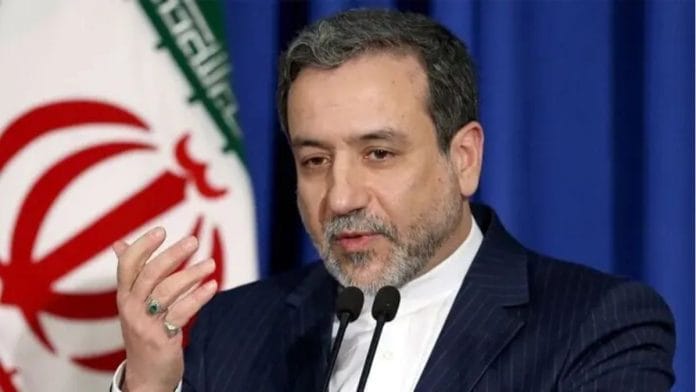
New Delhi: Iranian Foreign Minister Seyed Abbas Araghchi will travel to Beijing Wednesday on the invitation of the Chinese government, as the fragile Iran-US ceasefire teeters on the edge. His visit comes days ahead of US President Donald Trump’s visit to Beijing between 14 and 15 May.
During his visit, Araghchi will be holding meetings with his Chinese counterpart Wang Yi.
“Minister of Foreign Affairs of Iran Seyyed Abbas Araghchi will visit China upon invitation on May 6. Member of the Political Bureau of the CPC Central Committee and Minister of Foreign Affairs Wang Yi will hold talks with him,” the Chinese Foreign Ministry said in a statement Tuesday.
The announcement by Beijing comes as Iran launched strikes on the UAE Monday, injuring three Indians in Fujairah. The strike occurred after the US’ “Project Freedom” to reopen the Strait of Hormuz, using guided missile destroyers, to aid merchant vessels in transiting the global waterway. Two US-flagged ships, including one owned by Maersk, the Danish shipping giant, safely passed through the Strait Monday.
China has been one of the biggest backers of Iran. Beijing has continued to purchase Iranian oil, despite US sanctions. Earlier in April, Pakistani Deputy PM and Foreign Minister Ishaq Dar had travelled to Beijing as Islamabad ramped up its efforts to broker a ceasefire between Iran and the US.
Days later, on 8 April, the two countries announced the ceasefire, which remains in effect, despite the military action Monday. Trump claimed to have destroyed seven Iranian speed boats Monday as Washington continues to find methods to open up the Strait.
The effective closure of the chokepoint has roiled global energy markets, as a fifth of the world’s oil supplies transits through the Strait. China played a role in pressing Iran to accept the ceasefire deal, according to media reports.
Beijing is reported to have pushed Tehran to be flexible to diffuse tensions with Washington, according to the The New York Times.
Iran has maintained that as long as the US lifts its naval blockade, direct negotiations for a peaceful settlement will not continue. The US and Iran met in Islamabad on 11 April, in an attempt to negotiate a deal. However, the talks were unable to find a pivotal breakthrough to lead to a peaceful settlement of the current war.
For years, Beijing has remained a key partner for Tehran, not only economically, but also diplomatically. China’s actions have aided Iran in weathering the international sanctions regime, while offering Tehran a lifeline through oil purchases.
On Monday, US Treasury Secretary Scott Bessent, in a strong rebuke against Beijing, urged the Chinese to “step up” with some diplomacy to force Tehran to open up the Strait of Hormuz. Bessent labelled China’s purchases of Iranian oil as Beijing funding the world’s largest state sponsor of terrorism.
“Iran is the largest state sponsor of terrorism, and China has been buying 90 percent of their energy, so they are funding the largest state sponsor of terrorism,” Bessent said in comments to Fox News, the American broadcast company.
Bessent has been leading the US’ economic campaign against Iran, unveiling multiple sanctions over the last couple of weeks, in an attempt to hinder Tehran’s remaining links to the global economy.
At the same time, tensions between the US and China have eased in the last year. Trump met with Chinese President Xi Jinping in the South Korean city of Busan last year. The American President was set to travel to China earlier this year, but the visit was postponed to 14 and 15 May following the start of the ongoing hostilities between the US and Iran on 28 February.
At the end of April, however, the US imposed sanctions on Chinese refineries purchasing Iranian oil. Beijing moved quickly to shield its companies and urged them to continue ignoring American sanctions.
(Edited by Vidhi Bhutra)
Also read: Iran has the right to retaliate to Gulf nations used by US to launch attacks, Tehran tells ThePrint