







New Delhi: In a statement to ThePrint Monday, Iran said that as a “civilisational state”, it will not bow down to Western pressure, defending its right to “legitimately” respond to countries across the Gulf militarily, if their territory is used by the US to attack the West Asian nation.
“Iran is not merely a political actor in today’s equations; it is a multi-millennial civilisation that holds a unique place in the historical memory of the region and the world. It is a country that has emerged from centuries of trials, invasions, sanctions, and pressure, remaining steadfast in its identity, independence, and dignity,” the Iranian Embassy said in a statement to ThePrint. The statement is in response to comments made by the Ambassador of Israel to India Reuven Azar in an interaction with ThePrint’s newsroom last week.
The statement added: “Iran is a civilisation thousands of years old; a civilisation whose historical memory has weathered the rise and fall of empires, sanctions, aggressions, and pressures, yet remains standing. Within this civilisational context, the Islamic Republic is the continuation of the will of a nation that has defined independence as a non-negotiable principle. It is this very historical rooting that causes external analysts to repeatedly fall into perceptual and calculative errors when trying to understand Iran.”
The Embassy was categorical in Tehran’s “assertion of the right to legitimate defence” that allows any sovereign state to “respond proportionately to the source of aggression”.
“Our martyred leader (Ayatollah Ali Khamenei) had also previously declared in no uncertain terms that if the United States were to use its bases in Arab countries to act against Iran, the Islamic Republic would respond directly to the sources, an action that could expand the scope of conflict to a regional level,” the statement added.
Last week, the Israeli envoy in an interaction with ThePrint, said that the Islamic Revolutionary Guard Corps (IRGC) was calling the shots in Iran, and that the effective closure of the Strait of Hormuz has “boomeranged” against Tehran, with the US now imposing a naval blockade.
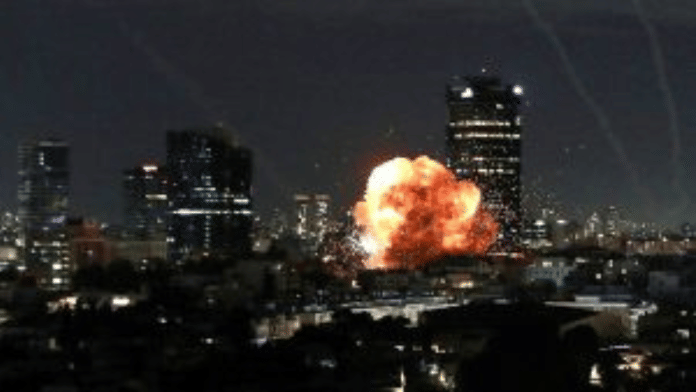
Tensions are on the rise in West Asia, with the United Arab Emirates Monday announcing that it engaged 19 missiles and drones launched by Iran against its territory. Three Indians were injured in an attack against a petroleum complex in the UAE’s Fujairah. Prime Minister Narendra Modi condemned the attack Tuesday, and called on countries to cease hostilities and attacks against civilian infrastructure.
The UAE has faced the brunt of Iran’s retaliation. Over 2,500 missiles and drones have been launched at the UAE from Iran during the course of the 40-day war, including Monday’s strikes.
The effective closure of the Strait of Hormuz has roiled the global energy markets. The US launched ‘Project Freedom’ using guided missile destroyers to aid merchant vessels to transit through the Strait of Hormuz. Iranian Foreign Minister Seyed Abbas Araghchi in a statement Monday pointed out that there are no “military solutions” to a “political crisis”.
A fragile ceasefire remains in place between the US and Iran since 8 April. The first round of direct negotiations between Iran and the US in the Pakistani capital of Islamabad on 11 April did not result in a peaceful settlement to the conflict. The conflict began on 28 February with joint US-Iran airstrikes across Iran, which killed Supreme Leader Ayatollah Ali Khamenei.
“The Iranian nation has not responded to pressure with passivity. In days when threats and attacks intensified, the people did not retreat from the stage; instead they took to the streets, manifesting a solidarity that showed national security is no abstract concept to them,” the Embassy of Iran to India’s statement said.
The statement added: “The images of Iranians returning to their country rather than fleeing it, and the continuous presence of the public in the communal sphere, testify the fact that Iran’s primary capital is not merely ‘hard power’, but the profound bond between a people, their land, and their national identity.”
The Embassy further said that Iran “cannot be understood through the lens of security clichés or propaganda narratives” while highlighting what it perceives as Israel’s participation in a “relentless series of wars and military aggression” in 1948, 1950, 1956, 1967, 1972, 1973, 1976 and 1978—all before the Islamic Revolution of 1979.
Despite decades of sanctions, economic pressure and various forms of ‘sieges’ have transformed into Iran’s national strategy to “bolster its domestic capabilities, in areas such as advanced technologies, defence industries and scientific research,” the statement added.
“From this perspective, aggression against Iran cannot be viewed as a mere military act; it is part of a broader antagonism toward any independent, civilisational model that refuses to become a plaything for dominant powers.”
For the US and Israel, the main security concern remains the perceived capability of Iran to build a nuclear weapon. Pakistan continues to play its role as a mediator, with Tehran briefing Islamabad on its current position regarding the negotiations for a peaceful settlement, Araghchi added in his statement on X.
(Edited by Viny Mishra)
Also read: IRGC calling the shots in Iran, ‘Hormuz card’ boomeranged—Israel’s Ambassador to India Reuven Azar
It does. Iran is responding in self defence, not initiating the conflict, or subsequent fighting. 2. All economies, in Asia most of all, also developing countries, are hurting. Perhaps Europe and Japan in particular, could weigh in more strongly on peaceful options being explored further.