





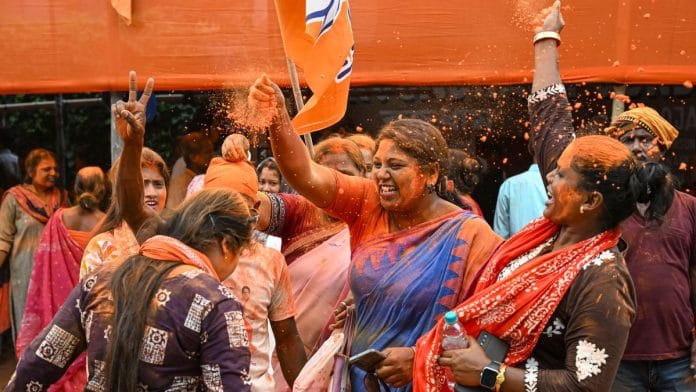


Kolkata: Monday’s West Bengal election results reaffirmed what years of voting pattern had signalled: the Dalit Hindu Matuas held firm with the Bharatiya Janata Party, and their loyalty proved helpful in BJP’s historic first victory in the state.
An analysis of Election Commission data shows the community voted heavily for the BJP across Matua-dominated constituencies in North 24 Parganas—33 assembly seats—and Nadia, with 17.
Together, the two districts account for roughly 40 percent of the Matua population. Bagdah, Gaighata, Bangaon North, Bongaon South, Habra, Haringhata, Ranaghat, Chakdah and Krishnaganj–all went the BJP’s way.
The margins told a consistent story. In Gaighata, the spiritual hub of the Matua community in North 24 Parganas, BJP’s Subrata Thakur won by over 47,000 votes, defeating TMC’s Narottam Biswas. Subrata is the grandson of Matua matriarch Binapani Devi—known as ‘Boro Maa’—and the elder brother of MP Shantanu Thakur, Union Minister of State for shipping and the community’s most prominent BJP face.
The family’s electoral reach extended to Bagdah, where Shantanu’s wife Soma Thakur, won 1,21,307 votes—a margin of over 34,000—defeating TMC’s Madhupana Thakur. Madhupana is the daughter of Mamata Bala Thakur, TMC’s Rajya Sabha MP and Matua leader, who is married to Kapil Krishna Thakur—Binapani Devi’s elder son and a former TMC parliamentarian. The Thakur family’s internal fracture, with Subrata and Shantanu on the BJP side against Mamata Bala’s TMC loyalties, played out sharply in the results.
Elsewhere across the two districts, the BJP swept Matua heartlands by wide margins. In Bangaon North, Ashok Kirtania won 1,19,317 votes, defeating TMC’s Biswajit Das by over 40,000 votes.
In Bangaon South, Swapan Majumder beat TMC’s Rituparna Addhya by a margin of over 37,000.
In Nadia’s Ranaghat Dakshin, Ashim Kumar Biswas polled 1.4 lakh votes against TMC’s Sougata Kumar Barman, who got 75,546 votes. In Chakdaha, Bankim Chandra Ghosh won 1.15 lakh votes to TMC candidate Subhankar Singha’s 78,488. In Haringhata, Asim Kumar Sarkar won by 22,000 votes; TMC’s Rajib Biswas received 85,845.
The Matua community—a Hindu sect whose members migrated from Bangladesh to Bengal largely during Partition and the 1971 India-Pakistan war, with further waves arriving in response to religious persecution—do not hold Indian citizenship.
The 2019 Citizenship Amendment Act (CAA) was meant to address this, but the process has moved slowly and generated significant discontent within the community. But Monday’s results showed that discontent did not translate into a vote shift.
That the community voted as it did is notable against a second source of anxiety: the Special Intensive Revision (SIR) of electoral rolls.
In North 24 Parganas, 3.25 lakh names were struck off voters’ lists following the exercise and adjudication by judicial officers—an average of 9,869 deletions per constituency across the district’s 33 seats.
In Nadia, where the population is estimated at 51 lakh, two lakh names were removed in the final supplementary list published at midnight on 6 April, averaging 12,272 deletions per constituency.
The Matua community, concentrated in both districts, had viewed SIR with alarm.
Both parties also courted the community aggressively.
In December 2025, Union Home Minister Amit Shah told an audience in Kolkata that the voting rights of Matua CAA applicants would be preserved. In March 2021, ahead of that year’s assembly elections, Prime Minister Narendra Modi visited Orakandi in Bangladesh—birthplace of Harichand Thakur, the Matua sect’s founder, and his son Guruchand Thakur. The TMC, meanwhile, established a university in North 24 Parganas named after the sect’s founders in 2018 and announced a range of welfare measures for the community.
But, on Monday, it was the BJP’s years of outreach that held.
Also Read: Already on margins, Congress & Left make minor gains in Bengal but still left fighting for relevance