





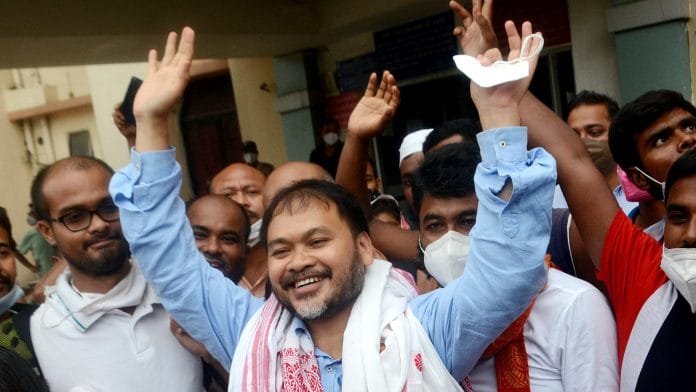


New Delhi: Activist-turned-politician Akhil Gogoi of Raijor Dal was trailing behind Bharatiya Janata Party’s Kushal Dowari in Assam’s Sibsagar assembly constituency by 328 votes after 3 round of counting of votes on Monday.
Gogoi, the sitting MLA, secured 11,821 votes whereas Dowari got 12,149 votes, according to data of the Election Commission.
The result carries particular weight in a constituency where Gogoi’s personal influence is the decisive variable—as it was in 2021, when he won the seat from jail. His imprisonment over cases linked to the anti-Citizenship Amendment Act (CAA) protests had made the contest a referendum on civil liberties.
The race this time has an added complication: a split within the NDA in Assam. Kushal Dowari of the BJP and Prodip Hazarika of the AGP are contesting against each other.
Hazarika is no minor figure. A veteran of the Assam agitation of the 1970s-80s and a five-time MLA from the now-dissolved Amguri seat, he brings decades of political capital to the fight.
Dowari’s trajectory is more chequered—a former United Liberation Front of Asom (ULFA) insurgent who joined electoral politics with the BJP, he won Thowra in 2006 and 2016, but lost the seat to the Congress in 2021.
Sibsagar’s electorate—a mix of Ahom community voters, tea-tribe workers, and urban middle class—has historically rewarded candidates who can speak to more than one constituency at once.
How Gogoi won in 2021
Gogoi’s 2021 victory was, by most accounts, a campaign conducted while he was incarcerated. Held in custody, he filed his nomination through authorised representatives under permissions from jail authorities. His supporters and grassroots networks, built through years of activism, ran the campaign entirely on his behalf. His imprisonment — framed by his base as political persecution — became a flashpoint that amplified rather than diminished his appeal.
He had founded Raijor Dal the previous year, in 2020, while still incarcerated. The party positioned itself as a “regional alternative” anchored in federalism, secularism and opposition to the CAA. It emerged from more than a decade of activism through the Krishak Mukti Sangram Samiti.
The party advocates what it calls “sub-nationalism”—a politics of Assamese identity, land and farmers’ rights, and greater state autonomy—though its influence remains largely concentrated in pockets of Upper Assam, and its electoral fortunes remain closely tied to Gogoi himself.
Gogoi was released from jail in July 2021 after a National Investigation Agency (NIA) court absolved him of all charges and quashed both Unlawful Activities (Prevention) Act cases against him.
The activist-politician grew up in a modest rural household and studied at Cotton College in Guwahati before pursuing a Master’s degree in Sociology from the Delhi University.
Before entering electoral politics, he spent years working with farmers, labourers and indigenous communities across Assam, establishing himself as an activist focused on land rights, corruption and environmental concerns.
(Edited by Prerna Madan)
Also Read: ‘3G’ vs BJP: What seat-sharing pact of 3 Gogois means for Oppn & CM Himanta in Assam