








Much of the global attention has been fixated on the Arabian Sea, Red Sea, and the Persian Gulf, resulting in a relative neglect of some critical developments in the Eastern Indian Ocean, a major maritime region encompassing the Bay of Bengal, the Andaman Sea, and the waters surrounding Indonesia and Western Australia.
This area is witnessing two significant developments that could adversely impact Indian national security and maritime interests.
The first is the nascent ambition of the Indonesian political establishment to impose a levy on ships passing through the Strait of Malacca. It’s something their ancestors tried some one thousand years ago by trying to establish their monopoly on navigation passing through this area, which the Chola rulers of India foiled determinedly by occupying parts of Indonesia and Malaysia.
The second is the determined effort of China to pressurise Thailand for the construction of the Kra Isthmus canal that would provide direct maritime connectivity between the Andaman Sea and the Gulf of Thailand.
With these developments brewing, India’s answer is the long-pending Great Nicobar Island Development Project. In February 2026, the National Green Tribunal dismissed fresh challenges to the project’s environmental and coastal clearances, allowing it to proceed. A master plan was subsequently notified for its completion in three phases, with the final stage targeted for 2047. The mega project, however, has invited sustained opposition from the Congress party. What explains this opposition? Why is this project so vitally important for India?
Also Read: Great Nicobar Project is a trade game-changer for India
Cholas to the Chinese
A brief historical survey of the Thai-Malay peninsula and Indonesia offers some useful insight. Even centuries ago, the Strait of Malacca area had been a hotly contested zone, inviting interventions from the Chinese, Indonesian, and Indian powers.
Until the end of the 4th century AD, the preferred line of maritime communication between eastern India and China was through the Kra Isthmus, a narrow strip of land in peninsular Thailand that separates the Andaman Sea from the Gulf of Thailand.
Indian mariners would sail to the Andaman Sea side of the Kra Isthmus and offload their cargo. It would then be transported across the isthmus to the Gulf of Thailand side, where another ship would take it along coastal Cambodia and Vietnam to China. Since these coasts formed a significant segment of their journey, Cambodia and Vietnam witnessed the emergence of Hinduised kingdoms by the 4th century AD. Similar Hinduised city-states also emerged in eastern peninsular Thailand and Malaysia around the same period.
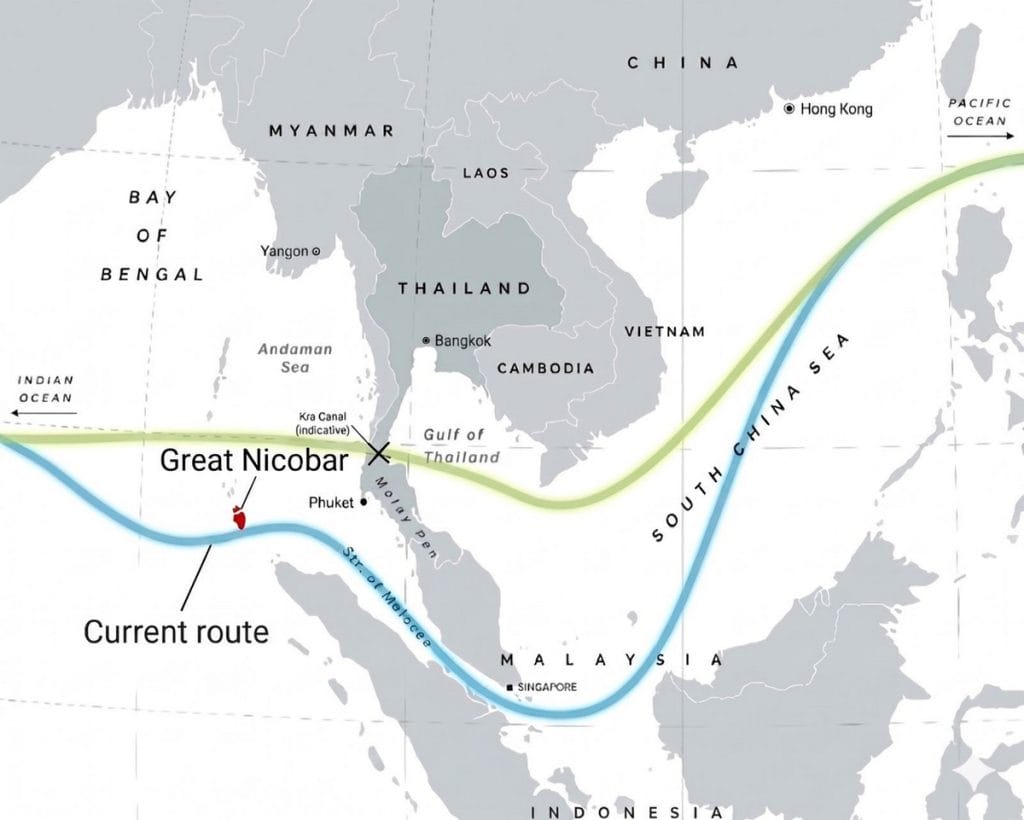
However, by the early 5th century AD, a new all-sea route to China via the Strait of Malacca began to supplant the Kra Isthmus route. The primary beneficiary of this change was the maritime state of Srivijaya, which had its nucleus in Sumatra and, at the height of its power in the 9th-10th century AD, controlled portions of southern Thailand, the whole of Malaysia, and much of Kalimantan. Its strategic location gave it immense wealth and the potential to establish a kind of maritime monopoly over the Strait of Malacca. But when it tried to do so in the 10th century, it was met with a prolonged confrontation with the Chola rulers of South India, who were determined to ensure freedom of navigation in the Strait and South China Sea.
As recorded in Chola inscriptions, the Cholas not only invaded Srivijaya in 1025 AD but also occupied and ruled Malaysia and Sumatra for the next one hundred years or so. The Cholas had to retreat in the 12th century, after which Srivijaya re-established its authority. However, a century of Chola rule rendered it too weak to establish any kind of monopoly in the Strait.
By the early 15th century, Islam became the dominant religion in the Malay Peninsula, and the Islamic Sultanate based in the Peninsula entered into a protracted conflict with the Java-based Hindu-Buddhist Majapahit dynasty. In this conflict, the Malay Sultanate received direct and indirect support from Ming China against the Majapahit dynasty. Gradually, Java and Sumatra underwent profound Islamisation in the 16th and 17th centuries.
Today, this Strait, a vital node in global maritime networks, has acquired a new intensity of contestation due to the economic and naval rise of China.
For China, the strategic agenda is quite obvious: it should have either total domination over the Strait or, if that is not possible, a new maritime route should be opened to obviate its dependence on the Strait of Malacca trade.
The Indian imperative, meanwhile, is to keep the Malacca Strait a zone of free navigation during peacetime, while simultaneously developing its naval and logistical capabilities to interdict it in the event of any prolonged warfare with China. Augmenting India’s economic and maritime footprint in the Andaman Sea is a prerequisite for actualising these strategic goals.
Imperatives for Great Nicobar Development Project
Seemingly taking a leaf from Iran’s attempt to charge levies in the Strait of Hormuz, Indonesian Finance Minister Purbaya Yudhi Sadewa reportedly suggested on 22 April that Indonesia, Malaysia, and Singapore should jointly impose tolls on ships passing through the Strait of Malacca, with the revenue divided equally among the three nations.
The proposal invited swift global backlash, forcing the Indonesian Finance Minister to retract his statement. But this retraction may be due to temporary exigencies, and one cannot rule out the possibility that the Indonesian state may resort to such a measure, which may also involve blocking the Strait by the Indonesian navy, in the event of a prolonged conflict in the area, which would pose a grave danger to India.
Meanwhile, China has been exerting pressure on Thailand to allow the construction of a canal across the Kra Isthmus, which would enable seamless maritime connectivity between the Andaman Sea and the Gulf of Thailand. Thailand has resisted this idea so far, but one cannot be sure if this will remain the situation in future. If this canal is ever built, it will expose the Andaman and Nicobar Islands and much of the Bay of Bengal littoral area of India to direct Chinese threats. In such a situation, China’s dreams of encircling India in its “String of Pearls” strategy would be quite close to reality.
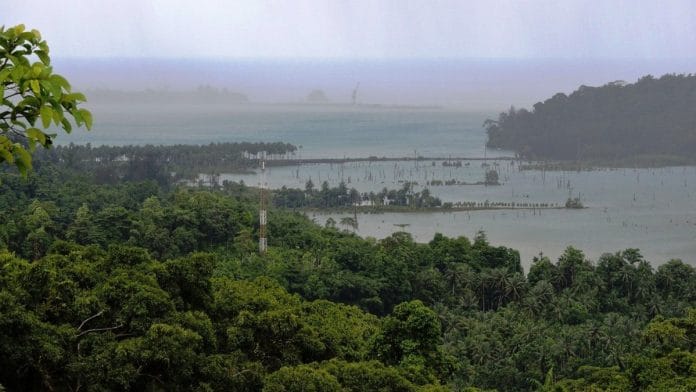
For India, a major counter to these challenges is its massive development project on Great Nicobar Island, situated approximately 150 km from the Indonesian island of Sumatra.
The Great Nicobar Project will entail an investment of Rs 80,000 to 90,000 crore, and involve the construction of an international container trans-shipment terminal, a dual-use civil and military airport, a power plant, and a township.
It is expected that the proposed international container trans-shipment terminal will offer stiff competition to Singapore in handling cargo. The dual-use civil and military airport will enhance India’s capacity to keep track of developments in the Strait of Malacca. The Indian Navy already has a base on Great Nicobar Island, and the proposed civilian and military infrastructure will further enhance its monitoring and power projection capabilities across the Strait of Malacca and beyond.
Also Read: History of Indians in the Arab world—port builders, Jat governor, translators, and slaves
Congress should take a cue from Nehru
Like any infrastructure project, the Great Nicobar Development Project will entail the loss of some forest cover and ecological disturbance. The opposition has latched on to this, with Congress leader Rahul Gandhi recently calling the project “one of the gravest crimes” against the country’s natural and tribal heritage.
But the long-term benefits of this project, such as enhanced maritime security, reduced dependence on foreign transhipment hubs, and stronger deterrence, will far outweigh this loss. The Government of India’s policy should focus on the speedy completion of this project, while making efforts to minimise and mitigate environmental damage. In a 1 May release, the government clarified that it has planned compensatory afforestation over 97.30 sq km and that no relocation of tribal communities is proposed.
As a nation develops, it has to make careful choices between the imperatives of development and the needs of environmental preservation.
In the 1950s, during the construction of the Nagarjunasagar dam in then Andhra Pradesh, Pt Jawaharlal Nehru faced a dilemma. The construction of this reservoir was bound to submerge some great Buddhist archaeological sites. For a civilisational state like India, that was bound to be a great loss of heritage.
The statesman in Pt Nehru took a painful decision: the heritage of the past should not be allowed to halt the development of a modern industrial nation. A massive archaeological salvage operation was undertaken. Whatever could be salvaged was salvaged, but the construction of the reservoir was completed with great speed.
Back then, the Congress and its leadership, still imbued with the fragrance of the great freedom struggle against British colonial rule, displayed remarkable statesmanship and resolve of nation-building. The nation expects similar statesmanship from the current leadership of this party in safeguarding Indian maritime security in a rapidly changing world.
Dr Birendra Nath Prasad teaches maritime history and the history of Hindu and Buddhist cultures of Southeast Asia at Jawaharlal Nehru University, New Delhi. His recent edited volumes include Maritime Southeast Asia: History, Culture and Religion, c. First Century CE–Fifteenth Century CE and History, Economy and Religion: Mainland Southeast Asia, c. First Century CE–Fourteenth Century CE, jointly published by Manohar Publishers, Delhi, and ISEAS Publishing, Singapore. Views are personal.
(Edited by Asavari Singh)