






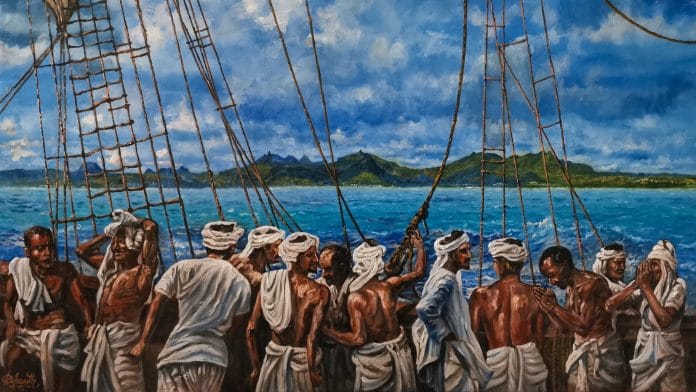


Since February, over 12 lakh Indians have streamed home from the Gulf as instability continues in New Delhi’s neighbourhood. This has been a recurring feature of the past century. In 1990, 2011, 2014, and 2015, among other occasions, tens of thousands of Indians have been evacuated and brought home when at risk during the Gulf War, the Arab Spring, and the rise of ISIS, among other regional upheavals.
India’s largest diaspora — over nine million people — lives in the Gulf and has always lived a paradox. Indians were indispensable to the economies that hosted them, yet were periodically reminded that their presence is conditional.
From the buffalo herders who built one of the world’s greatest medieval ports, to the Jat governor of Egypt, to academics translating Sanskrit works, and enslaved women trafficked for profit, here is one part of the history of Indians in the Arab world.
Jats in the Caliphate
The history of the Indian diaspora extends much further back than one might expect. From as early as the 3rd millennium BCE, we know of traders from “Meluhha”, the Harappan Civilisation, who lived and traded in present-day Iraq and Oman. In an earlier edition of Thinking Medieval, we discussed a 17th-century Bania diaspora that lived in major Gulf cities such as Bandar Abbas. Of course, what we think of as “Indian” was not necessarily what medieval people thought of as “Indian”. A group known as the Zutt—the Arabic rendition of Jat—offers insight.
Many tales are told of the Zutt and how they arrived in the Gulf. According to historian Kristina Richardson (Roma in the Medieval Islamic World), an apocryphal tradition claims that Bahram Gur (r. 420–438 CE), the Sassanian king of Iran, wrote to “the king of India” asking for musicians. What he received, according to Arabic chroniclers, was a tribe of between 10,000 and 12,000 “Zutt”, relocated with their camels and buffalo herds from the Indus delta and Makran drylands to the marshlands of southern Iraq. A canal, known even today as the Nahr al-Zutt, may have been established for them. Historian Andre Wink, in Al-Hind: The Making of the Indo-Islamic World (Volume 1), adds context to this legend. Bahram Gur established several settlements across the Gulf, crewed with mercenaries to contain piracy. As a nomadic, pastoral people, the Zutt may have been ideal caravan guards.
Over the next centuries, Zutt tribes from the Indus area gradually spread along the Gulf. In Sassanid Soldiers in Early Muslim Society, historian Mohsen Zaveri notes that some Zutt spoke Farsi and considered themselves Persian, even serving in Sassanian military units. However, the Arab conquests that erupted throughout the region in the 7th century eradicated Sassanian power and brought several important changes.
For one, the Zutt — along with another group, possibly Malays, called the Sayabija — were formally settled in the port of Basra, where they guarded caravans and took part (reluctantly) in the vendettas of Arab tribes. The Umayyad caliphs, who consolidated authority in the 8th century, deported 27,000 Zutt to present-day Syria, on their border with the Byzantine Empire. They not only combated bandits but also a “plague of lions”. Another major influx of Zutt arrived in Iraq after the Arab conquest of Sindh, though their living conditions remained miserable. A serious rebellion ensued, threatening trade routes and the authority of the Abbasid caliphs — perhaps best known in India for commissioning translations from Sanskrit into Arabic. In 834 CE, after a rebellion that had seriously disrupted Abbasid authority in southern Iraq, another 27,000 were marched to the Byzantine border. Many were massacred. A Zutt song, recorded by the medieval Arab chronicler al-Tabari, curses the people of Baghdad for their reliance on luxurious dates, Chinese silk, and silk brocade.
Also read: Medieval NRIs: How Indian monks rewrote Buddhism in China
The dark history of enslaved Indians
Al-Jahiz of Basra, the greatest prose stylist of the Abbasid age, was a contemporary of those deportations. In his Book of Animals, he cites an authority who described the Zutt with contempt as “mosquitoes flying on the back of the bull… then they dipped their probosces into the hide of the buffalo.” In fact, the Zutt’s connection to India was so distant that, in Arab sources, aside from markers of “otherness” such as their distinctive clothes and “cross-shaped” hairstyles, writers seemed generally unaware of their Indian origins.
Ironically, the same al-Jahiz, in his essay “The Superiority of Blacks to Whites”, defends East African slaves (Zanj) against Arab disdain, using “Indians” for his central argument. In the voice of these slaves, he writes: “We would reply by asking you whether, among all the captives brought from India and Sind, you have ever found one that had the slightest hint of intellect, manners, culture and education. If you have not, why should you expect to find these qualities among East African slaves?” (Translated by James Colville).
He then lists what he considers self-evident in the refined culture of Arabic literati, a view supported by several Abbasid works such as The Book of the Wonders of India. He argues that Indians are pre-eminent in astronomy, mathematics, medicine, sculpture, and chess, and that India gave the world the Panchatantra. So how is it, he asks, that despite the many captives brought from India, none displayed these qualities? His answer: “captives come from the margins of society” — from shores, swamps, jungles, and islands, from hired hands and fishermen. The enslaved cannot be judged by the standards of the societies that enslaved them.
It is a sophisticated argument, and al-Jahiz deploys it to make a point about Arab attitudes to Zanjis. In fact, in the 860s — mere decades after the Zutt rebellions — Zanj slaves had also risen up around Basra, only to be violently suppressed. But reading against the grain, we see that for elite Arabs like al-Jahiz, elite Indians served as a benchmark of civilisational achievement. At the same time, “ordinary” Indian captives seem to have been unremarkable in Abbasid cities, sourced from Sindh, from traders within India, and from subjugated populations like the Zutt.
Al-Jahiz’s sophistication is doubly ironic because, as a product of his time, he also wrote extensively about enslaved Indian women. In her essay “Slaves for Pleasure in Arabic Sex and Slave Purchase Manuals from the Tenth to the Twelfth Centuries”, historian Pernilla Myrne cites him: “Know that there is abundant happiness and complete pleasure only in the brood of two dissimilar kinds… the mating of an Indian woman with a Khurasanian man; they will give birth to pure gold.” Such ideas likely shaped practices in the Abbasid slave markets, where Indian and Sindhi women were categorised and ranked alongside Zanj, Berbers, Turks and Byzantines. Generally, Byzantine and Turk slaves were considered high quality, Sindhi medium, and Indian low-grade.
Also read: The story of India’s forgotten Afghans — horse-traders, mercenaries, kings
‘Success’ in a medieval diaspora?
A different class of Indians was also present in the region, having arrived through far more comfortable means — for highly skilled work. As with the Zutt, this too had pre-Arab precedent. The academy of Jundishapur — founded in 260 CE by Shahpur I in Khuzistan, where the Zutt had grazed their herds from the 5th century onwards — was, by the 6th century, the most sophisticated medical institution in West Asia. According to historian Mehmet Mahfuz Söylemez, in “The Jundishapur School: Its History, Structure and Functions”, an Indian community had settled there by this time. Hindu and Buddhist Indians studied alongside Nestorian Christians and Mazdakite Iranians in what Söylemez describes as an institution that “could compete with modern institutions of education” in its tolerance of different backgrounds.
Among these scholars was Mankah, who in the early 9th century translated Sanskrit medical texts into Pahlawi at Jundishapur and produced the Kitab al-Sumum — the Book of Poisons. This book was originally attributed to “Shanaq”, believed by some scholars to be Chanakya. Manakh later gained patronage under Caliph Harun al-Rashid, who summoned him to Baghdad at the request of the Barmakid family, whose members themselves were Buddhists from Balkh who had converted to Islam. In Baghdad, Mankah translated Sushruta’s surgical texts into Arabic for Khalid Barmakid. His translations were widely used by Jundishapur’s doctors and professors and they circulated in the hospitals of Baghdad for decades. Beyond scattered references in medieval bibliographies, however, little is known about his life.
Far from Baghdad, 9th-century Egypt was a troubled frontier for the Abbasid caliphs. Rebellion, factionalism and weak governance made it difficult for the caliphs to extract any wealth from the province. This began to change with the arrival of Al-Sari ibn al-Hakam al-Zutti (“Al-Sari, son of al-Hakam, the Jat”). When he arrived, according to the Cambridge History of Egypt, he was “a man of no importance.” But he gradually carved out a dominion from Fustat to Aswan, playing Abbasid princes against each other. In 819, he publicly drowned a group of enemies in the Nile. After his death in 822, his son negotiated a surrender in exchange for 10,000 dirhams and a palace in Samarra.
And so, in the 9th-century Gulf, Indian diasporas existed simultaneously within the same empire, sometimes in the same cities. Those who navigated state upheavals, like Al-Sari, retired in splendour, as part of the Gulf elite. Those with specialised skills, like Mankah, were esteemed and influential. And those without either — like the thousands of Zutt — were displaced, exploited and erased.
In all this, the Indians of the medieval world mirror today’s diaspora of nine million, still captive to the whims of unstable Gulf regimes.
Anirudh Kanisetti is a public historian. He is the author of ‘Lords of Earth and Sea: A History of the Chola Empire’ and the award-winning ‘Lords of the Deccan’. He hosts the Echoes of India and Yuddha podcasts. He tweets @AKanisetti and is on Instagram @anirbuddha.
This article is a part of the ‘Thinking Medieval‘ series that takes a deep dive into India’s medieval culture, politics, and history.
(Edited by Prashant Dixit)