





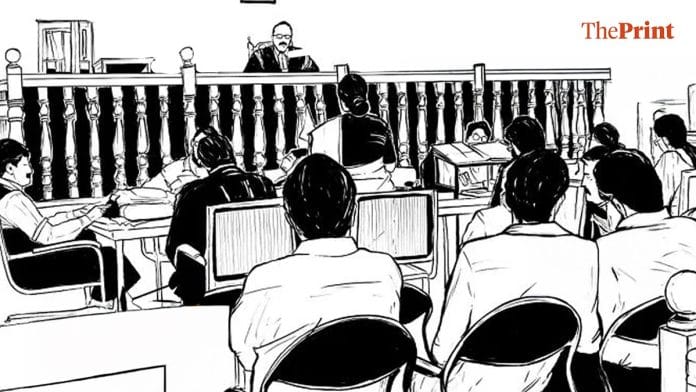


New Delhi: A judge of the Rohini district court in New Delhi was sent to the Delhi Judicial Academy on the directions of the Delhi High Court after a video of a heated courtroom exchange between the judge and a lawyer went viral on social media.
The incident came amid a spate of similar instances of courtroom conflict between judges and lawyers; highlighting that even the usually respectful relationship can sometimes get fractious.
The Supreme Court has long likened the Bar and the Bench to “two indispensable wheels of the chariot of justice”, emphasising that an amiable relationship between the two is imperative to the pursuit of justice. Yet, the past year alone has witnessed multiple instances of highly publicised courtroom disputes across the country.
Viral courtroom clips of judges and lawyers shouting and threatening each other are usually followed by strike and boycott calls by bar associations demanding action. And even though the Supreme Court has built fairly clear jurisprudence on this vital relationship—lawyers cannot go on strike, judges and advocates are bound by mutual restraint, and conflicts should be handled through grievance mechanisms and not public showdowns—there is an increasing number of such instances coming to light.
Whether this increased visibility of disputes is due to technological advances or increased courtroom combativeness is unclear.
‘Chariot of justice’
Repeated incidents reveal a familiar reactionary pattern on both sides.
On the judicial side, the Supreme Court has stressed that strikes are illegal, the Bar and Bench must work together, and discipline of advocates must follow the Advocates Act. It has also urged judges to be patient, especially with young lawyers, while insisting on courtroom decorum. It has further asked high courts to set up grievance redressal committees and improve security in district courts.
On the lawyers’ side, district bars often respond first with strike calls and abstentions, even though those tactics contradict Supreme Court directions.
At the same time, higher Bar bodies increasingly act through letters, demands for an Advocate Protection Act, resolutions and public campaigns, like in an episode in Andhra Pradesh.
A widely-circulated video from the Andhra Pradesh High Court in early May saw a judge issuing oral directions for an advocate, who was repeatedly apologising, to be taken into judicial custody for behaving “indolently”. While Bar intervention ensured the direction was not executed, the Bar Council of India and the Supreme Court Bar Association both wrote to the Chief Justice of India expressing their dismay.
The matter came before a Bench of Chief Justice Surya Kant and Justice Joymalya Bagchi who declined to take further action, but used the occasion to address the institutional obligations of the Bench. Judges at all levels, the court said, must exhibit “patience, compassion, and a spirit of encouragement, particularly towards young entrants to the legal profession”. Senior members of the Bar, the court said, have a professional obligation to inculcate discipline, ethics and advocacy standards among younger lawyers.
The court also observed that the “strength and calibre of the Bench at all levels depends upon the continuous nurturing and development of the Bar”. Further, all high courts were directed to constitute Grievance Redressal Committees at high court, district, and taluka levels to deal with such disputes.
In October 2025, in Jharkhand, the high court initiated suo motu contempt proceedings against an advocate who “misbehaved” with a judge. On approaching the Supreme Court, CJI Surya Kant’s bench directed the lawyer to tender an unconditional apology and asked the high court to consider it “sympathetically”. The high court eventually dropped the case.
In other judgments, the court has framed the relationship in familial terms, warning that “a fault committed by one does not warrant the other to resort to punitive destruction”. Candour and honesty on either side, it added, must be met with “patience and dignity” on the other. Judges, especially when dealing with young advocates in high‑stakes environments, have been advised to adopt something like a “parental” temperament rather than a punitive one.
In a judgment suspending the contempt conviction of senior advocate Yatin Oza, the Supreme Court said earlier this month that the Bar is the “relentless seeker of truth”, fearlessly articulating the litigant’s voice, while the Bench is the “ultimate custodian of the Constitution”, ensuring impartial and timely justice.
Because their functions are distinct yet “so deeply interwoven”, the court said, the actions of one inevitably affect the efficacy of the other. A diligent, ethical Bar elevates jurisprudence; indiscipline “stalls the chariot of justice”. Conversely, “a patient and engaged judiciary” empowers lawyers to argue fearlessly instead of defensively.
Another facet of this relationship is reflected in the Bench’s response to disagreements. In April 2025, in Haryana, a magistrate formally recorded that two advocates had created a “ruckus” in court, made “baseless allegations”, and threatened to “teach a lesson” to the court. Both Faridabad and Gurgaon Bar associations went on strike in protest.
The Supreme Court has been uncompromising on strikes and boycotts by lawyers.
In the Constitution Bench decision in Ex‑Captain Harish Uppal vs Union of India (2003), it held that advocates have no right to strike or boycott courts, except in the “rarest of rare” cases involving the dignity or independence of the judiciary or the Bar, and even then only for a very short, exceptional protest.
The court emphasised that strikes seriously prejudice litigants, disrupt the administration of justice, and cannot be justified as a routine mode of protest. It also made clear that courts cannot suspend work because of a boycott call by bar associations.
Despite this, strikes by bar associations have remained common enough for the Supreme Court to seek details from the Bar Council of India in 2023, on the frequency of stoppages and reiterating that courts cannot be held to ransom by bar boycotts.
‘Clandestine’ filming of court proceedings
Whether courtroom conflicts are genuinely increasing or simply more visible is an unresolved question. When CJI Surya Kant’s bench dealt with the Andhra Pradesh High Court matter, it cautioned the media that the circulation of decontextualised video clips “can cause unwarranted prejudice” and called for “a heightened sense of responsibility”.
A day after the Rohini court judge was transferred, the Delhi Judicial Service Association (DJSA), which represents Delhi’s district judiciary, issued a statement requesting the Delhi High Court for directions to have the video removed from social media platforms.
The “clandestine” filming of court proceedings and its viral circulation, the DJSA said, was a “direct assault on the dignity, independence and majesty of the judicial institution” designed to “subject judicial officers to unwarranted intimidation, vilification and public pressure”.
Saumya Sharma is an alum of ThePrint School of Journalism, currently interning with ThePrint.
(Edited by Viny Mishra)
Also Read: Why district judges almost never make it to India’s Supreme Court