



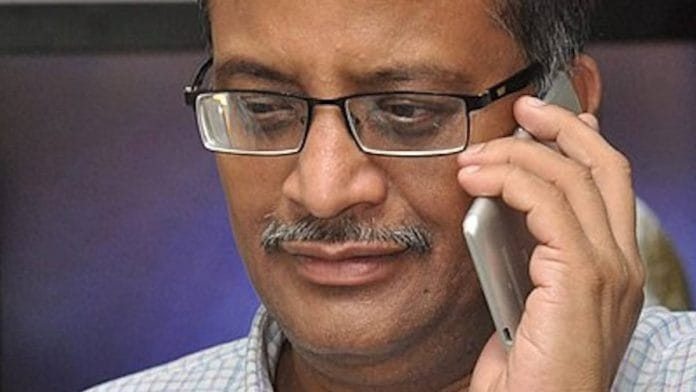
Gurugram: Ashok Khemka, the Haryana IAS officer known for nixing a Robert Vadra-DLF deal and being transferred nearly 60 times during his career, has won a significant legal battle.
The Punjab and Haryana High Court ruled on 29 May that denying him empanelment at the level of additional secretary or secretary to the Government of India was discriminatory and violated Articles 14 and 16 of the Constitution.
The detailed judgment by the court has come out now.
A division bench of Justices Harsimran Singh Sethi and Deepak Manchanda allowed Khemka’s writ petition, holding that since the central government had granted relaxation of an eligibility condition to at least 20 similarly situated IAS officers—including one after specifically rejecting Khemka’s claim—there was no valid reason on record to have treated him differently.
The court, directed that since Khemka has retired, he be treated as empanelled at the additional secretary/secretary level for the limited purpose of future assignments and considerations for which such empanelment is a minimum eligibility requirement.
Khemka belongs to the 1991-batch of the Haryana cadre of the IAS. In 2010, he was empanelled as joint secretary to the Government of India. When his batch-mates were being considered for empanelment as additional secretary and secretary in 2019, he was left out on the ground that he had not served on central deputation for a minimum period of three years at the level of deputy secretary or above—a requirement under the applicable rules.
Khemka challenged this before the Central Administrative Tribunal (CAT), which rejected his plea in three orders passed in July 2023, holding that the rule, warranting a minimum tenure of three years as deputy secretary, could not be relaxed. He then moved the Punjab and Haryana High Court.
The discrimination argument
Khemka’s counsel pointed out that the Union of India had already exercised its power to relax this very rule in favour of at least 15 IAS officers who had no central deputation experience, and four others who were empanelled directly as secretary or equivalent, also with nil central experience. A list of 20 such officers from various state cadres, drawn from records available on the DoPT website, was placed before the court.
More significantly, even after Khemka’s claim was rejected in 2021, a 1992-batch Tamil Nadu cadre officer, J. Radhakrishnan, was granted the same relaxation and empanelled as additional secretary/secretary on 7 March 2022.
The Union of India did not rebut any of this.
The High Court found that the government had repeatedly exercised its power to relax the rule and had done so even for an officer from a batch junior to Khemka. The failure to extend the same benefit to Khemka, without any explanation distinguishing his case, amounted to discrimination, the court held.
Why the order is important even after retirement
The practical stakes were explained by Khemka’s counsel during the hearing: even after retirement, IAS officers are considered for various assignments and advisory roles where empanelment as additional secretary or secretary is a minimum eligibility condition. Without such empanelment on record, Khemka would be at a disadvantage compared to batch-mates who were empanelled before retirement, even when the underlying cause for his non-empanelment was a rule that the government itself had routinely waived for others.
The court accepted this reasoning and said that while an active posting on deputation is no longer possible, the empanelment must be recognised for any future assignment or consideration.
Khemka is one of the most written-about IAS officers in India, less for his administrative work, spanning stints in various Haryana departments, and more for the trouble that work brought him. His decision in 2012 to cancel the mutation of land transferred from DLF to a company associated with Robert Vadra, son-in-law of then Congress president Sonia Gandhi, made national headlines and was followed, within days, by yet another transfer.
By the time he retired in April 2025, he had been transferred around 57 times in roughly 32 years of service. Khemka himself had spoken and written about this pattern over the years, and his case attracted attention from both those who saw him as a symbol of integrity under pressure and those in government who found his interventions disruptive.
(Edited by Gitanjali Das)
Also Read: At least 8 Haryana IAS have skirted legal troubles in last 3 yrs, after govt refused prosecution nod