





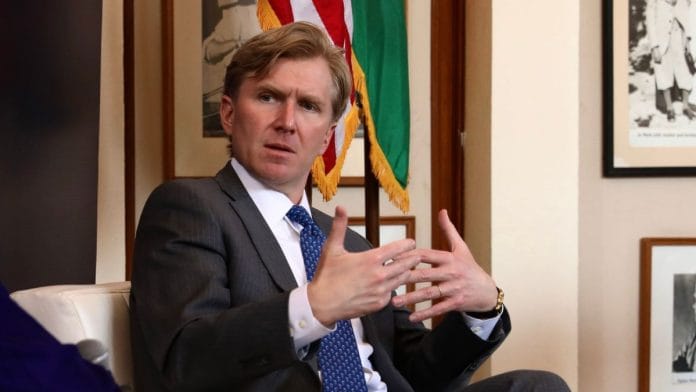

New Delhi: Two months after the Trump administration abandoned the term ‘Indo-Pacific’ for its military command and reverted to its original name—Pacific Command—US Under Secretary of War for Policy Elbridge Colby revived the term during his maiden tour of Southeast Asia.
In an address at Manila’s Stratbase Institute Monday, Colby repeatedly described US interests as being rooted in the “Indo-Pacific”, while calling for a greater partnership with the Association of Southeast Asian Nations (ASEAN) members. From Manila, Colby is to travel to Indonesia, Thailand and Cambodia, accompanied by Assistant Secretary of War John Noh.
In June, the Department of War announced that the US Indo-Pacific Command (USINDOPACOM) will officially restore its name to the US Pacific Command (USPACOM), claiming to “honour the command’s deep historical roots, fostering a sense of pride and collective spirit among all who serve in the Pacific”.
Yet, Colby appeared to have little interest in abandoning the term. The word was used at least five times in his speech to emphasise that “America’s interests are more engaged than ever in the Indo-Pacific,” and that the Department of War was “concentrated on ensuring those interests are stoutly defended”.
Also Read: China doubles down on confrontation with Philippine Navy, Japan as ASEAN ministers meet in Manila
Colby skips China mention
The tour places ASEAN at the center of Colby’s effort to redefine the American presence in Asia under Trump 2.0, a shift from the earlier hardline policy in its first term. “We are replacing the hollow, merely symbolic engagement of previous decades with a formidable, resource-backed posture calibrated to actual structural realities. We are not leaving; in fact, we are digging in, to ensure a favorable balance of power where it matters most”.
Interestingly, his speech had no direct reference to Beijing, Chinese military power or the South China Sea. Colby instead spoke more about maintaining a favourable “balance of power”, strengthening American military capabilities and persuading regional partners to do more for their own defence. “When we ask our allies and partners to step up, to invest more in their own defense, and to take responsibility for their own sovereign security, we are not signalling abandonment,” he said. “We are looking for partners, not protectorates.”
He praised what he called the “ASEAN way”, describing it as “pragmatism, an openness to dialogue, respect for counterparts, proud nationalism, and a focus on economic prosperity”.
“The United States is now taking a page from the ASEAN Way,” he said.
Relations between ASEAN and America during Donald Trump’s first term were often strained, especially when the United States withdrew from the Trans-Pacific Partnership, disappointing many Southeast Asian governments that had viewed the agreement as an important vehicle for American economic leadership and multilateral cooperation in the Asia-Pacific.
Trump has showed little personal interest in ASEAN’s multilateral institutions. He did not attend a single East Asia Summit during his presidency and never appointed an ambassador to ASEAN or to Singapore. His administration’s engagement with individual ASEAN members was similarly limited, although its ‘America First’ approach was reflected in efforts to press even smaller Southeast Asian economies to address trade imbalances with the United States.
There were, however, elements of Trump’s China policy that some ASEAN governments viewed favourably like a more confrontational stance toward Beijing, formally identifying China as a strategic competitor, and being critical of its actions in the South China Sea.
Washington had also increased its military presence and freedom of navigation operations in the disputed waters, conducting them roughly once every one to two months, compared with once every three to five months during the Obama administration.
The intensifying US-China trade conflict had also created economic opportunities for the region. As companies, including Chinese manufacturers, shifted production out of China to avoid American tariffs, ASEAN economies attracted new investment and expanded their trade with the United States.
Colby then went on to warn against what he called “middle power alliances designed to exclude America,” arguing that regional security initiatives should complement American capabilities rather than replace them. Such efforts, he said, should “integrate and be complementary with America’s — not vainly and futilely seek to exclude or supplant us”
Colby appeared to recognise China’s hold although the country missed a mention. Colby did make a subtle mention without naming the country. “As Secretary Hegseth said at the Shangri-La Dialogue in Singapore, ‘A Pacific dominated by any hegemon would unravel the regional balance of power and undermine the equilibrium we all seek to preserve.’ This longstanding view of the United States — an Asia free of hegemony — has been at the core of our regional approach since the earliest days of our Republic.”
“We may not agree on everything,” Colby said, “but we respect your countries, your independent pathways, your nationalism, and the reality of our shared interests to work together collaboratively wherever we can.”
(Edited by Nardeep Singh Dahiya)
Also Read: India, East Asia move beyond trade rivalry towards strategic alignment as US-China contest escalates