







New Delhi: Beijing has put on two separate displays of maritime muscle-flexing even as foreign ministers of the Association of Southeast Asian Nations (ASEAN) gather in Manila for a regional summit. In the West Pacific, a Chinese Luyang III-class guided-missile destroyer fired live rounds inside Japan’s exclusive economic zone (EEZ) during a joint naval exercise with Russia, even as the Chinese Coast Guard (CGG) engaged in a violent clash with the Philippine Navy near the disputed Second Thomas Shoal in the South China Sea.
US Secretary of State Marco Rubio and India’s External Affairs Minister S. Jaishankar are among the leaders ministers gathered in Manila for the 59th ASEAN Foreign Ministers’ Meeting and its associated mechanisms. The summit will continue till 24 July.
Marking the first time Beijing has discharged live weapons within Japan’s EEZ , the Pacific incident occurred on Sunday about 180 km from Okinotori, Japan’s southernmost island. Japan’s Chief Cabinet Secretary, Minoru Kihara, confirmed the incident at a press briefing on Tuesday, saying Tokyo contacted Beijing via diplomatic channels, and conveyed that the drill “could have endangered the navigation of nearby ships”.” Kihara added: We will continue to monitor with concern the behaviours by Chinese and Russian vessels in the waters around our country.”
China firmly rejected Japan’s concerns during its regular press briefing on Tuesday. Chinese Foreign Ministry spokesperson Lin Jian accused Tokyo of using the drills, which he termed “legitimate and lawful actions”, to justify remilitarisation.
The spokesperson rejected Japan’s EEZ claim, stating that “under the UN Convention on the Law of the Sea, Okinotori is a rock, not an island, and is not entitled to an EEZ or continental shelf. Japan’s claim to an EEZ based on the Okinotori rock runs counter to international law. China’s activities on the relevant high seas are consistent with international law and customary international practice.”
Philippines Clash
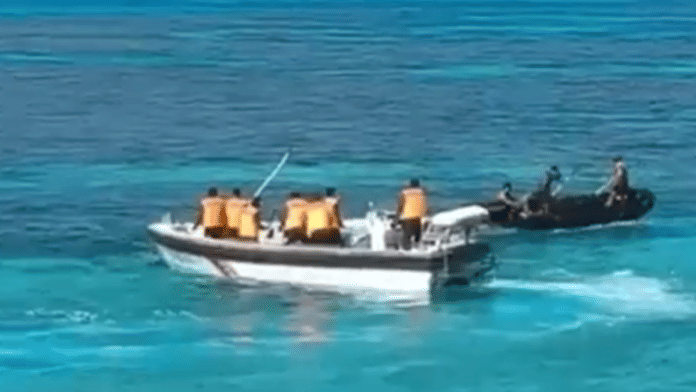
Another incident involving China occurred in the disputed South China Sea. On Monday, a Chinese vessel approached the Second Thomas Shoal in the South China Sea, which is controlled by the Philippines but claimed by China. The Philippine Navy dispatched two rubber boats to intercept the vessel, triggering a violent clash. Philippine authorities allege a Chinese crew member struck a Filipino sailor on the head with a wooden baton, causing serious injury.
Diplomatic friction escalated rapidly as both capitals summoned each other’s ambassadors. Addressing the confrontation on Tuesday, Lin blamed Manila for escalating tensions around the grounded warship. “On 20 July, as the China Coast Guard carried out normal rights protection and law enforcement activities in the sea near Ren’ai Reef, the Philippine side’s illegal ‘sitting’ warship deliberately sent two small boats to approach and collide with Chinese ships in a dangerous way, and violently attacked Chinese law enforcement personnel,” Lin said. He added that China made “solemn representations” to the Philippines Ambassador in Beijing. “China had to resolutely respond according to the law. After that, the Philippines turned it back, distorted the facts, and made a big fuss,” Lin said.
Manila’s position rests on the 2016 Permanent Court of Arbitration ruling that struck down Beijing’s sweeping territorial claims in the South China Sea, though China has refused to recognise the verdict.
The US State Department issued a statement condemning Chinese actions as “dangerous and aggressive.” It states that Chinese actions undermine “regional peace and stability”, while reaffirming the 2016 ruling as “final and legally binding”.
ASEAN Summit and Rubio’s Condemnation
The surge in aggressive maritime activity comes as the Association of Southeast Asian Nations (ASEAN) opens its 59th Foreign Ministers’ Meeting in the Philippines. The meet is to be attended by US Secretary of State Marco Rubio and Chinese Foreign Minister Wang Yi. The meet sets the stage for high-stakes bilateral showdowns between Wang Yi and his regional counterparts.
In a commentary written by Rubio upon his arrival in Manila, he criticised Chinese actions without referring to them directly. Rubio reiterated America’s “commitment to freedom of navigation in Southeast Asia” while adding that this freedom is “by no means guaranteed.” Referring to regional waters, Rubio said that “If those waters fall under the control of a power willing to use commerce as a geopolitical weapon, both the US and the ASEAN states would face dire new threats to their sovereignty, security, and economic futures”.
With Beijing doubling down on its maritime claims and Washington pledging counter-measures, the regional forum is set to test whether ASEAN diplomacy can de-escalate a rapidly volatile Indo-Pacific.
(Edited by Nardeep Singh Dahiya)
Also Read : China is worried about US–Philippines military exercises. It’s too close for comfort