






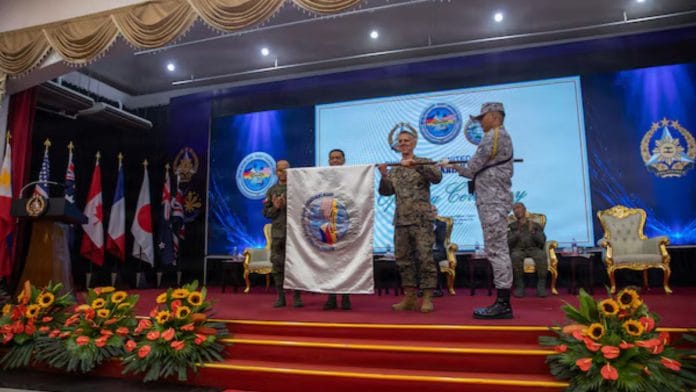


Balikatan 2026, one of the largest iterations of the long-running United States–Philippines military exercise, is underway. Balikatan, meaning “shoulder to shoulder” in Tagalog, signals alliance cohesion, shared strategic outlooks, and a more integrated defence posture in the Indo-Pacific.
This year’s exercise stands out for both its scale and expanding participation. France and Canada have joined alongside Japan, Australia, and New Zealand. Equally significant is its geography: Drills now extend from northern Luzon, facing the Taiwan Strait and Luzon Strait, down to Palawan near the contested South China Sea.
China has not been explicitly named as a target, but its response leaves little ambiguity about how it interprets the exercise and the networked military participation. Official statements have described the drills as destabilising, warning that they risk escalation and that the participating countries are “playing with fire.” Chinese social media commentary has portrayed Balikatan as an unprecedented display of military coordination near China’s periphery and part of a broader pattern of strategic containment.
China’s framing of the exercise
Chinese discourse clusters around three main arguments. The first is geography. Commentators emphasise the location of the drills—northern Luzon, the Batanes Islands, and Palawan—as inherently strategic. In this framing, Batanes is located in the Luzon Strait, a critical maritime passage linking the South China Sea with the Western Pacific and the waters near Taiwan. Batanes is around 200km from Taiwan. Palawan is highlighted for its proximity to the Spratly Islands, while northern Luzon faces the Taiwan Strait and adjacent sea lanes.
From this perspective, the choice of training areas comes across as deliberate. Chinese analysts argue that the exercise reflects an attempt by the US and the Philippines to strengthen operational control over key maritime chokepoints, which could potentially constrain China’s access to both the South China Sea and broader Western Pacific routes.
The second strand of Chinese commentary focuses on Japan’s growing role in regional security cooperation. Japan’s participation in multinational exercises and its increased presence in Indo-Pacific waters remain politically and historically sensitive for Chinese observers, who interpret these developments through the lens of unresolved wartime memory. One cited example is a Japan Maritime Self-Defense Force transit through the Taiwan Strait on 17 April. Shen Yi, Professor at the Department of International Politics at Fudan University, pointed out that the date coincided with the anniversary of the Treaty of Shimonoseki, under which Qing China ceded Taiwan and the Penghu Islands to Japan. Such movements are treated as symbolically loaded and politically driven acts.
The third element is a broader argument about alliance consolidation and US-led anti-China groups. The inclusion of multiple extra-regional partners in Balikatan is viewed in Chinese discourse as evidence of an emerging networked security architecture aimed at constraining China’s maritime behaviour.
Also read: India’s maritime vision is not just maturing—it’s gearing up to lead the Indo-Pacific arena
A show of fire power
At the same time, China’s own military activity in maritime domains is becoming increasingly visible and is framed domestically as routine, defensive, and stabilising.
Chinese social media highlights naval deployments as indicators of capability and modernisation rather than escalation. In March 2026, for instance, Chinese military outlets on WeChat released imagery of the 9th and 10th Type 055 destroyers conducting joint training exercises, marking what domestic commentary described as the fleet’s entry into a “ten-ship era.” The Type 055 destroyer has become a symbol of the PLA Navy’s evolving capabilities. Chinese military analysts describe it as a core component of future carrier strike groups, capable of integrated air defence, anti-submarine warfare, and long-range strike missions. China’s Ministry of National Defense framed its development as part of a broader shift towards blue-water operations and enhanced far-seas mobility.
Military commentator Song Zhongping argues that the Type 055 is a node within an integrated combat system. As China expands into what is often described domestically as a “three-carrier era,” these destroyers are seen as essential escorts for carrier strike groups, while also capable of independent operations. In this view, a fleet of such ships enables simultaneous task group deployments across multiple regions.
Military analyst Zhang Junshe highlights that recent exercises reflect growing emphasis on multi-domain integration, combining air defence, anti-submarine warfare, and coordinated fleet manoeuvres across extended distances. Reports of live-fire drills and multi-day deployments are presented as evidence of improving endurance, coordination, and operational complexity.
Beyond the Type 055, additional naval movements have drawn attention. A Chinese naval fleet transited waters near the Ryukyu Islands in the Western Pacific on 17 April, while on 21 April the amphibious assault ship Sichuan began sea trials in the South China Sea. Chinese official messaging emphasised that these activities were pre-planned and not directed at any specific actor.
Also read: Indo-Pacific security demands a strong India-Japan relationship
A region on the edge, but still engaging
Analysts at Chinese naval research institutions emphasise training in complex electromagnetic environments, long-range coordination, and multi-domain warfare. The focus is on building an integrated operational system capable of sustained activity across multiple maritime theatres. This mirrors a broader regional trend. Multinational exercises, deployments, and signalling activities are increasingly interconnected across a wider Indo-Pacific operational space.
Balikatan 2026 and China’s concurrent naval activity echo this shift as well. Within the Indo-Pacific, military preparedness is becoming more networked, more frequent, and more visibly tied to overlapping strategic geographies.
There is ongoing debate over whether the US is overextended globally. Yet, in the Indo-Pacific, security cooperation continues to expand rather than contract. If anything, it is becoming denser, more multinational, and more operationally integrated.
Sana Hashmi, PhD is a fellow at the Taiwan-Asia Exchange Foundation. She tweets @sanahashmi1. Views are personal.
(Edited by Theres Sudeep)