





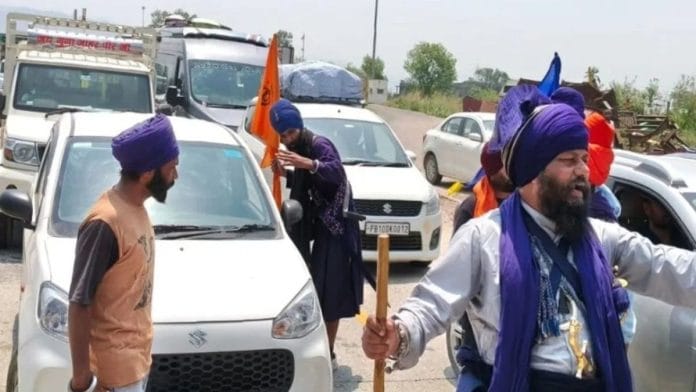


Shimla: The Kiratpur Sahib-Manali highway, a lifeline for tourists, traders and families shuttling between the plains of Punjab and the rugged hills of Himachal, witnessed an unusual scene on Wednesday. As the midday sun beat down, a group of Nihang Sikhs in their flowing traditional blue robes, some carrying spears and kirpans, positioned themselves near the Gara Mora toll point in Punjab’s Ropar district.
They weren’t blocking traffic entirely, but they were selectively stopping vehicles with Himachal Pradesh number plates entering Punjab. What they asked for was the so-called “Khalsa tax”—a voluntary contribution of Rs 100 from private cars and higher sums from trucks and buses, all in the name of “Sarbat Da Bhala”, the welfare of all.
Some paid up quickly, perhaps seeing it as a small price for smooth passage or out of respect for the Nihangs’ traditional authority. Others hesitated, exchanging puzzled glances or asking questions before contributing. By all accounts, the collection lasted only about an hour, from 11.30 am to 12.30 pm.
This wasn’t just another roadside protest or a symbolic drive, but a clear warning to the governments of both Himachal Pradesh and Punjab that the patience of border communities is running out over the contentious entry tax issue.
Nihang leader Achhar Singh said the initiative was launched to protest the entry tax imposed on Punjab vehicles entering Himachal Pradesh. He claimed that the issue has been raised repeatedly over a long period, but no concrete solution has emerged.
The Nihang organisations, including the Tarna Dal, had been threatening such action for weeks as part of the broader agitation led by the Himachal Entry Tax Sangharsh Committee. Backed by transporters, farmers, traders and religious groups, the protesters argue that Himachal’s levy unfairly burdens people from neighbouring states who cross the border daily for work, education, medical needs, family visits, or tourism-related business. Many families along this stretch have relatives and economic ties on both sides, making the tax feel less like infrastructure funding and more like a daily penalty on normal life.
After the brief collection, the groups paused their campaign following appeals from farmer leaders and local police, who urged restraint to avoid escalating tensions during the busy pre-tourist season. But Baba Achhar Singh Mahakal, a prominent Nihang voice, made it clear that this pause was temporary.
In strong words directed at the Punjab government, he issued a 10-day ultimatum: “Punjab government ko 10 din ka ultimatum…Himachal ko ‘jaise ko taisa’ jawab dete hue saman (reciprocal) tax lagane ki ghoshna karein ya sangathanon ke saath baithak kar apna rukh saaf karein. Agar thos kadam nahi uthaya gaya, to border par majbooran sthayi morcha laga diya jayega aur andolan ko aur tez kiya jayega.”
He emphasised that if no firm steps are taken—either by announcing a reciprocal tax on Himachal vehicles or by sitting down for clear talks—the Nihangs would have no choice but to set up a permanent morcha (front) at the border and intensify the movement.
Living the dispute on the ground
For ordinary people, this isn’t abstract policy talk. Balwinder Singh, a transporter who moves goods between Chandigarh and Manali regularly. “Every time I enter Himachal, I feel the pinch,” he said while watching the scene unfold. “The roads there are tough, I get it, landslides, snow, all that. But when you’re crossing multiple times a week for livelihood, these charges start hurting the pocket and the spirit. Now this counter-step by the Nihangs…it shows how fed up people are getting.”
The dispute reignited earlier this year when Himachal revised its entry tax rates under the Himachal Pradesh Tolls Act of 1975. Although the state later rolled back some proposed increases, especially for private vehicles, the core demand for complete withdrawal remains unmet. Protests boiled over on 1 June with blockades at several Punjab-Himachal crossing points, causing hours of traffic chaos on key routes. The entry of Nihang groups has injected a visible cultural and assertive flavour into what was largely an economic grievance.
Himachal Pradesh officials have stood their ground, insisting the tax is indispensable for maintaining infrastructure in a mountainous state. With millions of tourists flocking in annually, revenue goes toward repairing damage from frequent natural challenges like landslides, heavy snowfall and erratic weather.
Revenue Minister Jagat Singh Negi has been particularly vocal in his rebuttal. He has described the “Khalsa Tax” protest as a conspiracy orchestrated by the BJP to create instability and political trouble rather than solve genuine issues. “All this is done by the BJP. States have their own right to impose entry tax. Now BJP is trying to instigate some people and create an issue. If our people are troubled, we will do everything to maintain law and order,” Negi told ThePrint.
On the Punjab side, authorities have so far focused on maintaining law and order. Police were present during Wednesday’s collection but reported no untoward incidents. The state government now finds itself under increasing pressure as the 10-day deadline looms, with calls growing louder for active mediation between Chandigarh and Shimla.
A senior Punjab official, told ThePrint, “It is for the governments of both states to see how to settle this issue. It does not require some kind of extra effort but just an honest effort to resolve the issue.”
(Edited by Gitanjali Das)
Also Read: Brotherly love to border toll: Why Punjab & Himachal keep squabbling over roads, rivers and revenue