








In 2024, around the time falling tourist numbers were beginning to sound the alarm, the Goa Tourism Development Corporation launched the “Goa Beyond Beaches” campaign. The department’s pitch document opened by describing Goa as “an idea of openness, cultural harmony, and a way of life that balances celebration with serenity”.
It outlined the department’s intent to go past the short-term goal of attracting visitors and instead create a tourism ecosystem that integrates culture, community, sustainability, and experience-driven travel. The Goa Brand — the document announced — “is no longer confined to postcards of beaches and sunsets.”
Underneath the prose, the department’s programmes include focusing on Goa’s spiritual circuit or Ekadash Teerth, and initiatives like heritage walks, food trails, and bed-and-breakfast schemes in “villages where centuries-old traditions still flourish”. The policy promises travellers a taste of Goa’s hinterlands. Over the years, private operators have started offering trails that take you to inland destinations like Tambdi Surla to see a 12th-century temple, monsoon treks into the state’s many forests or jaunts around a spice farm, and private tours with archaeologists to look at 9,000-year-old petroglyphs.
Still, for the bulk of Indian tourists, the pinnacle of the Goan experience is running into their drunk neighbour at an overcrowded beach shack with seizure-inducing lighting. For them, the state’s 105-kilometre coastline is more than enough. But for a growing number of travellers, or those who’ve had their fill of beachrot, inland hotels mark the next vacation frontier.
Villas vs estates
In some ways, dozens of private villas operated by management companies across the state offer a convenient compromise. These villas are located inland, but almost always only a short drive to the beach belt. They offer large families or groups of friends the amenities and on-call staff you’d expect at a hotel, minus the other people. Without the necessary guardrails of good behaviour and common spaces shared only by the group, it doesn’t matter if the music is too loud at 4 am or if the pool is full of cigarette butts.
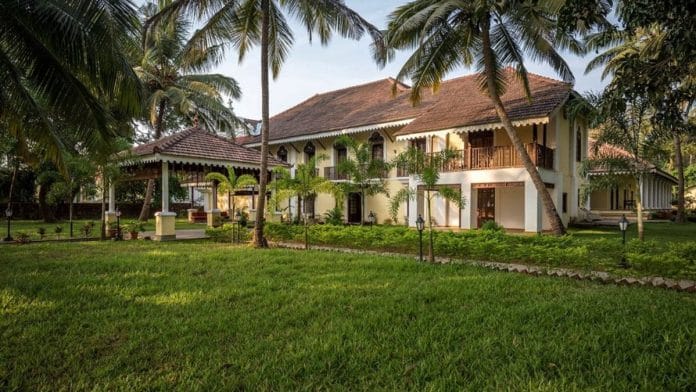
The hotels, however, are not for the guest looking for somewhere to sleep between beaches and pool time. The Postcard on the Mandovi is the newest one, located on a slip of land just off Panjim. It is the fifth Postcard property in the state, with 18 white-ivory suites overlooking the water and one of the few hotels with a private jetty, allowing guests to arrive by boat. Every Postcard hotel in Goa is located inland, including one in the village of Saligao, another that’s spread across 20 acres in the wildlife sanctuary of Netravali, and an ayurveda retreat in Old Goa.
Depending on who you ask, “Goa beyond beaches” is simultaneously an old and a new idea. Kapil Chopra, founder and CEO of the Postcard Hotels, told me that they launched in 2018 on the argument that Goa had been sold to the world through a very narrow lens.
“Hotels, packages and tourism experiences were largely built around the idea of partying,” he said. “Over time, Goa became known internationally more for accessible nightlife than for its architecture, food, history, culture and remarkable sense of place.”
The hotel company started by restoring large Portuguese estates and converting them into luxury hotels. Chopra is careful to draw a distinction between the villa hotels of today and the substantial estates “with an unusually generous relationship between the number of rooms, the architecture and the surrounding landscape” that Postcard is known for. The company’s next offering in Chicalim, a town close to Vasco da Gama, is in a 400-year-old Portuguese estate under restoration for the last three years. The 10-room hotel, overlooking the hills of south Goa, opens in October.
Chopra said that he is encouraged to see other thoughtful attempts in the market.
“What Goa must guard against is high-density, cookie-cutter development,” he said, “placing hundreds of rooms on a small parcel of land, adding a brand flag and calling it luxury.”
Much like the people of Goa, currently at loggerheads with the government, Chopra said he believes the conversion of paddy fields and orchard lands in Goa needs to stop.
“No zone changes or change in land use should be allowed or it will become an urban slum,” he warned.
According to him, Goa needs a more targeted hospitality policy based on architecture, heritage, culture, land-to-room ratios and a strong regional design language, a little like Europe.
“Imagine placing a generic 500-room hotel without architectural character on the canals of Venice,” he said. “It would be entirely inconsistent with the destination. Goa deserves the same sensitivity.”
The flip side to this argument, of course, is that a place remains accessible only to tourists who can afford the rack rate. About 30 per cent of Chopra’s guests are high-end international travellers staying at a hotel which “commands some of the highest average room rates not only in Goa, but across India”.
Also read: Goa in Rains tourism campaign now includes bans, lifeguards, FIRs
For the intelligent traveller
Not every inland hotel rooted in Goan villages is benchmarked like that. There’s the lovely Hacienda de Bastora, housed in a 75-year-old mansion and designed by architect Raya Shankhwalker. It is managed by the Taj Holiday Village Resort & Spa. There’s precious little to do in Bastora, aside from birdwatching, walking, and dining at the villa’s several cafes and bars. There’s also the lushly restored Amrapali House of Grace, located by the banks of the Zuari River. But perhaps the oldest player in the game is Siolim House, originally built for a noble Goan-Portuguese family. In the mid-1990s, when the house was in a crumbling state, long before Siolim came to be the hip expat enclave it now is, Varun Sood bought and restored the place.
Sood never imagined it as a hotel project: He was in his twenties, living in Europe, and homesick.
“I did not have the means to restore it,” Sood said, “and had no reason to believe that anyone would come and stay there. But I was always inspired by creative projects.”
Over three decades, Sood turned the 24-room mansion into a spare, elegant 10-room hotel and the gamble paid off.
He said that the hotel has always attracted the sensitive, creative, and intelligent traveller. Over the years, the average age of the visitor has dipped from the 50s to the mid-30s, but the disposition has held. They are all well-travelled, and they arrive already interested in Goan architecture and food.
“Almost nobody comes here by mistake,” Sood said. “It’s not for the rich and famous; nobody will get treated like Akshay Kumar.”
Even as Siolim changed around them, turning from a little alley into one of north Goa’s toniest thoroughfares, Siolim House has deliberately stayed away from the ultra-luxury space.
“We have resisted management companies and avocado bowls for years, to focus on the authentic,” Sood said.
Set against the state’s actual tourist inflow, the inland hotels amount to a few hundred rooms. It’s not enough to shift the economics of Goan tourism, but at least it demonstrates that it is possible to bring guests into a Goan village without leveling it completely. And that a certain kind of traveller will pay for the privilege of just being there.
This article is part of the Goa Life series, which explores the new and the old of Goan culture.
Karanjeet Kaur is a journalist, former editor of Arré, and a partner at TWO Design. She tweets @Kaju_Katri. Views are personal.
(Edited by Ratan Priya)