






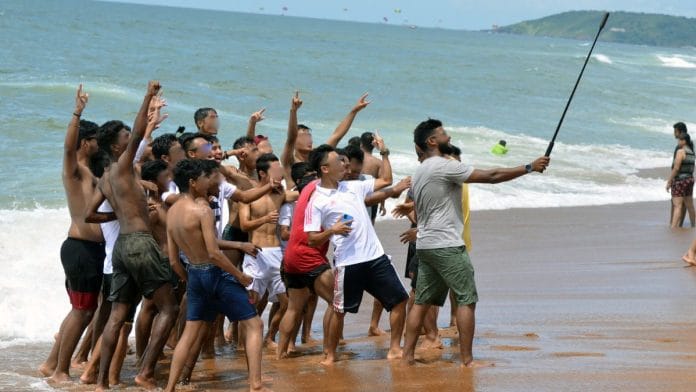


Ashpak Masali died on camera while scouting for a dramatic video on June 24. The 34-year-old from Karnataka’s Bijapur — a few hours up the highway from Goa — handed his friend a phone and climbed the rocks at one end of Baga, to where the picture would be best. The dark, craggy rocks are slippery on a regular, sunny day, but in the monsoon, they take on an even slicker skin of moss. A giant wave crashed against the rocks, sweeping Masali away.
According to onlookers, Masali had been drinking. Even though the sea was rough — and his friends told him as much — he went down to the lower shelf anyway, close to the swell, before the wave took him. In the video, you can see Masali struggling to stay above the water for a few minutes, but the strong undercurrent pulls him. His body washed up on the shoreline a few hours later.
Masali was one of 71 people to drown in Goa this year and it’s only July. While he was claimed by the coast, several of the season’s dead were found inland, against backdrops that look like laptop screensavers. Tourists make up a significant number of dead.
Chain of tragedies
At Metawada, on the Dudhsagar River, a few kilometres from the famous waterfall, five students from Vasco Da Gama rode the train up to Collem for a picnic before their college term resumed. Believing the water to be shallow, four of them waded in. Among them, three youngsters—two aged 19 and the other 21—were from the same family.
The rain-fed river was in spate, but four from the group ventured into deeper waters anyway. The body of one was found floating in the river, while the other three were discovered after a rescue operation. Just days after these deaths, two Karnataka teenage cousins drowned in the same river at Tambdimal, even after their 15-year-old sibling repeatedly reminded them that four young men had died there a week prior.
This same pattern has repeated several times this year. The last week of June also took Aditya Dilip Kumar Satpati, a 15-year-old student from Belagavi, who was swimming in the plunge pool below the Barazan waterfall at Surla, deep inside the Mhadei Wildlife Sanctuary. Satpati and five friends had trekked in from the Karnataka side on a closed trail, past the barriers and warning signs prohibiting entry.
A few days ago, a group of tourists from Uttarakhand entered the waters at the Sinquerim Beach in the early hours of the morning, ignoring all warnings. The tourists underestimated the current and were struggling in the water when an off-duty lifeguard rushed to their rescue. But poor visibility and rough sea conditions meant that one of the young men from the group got swept away — his body washed up ashore seven hours later.
It would be easy to interpret this grim ledger of preventable tragedies as an indictment of the tourism department. After all, the department has marketed the state as a year-round destination, with the monsoon as its centrepiece. But that would be the wrong conclusion to draw.
Also read: Leisure is a privilege in India—distributed unevenly along many lines
Warnings ignored
It’s a fair pitch — the monsoon is indeed when Goa is most alive. The coast is at its most cinematic, with its grey, enormous windswept skies reflecting the mood of the sea below. But it is the state’s hills and inland areas that really steal the show. The paddy fields green over almost overnight, and waterfalls that were a trickly stain on the cliffs just days before, roar down the ghats.
For the most part, Goa’s tourism has relied on winter arrivals, but over the last few years, the tourism department has systematically sought to broaden the calendar. Earlier this year, in a bid to expand domestic tourist footfalls, the department reportedly spent Rs 3 crore on a 45-day outdoor advertising campaign across 11 Indian cities. The targeted cities included those with a significant middle class, such as Lucknow, Prayagraj, Patna, Thiruvananthapuram, Pune, Nashik, Kolkata, several cities in Gujarat, and Hyderabad.
The spa brochure-vocabulary of these endeavours — #GlowonArrival, Monsoon on a Plate, Goa Beyond Beaches — leans into the aspirations of the middle-class domestic tourist. There is a concerted effort to package and promote festivals like São João and Chikhal Kalo that were once local affairs, reel competitions attached.
In March, the state’s tourism minister, Rohan A Khaunte, unveiled an eco-tourism policy built around nature trails, jeep safaris, monsoon treks, and river experiences. In May, it staged a Shackathon at Baga Beach, aimed at digital nomads. The two-day event featured beanbags in the sand and even a humanoid robot named Nino.
This year, Goa was named the country’s Best MICE Destination at the Great Indian Travel Bazaar Awards 2026 held in Jaipur. For those outside the tourism business, it is a recognition of Goa’s “growing prominence as a leading hub for meetings, incentives, conferences, and exhibitions in India.”
And yet, the crowds that these initiatives bring in find it difficult to pay attention to the many warnings and advisories that the state is at pains to issue. Red flags line the beaches all through the monsoon, accompanied by vocal announcements from lifeguards. Signboards at several waterfalls are unsubtle about spelling out the risk. But closure notices, laminated do’s and don’ts lists at hotels, and even barricaded entry points do little to deter the monsoon tourist.
South Goa has issued the same order every monsoon since 2023. This year too, the District Magistrate issued a 60-day order under Section 163 of the new Bharatiya Nagarik Suraksha Sanhita, banning swimming, bathing, diving, and cliff-jumping at every waterfall, river, lake, and abandoned quarry in the district. A similar move came from across the border, after the spate of deaths, when the Karnataka forest department banned its residents from the waterfalls and forest routes along the Goa frontier, warning of arrest under the Forest Act.
Also read: Mock the Indian uncle. Don’t turn him into a glib theory of India
‘We do our best to convince tourists’
The trouble is that a tourist who has travelled a long way and spent money feels entitled to a good time — and even nature must not interrupt their perfect holiday. No terms and conditions should thwart the selfie confirming their vacation. The warning is, then, not a non-negotiable fact, but merely an obstacle to be dealt with. You can notice this rule-breaking impulse among Indian tourists wherever they go, but Goa is where these waters are first tested.
In a report published in The Goan, from a couple of weeks ago, lifeguards said the hardest part was persuading tourists to heed their warnings. The Goa government has appointed Drishti Marine Lifesavers, a private agency that deploys over 490 lifesavers and marshals across 58 beaches in Goa, as well as high-footfall areas like Mayem Lake, Dudhsagar and Savri waterfalls.
Amit Mahale, a sector leader with the agency, said, “We do our best to convince tourists not to enter the sea whenever the waters are rough or there is a possibility of strong currents. But many simply ignore our appeals.” Mahale said that many drunk tourists get aggressive, arguing that they’ve “spent money to come to Goa only to enjoy the sea, so they don’t want to be stopped.”
Routine advisories issued by the agency, as well as other bodies, include advice against swimming or engaging in any watersports at the beach between June and October, staying at a minimum distance of 10 meters from the waterline, not venturing into the water during lightning and thunder, and refraining from taking selfies on rocky areas along the coast, especially since they tend to get a lot more slippery and mossy during the rains.
The last one has proved particularly difficult for lifeguards to enforce — those who are in pursuit of the perfect selfie or reel are very hard to dissuade. One of the lifeguards interviewed said that when the waves begin crashing against the rocks, they immediately ask visitors to move to safer spots, but are often ignored. This leaves lifeguards in the unenviable position of diverting their attention from monitoring swimmers to herding tourists like children.
“They don’t realise how quickly conditions in the sea can change,” Mahale said.
The state, the tourism department, and its many allied bodies have done what they can be expected to do. They can always do more by way of awareness drives, but the campaigns, bans, lifeguards, and even FIRs have all been aimed at one thing — keeping the tourists safe and alive. But the rest of us have to take on some responsibility. The least we can do is believe that the warning is meant for us.
Karanjeet Kaur is a journalist and a partner at TWO Design. She tweets @Kaju_Katri. Views are personal.
(Edited by Saptak Datta)