






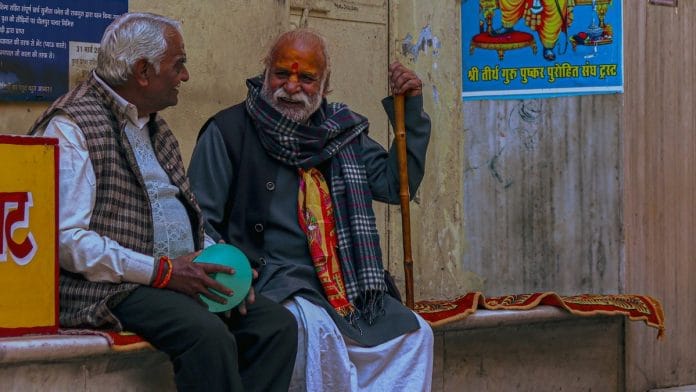


The Indian uncle is often mocked, and not without reason. He has opinions about your degree, your salary, your marriage, your phone, your posture and possibly your digestion. His advisory kit is familiar: beta, listen; work harder; keep the phone away; and yes, five soaked almonds in the morning. He treats the absence of consent as a small procedural irregularity.
So yes, the joke lands. One recent instance is The Economist’s “India’s republic of uncles”, a witty piece on the “cockroach” meme and India’s supposedly gerontocratic instincts, down to the soaked almonds. It is sharp. It is funny. It is also glib. The problem is not who writes about India, but the old habit of mistaking a clever metropolitan caricature for civilisational diagnosis.
Now, the uncle can survive mockery. What is less defensible is turning him into an all-purpose explanation for India. Judicial arrogance, exam failures, phone restrictions, corporate sermons, political authority and youth frustration are all placed under one convenient heading: uncle.
Also Read: From e-rickshaw pranks to denying lifts in the RWA—Indians’ joke is always on the poor
Good satire, lazy sociology
What is mocked as “uncle culture” is often closer to the moral common sense of the average Indian. A large Pew survey found that nearly nine in ten Indians — 88 per cent — consider respecting elders very important to being “truly Indian”, with little variation by religion, region, caste or age. Pew also found that India’s major religious communities broadly share this respect-for-elders ethic as part of religious and cultural life.
That does not make every elder wise, but it does mean that the uncle is not an exotic fossil left behind by modernity. He is part of India’s moral grammar: advice, intergenerational respect, restraint, family obligation, thrift, duty and accumulated experience. These values can become suffocating. But they are not automatically stupid merely because they are inherited.
Advice is not the problem; veto power is
“Consider my experience” is one thing. “I own your decision” is another. Many critiques of the uncle refuse this distinction because distinctions are bad for caricature.
Take marriage. Families may have views about whom their adult children marry. They may dissent, advise, warn, plead or ask hard questions. Marriage in India is rarely just a private contract between two isolated individuals; it joins families, habits, expectations and social worlds. A parent’s disapproval may therefore be morally relevant. But making parental approval a legal precondition for competent adults to marry is something else altogether. That is not guidance. It is adult infantilisation.
The same applies to age-based rules. A uniform rule for adult college students may be defended or opposed, but it should be argued as institutional discipline, not smuggled in as parental authority. Delhi’s drinking age of 25 is fair game for debate, too. The point is not that every age-based rule is irrational. But each requires its own argument. The glib version puts them all in one basket marked “uncle.”
Phones and social media are another good example. If Indian parents worry about smartphones, it is called gerontocratic panic. But Australia now requires designated platforms to take reasonable steps to prevent under-16s from having social-media accounts, and New Zealand requires students to keep phones away during the school day, including breaks and lunch.
One may oppose such rules. There are real questions about enforcement, privacy and overreach. And yes, restricting social media until 21 would be far more intrusive than a child-safety rule for under-16s. But concern about adolescent attention, addiction and digital harm is not an Indian uncle’s WhatsApp fever dream. It is now mainstream public policy across democracies. Apparently, paternalism becomes child safety when it travels with an OECD passport.
The same flattening appeared not long ago in the furore over Narayana Murthy’s 70-hour workweek remark. It was quickly folded into the familiar uncle file: old billionaire tells young Indians to work harder.
The criticism was not baseless. A country does not become productive by turning employees into office furniture. WHO and ILO research also associates working 55 or more hours a week with higher risks of stroke and death from ischaemic heart disease.
But Murthy’s point was not merely “make young people miserable.” It was about effort, productivity and national competitiveness. That argument may be crude, but it is not senile.
India indeed needs better skills, better managers, better incentives, and better institutions, but it is unserious to pretend that work ethic, distraction and productivity are imaginary concerns invented by old billionaires.
When mockery romanticises revolt
The glibness becomes most dangerous when mockery of the uncle turns into romance about revolt.
The Economist notes that young people in Nepal, Bangladesh, and Sri Lanka have been more “heavy-handed” with their ageing leaders, and calls it a “minor miracle” that their Indian counterparts have responded only with a “silly meme”: the Cockroach Janata Party. The line has a wink in it. But it is an irresponsible wink.
It comes close to a polished, magazine-style clarion call for anarchy: your neighbours brought governments down; why are you merely making jokes?
That comparison is glib. Bangladesh, Nepal and Sri Lanka saw youth mobilisation amid economic collapse, corruption, repression and violence. The UN described the repression of Bangladesh’s protests as brutal and systematic; Nepal’s Gen Z protests over corruption and a social-media ban left at least 19 dead and more than 100 injured; Sri Lanka’s Aragalaya emerged from severe shortages and economic collapse, and later hung over the country’s politics. Reuters described the 2022 revolt as a force that helped oust President Gotabaya Rajapaksa.
There have been stories of courage, yes, but also trauma, instability, and bloodshed.
A young citizen should not have to storm a palace, burn a public building or face bullets before a magazine agrees that she has agency. Anarchy is not a synonym for agency.
Also Read: State vs cockroaches—who wins a protest case in India?
The Indian way—agency without anarchy
What stands out in India is not the absence of youth agency, but the persistence of democratic faith. Indian youth protest, meme, vote, litigate, organise, and argue. They have not, by and large, chosen nihilistic revolt.
In 2019, the BJP won 41 per cent of the 18–25 youth vote, seven points higher than in 2014 and about four points higher than its overall vote share; the same study found Modi’s popularity had the strongest impact among young voters. In 2024, the youth vote became more competitive, and no party fully captured it as a separate constituency, as a 2024 youth-vote study noted.
One need not endorse every choice Indian youth make to recognise it as political choice. That is not servility. That is constitutional politics.
The viral “cockroach” meme itself proves the point. Young Indians took an insult, converted it into satire and unsettled authority. That is agency. The state’s nervousness only confirms that satire can bite without violence.
India does have too much unaccountable authority: parents who confuse concern with ownership, judges who mistake courtrooms for pulpits, business leaders who demand sacrifice without reciprocity, and governments that seek obedience after delivering incompetence. But that is not simply a problem of age. It is a problem of power.
A republic ruled only by uncles would be suffocating. A republic ruled by permanent eye-rolling would be insufferable. And a republic encouraged to confuse upheaval with empowerment would be worse.
India needs fewer people saying, “Don’t talk back.” It also needs fewer commentators implying, however coyly, “Why merely talk back when your neighbours have shown you how to bring the house down?”
The soaked almonds may be accepted or declined. The republic need not be set on fire over breakfast.
Dr Omkar Joshi is a Research Scholar at the Department of Sociology and Maryland Population Research Center at University of Maryland, College Park. Views are personal.
(Edited by Asavari Singh)