





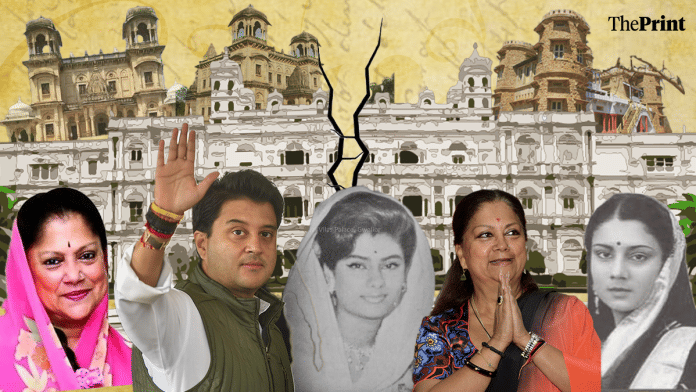


New Delhi: On the political arena as well as in courts of law, Jyotiraditya Scindia, scion of the erstwhile royal Maratha Scindia dynasty of Gwalior, and his aunts, Vasundhara Raje Scindia and Yashodhara Raje Scindia were always on opposite sides of the battlefield. However, the tide turned in 2020-2021, both in their political careers and legal disputes.
In March 2020, Jyotiraditya joined the BJP—the same party that has platformed his aunts, Vasundhara Raje and Yashodhara Raje. And in January 2021, the first signs of a settlement in the four decades-long property suits, involving Jyotiraditya and his aunts, Vasundhara Raje, Yashodhara Raje, Usha Raje and late Padmavati Raje, through her daughters, started appearing.
In the last four decades, each one of these suits has had a lifetime of its own, having passed down generations, with the original plaintiffs and defendants passing away, only to be replaced by their sons or daughters. Each one of these suits also involves properties worth crores—with some estimates placing the disputed properties at thousands of crores.
The suits are spread across different courts of the country, from Gwalior to Mumbai, span over four decades, and have all trappings of a royal game of thrones—with a son taking his grandmother to court for a claim on the property, while his father was still alive, buas (father’s sisters) filing suits against their nephew, claiming their own share in the royal heritage, and two wills.
And each of these suits may now finally reach a conclusion.
A lawyer involved with the case confirmed to ThePrint that the process for legal recognision of the settlement has begun, and hearing scheduled for Wednesday in the district court in Gwalior is crucial.
This story began when Maharaja Jiwajirao Scindia passed away in 1961, leaving behind his wife Vijaya Raje Scindia, his son Madhavrao Scindia, his daughter-in-law Madhavi Raje Scindia, and his daughters Usha Raje, Vasundhara Raje, Yashodhara Raje and Padmavati Raje.
The eldest daughter of the Scindia dynasty, Padmavati Raje ‘Akkasaheb’ Barman passed away in 1964, and her daughters, Kanika Devi Deo Barman and Pratima Devi Rane Barman stand for her in the suits. Jyotiraditya was born in 1971, and filed a suit against his grandmother and father even before he turned 20, claiming to be the sole heir to the Scindia inheritance. Multiple suits have since been filed across courts.
At stake are riches beyond the dreams of avarice—the opulent Jai Vilas Palace, Sakhya Vilas, Susera Kothi, Kuleth Kothi, Cottage Hill and Takenpore retreat in Gwalior. There’s also the Madhav Vilas Palace, Happy Vilas and George Castle in Shivpuri, and the Kaliadeh Palace in Ujjain, as per an India Today report from 2010. The family also owned Gwalior House, and Scindia Villa in Delhi, a flat in Samudra Mahal in Mumbai, Padma Vilas Palace in Pune, and Scindia Ghat in Varanasi, according to the same report.
Palaces, gold, silver cigarette cases
Just the sprawling Jai Vilas Palace compound and other properties in Gwalior are worth over Rs 10,000 crore. This is as per an estimate by Bhopal-based journalist Rakesh Dixit, as quoted in the 2021 book, ‘The House of Scindias: A Saga of Power, Politics and Intrigue’ written by senior journalist and political analyst Rasheed Kidwai.
An affidavit listing the statement of assets and liabilities of Jyotiraditya Scindia lists the assets and liabilities of the Hindu Undivided Family (HUF) of Jiwajirao Scindia as on 30 June 2024.
The affidavit states that the open land within Jai Vilas Compound, including the common road, is valued at Rs 198 crore. Rani Mahal is valued at Rs 32.72 crore, Hiranvan Kothi is valued at Rs 28.63 crore, Shanti Niketan has a market value of Rs 20.45 crore, while Vijay Bhawan has a market value of Rs 22.49 crore.
The assets also include racket courts, Chhoti Vishranti, a picnic spot, a railway carriage or ghanti ghar, an electric power house or roshni ghar and stables. There is also land at Srigonda, Maharashtra, worth Rs 31.79 lakh and another piece of land at Limpengaon, Maharashtra, which is not in Jyotiraditya’s possession, worth Rs 88.27 lakh.
The total market value of just these inherited or ancestral residential houses is listed as Rs 326 crore.
However, Jyotiraditya Scindia’s affidavit also has a disclaimer against these immovable assets of the HUF—that this information shall not be considered as a waiver of any claims pending in suits, including the suits filed in Gwalior, Pune and Mumbai.
While the disclaimer only seems to pertain to the HUF’s immovable assets, the HUF also has movable assets worth Rs 26.57 crore. This includes gold ornaments, worth Rs 17.10 crore, a 9 carat gold cup worth Rs 1.13 crore, silver utensils worth Rs 6.88 crore, and even silver cigarette cases worth Rs 20,000.
Among his own assets, Jyotiraditya lists two flats in Mumbai’s Samudra Mahal, one of which has been declared as inherited. The market value of the 3,553 sq ft flats is listed as Rs 35.53 crores.
There are also 15 trusts that were set up by the erstwhile Maharaja’s wife, Vijaya Raje Scindia, with different family members as trustees. These include the Jai Vilas Trust, Jyotiraditya Trust, Mannu Mahal Trust, Mannu Raje Trust, Rang Mahal Trust, Gorkhi Trust, Mahdji Trust, Jankoji Rao Trust, Rani Usha Raje Charitable Trust, Chinkoo Raje Trust, Padma Raje Charitable Trust, Yashodhara Raje Trust, Kamla Raje Trust, and Vasundhara Raje Charitable Trust.
Who gets what
The disputes among the Scindia family primarily revolve around the principles to be applied to the succession in the royal lineage.
Jyotiraditya has pointed out that before his death, Maharaja Jiwaji Rao filed his wealth tax return as an ‘Individual’ for the year 1960-61, and not as a Hindu Undivided Family (HUF). During his lifetime, the Maharaja had created four separate trusts, investing Rs 5 lakh in each trust for the benefit of each of his four daughters for them to use on attaining majority. In 1955, the Maharaja had also executed a gift-deed donating to his daughter Yashodhara Raje the property known as Sakhya Vilas in Lashkar, Gwalior.
After the Maharaja’s demise, his son Madhavrao Scindia was recognised by a certificate issued by the government as the “sole successor of all private properties, movable, immovable”, held by the deceased Maharaja.
However, Jyotiraditya claims that the properties devolved by succession to his father were governed by the ‘Rule of Primogeniture’ or jyeshthadhikar—a hereditary system where the eldest legitimate son inherits the entire estate of the parents on their death. This rule was traditionally applied to royal and noble families to ensure the consolidation of wealth and power within a single lineage.
The rule was recognised under Section 5(ii) of the Hindu Succession Act, which says that the law does not apply to the estate which descends to a single heir by terms of any covenant or agreement entered into by the ruler of an Indian State with the Government of India. Jyotiraditya has asserted his right to inherit the “disputed properties” also by operation of the Rule of Primogeniture.
Meanwhile, after her husband’s death, Vijaya Raje Scindia executed various partition deeds, and formed trusts to manage the properties. Jyotiraditya has alleged that the trust and partition deeds were engineered by his grandmother, to show the properties as belonging to an HUF because she would not have otherwise got anything except maintenance.
On the other hand, Jiwaji Rao’s daughters have been claiming that as he died after the enactment of the Hindu Succession Act 1956, the law would apply to them. Since they were ‘class-I’ heirs, they had a share in the suit properties, they say.
300 page-long list of assets
In 1984, when her son Madhavrao Scindia was still alive, Vijaya Raje Scindia filed a suit in the Bombay High Court, for a partition of movables that were a part of the HUF.
The list of movables that were a part of the dispute was 300 pages. It included heritage paintings, 623 kg of gold, 332 kg silver and antique paintings from 9th century A.D. till the 14th century A.D.
Since Vijaya Raje Scindia passed away while the suit was pending, her former private secretary Sardar Sambhaji Angre was appointed to represent her estate. After Angre’s passing away, the Swadeshi Jagran Manch convener remained the sole plaintiff in his capacity as the executor of her estate, as per her will.
The defendants also went through a series of replacements. The original first defendant was Madhavrao Scindia, while the second defendant was Madhavrao’s wife, Madhavi Raje Scindia. Defendants number 3, 4 and 5 were the daughters of Vijaya Raje and Jiwaji Rao—Usha Raje Rana, Vasundhara Raje, and Yashodhara Raje. Defendants 6 and 7 were daughters of the eldest daughter of Vijaya Raje and Jiwaji Rao, Padmavati Raje ‘Akkasaheb’ Deb Barman—Kanika Devi Deo Barman and Pratima Devi Rane Barman.
On Madhav Rao’s passing, his son Jyotiraditya Scindia and daughter Chitrangada Raje Scindia joined the suit as first defendants.
The suit was listed for framing of issues only in 2018—34 years after the suit was first filed.
While the Bombay High Court was first informed that the parties were possibly looking at a settlement in January 2021, the high court set a deadline for the parties three years later in January 2024. It noted that the suit had been pending for several years and was still at the stage of filing an affidavit of evidence of the defendant.
When the bench was told by the parties that they were trying to settle the disputes, it said that “if the parties are unable to settle their disputes or they are taking a long time to do so, the proceedings before this court in the present suit cannot remain in suspended animation”.
The court, therefore, directed them to place the terms of settlement before it within a period of eight weeks, warning that it will proceed with the suit if the terms aren’t submitted.
A lifetime of suits
A prominent suit in the case was filed by Jyotiraditya even before he turned 20, in a district court in Gwalior against his grandmother Vijaya Raje Scindia, and his father Madhavrao Scindia.
Madhavrao Scindia was the only son of the late Jiwaji Rao Scindia and Vijaya Raje Scindia. After Jiwaji Rao’s demise, Mumbai-based advocate D. M. Harish acted as a sole arbitrator, dividing certain properties between the mother and the son through an arbitral award dated 1 April 1980.
Early in the dispute, Jyotiraditya had demanded a temporary injunction on his grandmother from dealing with the suit properties, alleging that she had already executed several documents alienating various suit properties. For instance, he alleged that Vijaya Raje had already accepted earnest money of Rs 1 lakh from an intended lessee for their property at Sarojini Nagar, and that similar arrangements had been made for the Kusumpur Clay Mines in Vasant Vihar and Sarojini Nagar in Delhi.
In October 1990, an additional district judge in Gwalior passed an order of temporary injunction in Jyotiradtiya’s favour, observing that he would suffer irreparable damage if Vijaya Raje Scindia is not restrained from alienating, transferring and parting with any of the properties in dispute.
This was challenged before the Madhya Pradesh High Court, which upheld the trial court’s temporary injunction.
The disputes got further complicated after the passing of Vijaya Raje in 2001.
Angre produced a handwritten will drafted in 1985 that had disinherited her son and grandson while bequeathing two-thirds of the assets to her daughters and one-third to charity through a trust, which was to cover the fifteen trusts she had formed earlier, as per Kidwai’s book. Angre and Gurumurthy were the executors of her will.
Angre filed a probate petition before the Delhi High Court in 2001, which remains pending. A probate is a legal document proving the will is real and giving the executor the power to handle the deceased person’s money and property.
However, Vijaya Raje’s daughters, Usha Raje, Vashundhara Raje and Yashodhara Raje filed a parallel petition in the Bombay High Court in 2001, claiming that her will was executed in February 2001, and that it only bequeathed her property to her three daughters.
In September last year, the court was told that the family members had agreed to a settlement of the dispute and that Jyotiraditya and Chitrangada had withdrawn their objections for issuance of the grant of probate in favour of their aunts.
In February this year, the court allowed their petition, after noting that all the daughters, granddaughters and grandson had given their consent in favour of Vijaya Raje’s three daughters.
The court, therefore, directed the office to issue probate after verifying if any cross petition or caveat had been filed.
‘180 degree somersaults’
Another Scindia suit was filed in 1985 in a Pune civil court by Vijaya Raje Scindia for partition and for separate possession of her half of the share in the properties.
She told the court that the defendant, her son Madhavrao Scindia, had the other half of the properties, while the other defendants—her daughters—Usha Raje Rana, Vasundhara Raje, Yashodhara Raje, and late Padmavati Raje Deb Barman, represented through her daughters Kanika Devi Deo Barman and Pratima Devi Rane Barman, did not have any share in the properties.
The 1999 ‘will’ turned the fate of the daughters in this suit. The daughters then became the plaintiffs in the suit in 2012, and Madhavrao Scindia was replaced by his legal heirs.
However, in 2016, the daughters told the court that the amended plaint adding them as plaintiffs was filed “mechanically” in the court without their signatures or authorisation.
The issue was that this amended plaint showed them as the legal heirs of Vijaya Raje Scindia, who had contended that the daughters did not have any share in the properties. This, effectively, was spoiling their chances and claims that they had filed in other courts, that they had also inherited the estate of their father in equal shares along with their mother and brother. In fact, in parallel, the daughters had filed another suit for partition in 2010 in a Gwalior court.
Vijaya Raje’s original contention that the daughters were not entitled to any share in their father’s properties—which was filed as their contention in the amended plaint—was, therefore, possibly viewed as contradicting the daughters’ claims in other suits.
But the court rejected their application for amending the plaint in 2017, while the lawyers for Jyotiraditya and Chitrangada Raje argued that they can’t be permitted to introduce a new case “by taking 180 degree somersaults” to the relief claimed by Vijaya Raje.
As per court documents, the trial in the suit has remained stayed by the Bombay High Court since October 2018.
Finally, a ray of light
In 2021, there appeared hope of a settlement in the dispute for the first time in the courts.
In January 2021, the Bombay High Court was told that the parties were exploring the possibility of settlement of the dispute. In November 2021, the district court was informed by parties that they were trying to settle the case, after which the court adjourned the proceedings sine die, and ordered that the court records must be preserved till then.
An order passed by the Madhya Pradesh High Court on 11 January 2023 once again noted that the lawyers for the parties had submitted that there were “fair chances of settlement” of the dispute between the parties.
However, the court was told that since this was listed as one of the oldest cases, the trial court had refused to adjourn the case for settlement and had listed one of the matters for hearing of an application under Order 7 Rule 11 of the Civil Procedure Code on 13 January 2023. This application is filed by a defendant to seek the premature dismissal of a civil suit.
The parties also told the high court that if the application was decided by the trial court, it would inevitably derail the settlement. Therefore, the parties submitted that in the interest of justice, the proceedings pending before the trial court be stayed for a reasonable time, so that the settlement may be arrived at between the parties.
A single judge bench had then stayed the proceedings in one of the suits pending before the trial court, till the next date of hearing. The court kept extending this interim order over subsequent hearings.
The extended period of settlement between the parties also tested the patience of the court. In March 2025, the court noted that Jyotiraditya Scindia’s lawyer had been asking for more time to argue the matter, and opined that the lawyer was “trying to linger on the matter, as on the very first date i.e. on 11.01.2023, he had obtained the stay and under the garb of compromise, he doesn’t want to argue the matter”. The court called these “delaying tactics”.
However, a year later, in March 2026, the court was finally informed that the matter had been amicably settled between the parties and that they were going to file a compromise before the trial court.
This is an updated version of the article
(Edited by Viny Mishra)