



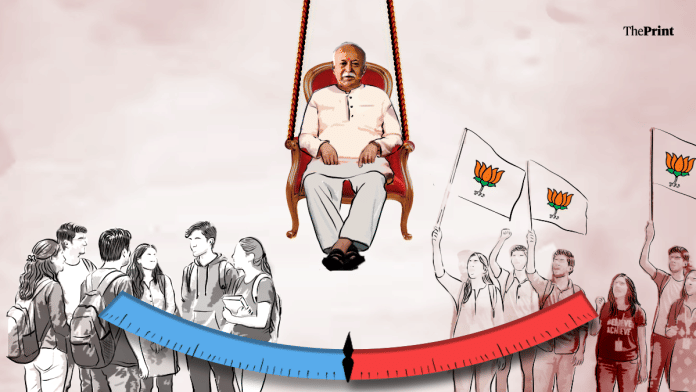
Mohan Bhagwat, sarsanghchalak or chief of the RSS (Rashtriya Swayamsevak Sangh), has seen a dramatic transformation in his image since he set about repositioning the RSS leading up to its centenary. Whether this is making him toss and turn in bed at night or sleep better, he won’t tell us. It’s just that becoming some kind of a liberal mascot, at least for some, wasn’t on his, or any saranghchalak’s KRAs.
He’s got both his loyalists and hard critics confused. The hard ideological base has been thrown by what they see as some increasingly liberal positions he’s taking. This has led to the rise of an Indian “trad” grouping, sticking to the older Hindu conservatism and nationalism which they see the RSS deviating from under Bhagwat. Sort of like the MAGA to the right of the classical Republicans in the US, although we can’t stretch that comparison too far.
Equally, he’s confused the hard liberal community for whom the BJP, Narendra Modi and the RSS are a three-in-one entity. For some of them Bhagwat now brings relief. Are these winds of change? Is he cautioning Modi government? Is he resetting the RSS worldview closer to center? Let me underline first of all, the fundamental ideology and philosophy of the RSS isn’t about to change. What’s on display is political pragmatism in the 13th year of power.
Over the past five years, Bhagwat has shifted or at least articulated differently the RSS position on many key and divisive issues. He has said multiple times that everybody in India (and by implication the subcontinental landmass) has the same DNA, going back 40,000 years. What religion they follow doesn’t matter. He also said stop looking for a shivling under every mosque.
He has said, as has his putative successor Dattatreya Hosabale, that India should remain engaged with Pakistan. They might nuance it as people-to-people contact, but it’s a step forward from the government’s position. All of these are resets—the reason conservatives are furious and the liberals enthused. This is among the reasons that five prominent Muslim personalities had called on Bhagwat on 22 August, 2022, seeking a dialogue.
If the liberal community looks up to an RSS chief for succour, for moderating the Modi government, India has come some distance. You can view this cynically or optimistically. It’s also plausible that he plays the good cop when things go particularly rough for the government; as now, post-Jantar Mantar. The key minister who was made to resign is also a prominent RSS figure.
Also Read: Modi govt response to Gen Z protest shows a rare vulnerability. It’s an opportunity for Opposition
We first need to look at what was said last Thursday. This was days after BJP MP and actor Kangana Ranaut described Gen Z as “generation gutter”. On 30 July, Atul Limaye, joint general secretary of the RSS, told a gathering of ABVP (Akhil Bharatiya Vidyarthi Parishad, student wing of the RSS) workers in Chhatrapati Sambhajinagar, Maharashtra, that Gen Z protest saw anti-national slogans at Jantar Mantar. The Left’s concept of “alternative politics” was successfully tested through the agitation, he said. Dr Ambedkar, he said, “had warned about anarchists long ago” and now “is the time to decode this, understand it and take precautions against such anarchist forces, which are detrimental to the nation.”
It’s evident that Bhagwat was watching from a distance and was worried about the youth’s anger towards Modi government. That’s why he accepted an invitation from India’s International Movement to Unite Nations (IIMUN) for a Q&A session with “Gen Z and Gen Alpha”. The first thing Bhagwat did was to demolish any criticism of the Gen Z protesters as anti-national.
“I have faith in Gen Z,” he said. “Protest is a right in democracy, it isn’t anti-national.” Protest and agitation, he elaborated, is an essential part of consensus-building. “It’s a part of the process,” he said. He called grievances of the youth and need for reforms justified. He said 6 percent of GDP should be spent on education. That, by the way, has been a dream coming from the fifties and reduced to a mere platitude through generations.
If he had to choose who to believe (between generations), he said he’d rather believe Gen Z. Student protests, he added, are legitimate and a valid element in democratic dialogue, “especially when normal channels of communication fail”.
He did not stop here, and that’s what drew even greater interest as to who he was speaking to. “Young people respond better to dialogue, not dictation,” he said. Don’t expect “unquestioning obedience” from them. Respect the younger generation. Kangana Ranaut was the first to get the memo. She reeled back from her “Gen Z is anti-national” line and told reporters outside Parliament Friday that “Gen Z is our biggest strength, and we are proud of the generation”. This course correction has come from the very top, the sarsanghchalak.
Also Read: 2026 is like 1973 Indira-era oil shock plus youth anger. Modi has space, but not immunity
An even more significant and also somewhat intriguing caution has come in from Bhagwat when asked to give a leadership lesson to the young generation. What are the three ideal qualities for leaders of tomorrow, he was asked.
First of all, he said, and this is my best effort at translation with some abridgement, leadership means teamwork. When we think of a leader today, he says, a picture emerges (“ek chitra aata hai”). It looms in front of us, delivering speeches, winning elections, giving sermons to people. This doesn’t cut it (iss se nahin hota hai). Real leaders are those who remain behind, they work from within. “Leadership is to create leaders,” he said, “it is not to lead by myself only.”
There will be obvious questions about who’s he referring to, or is he referring to anybody at all. It isn’t a question anybody in the BJP would dare to raise or answer. But it won’t go unnoticed.
The Modi government’s capitulation to Jantar Mantar was rather dramatic and total. This was just after senior ministers had said that they weren’t like the UPA and their ministers won’t resign under pressure. As the government smarted from this setback on the top of the Monsoon Session, Parliamentary Affairs Minister Kiren Rijiju shared on X an old clipping of an Indira Gandhi interview to a foreign network justifying the Emergency. The irony of a Cabinet minister from the BJP (all BJP and RSS leaders were jailed) sharing an Indira Gandhi interview justifying the Emergency apart, we have to let it play out. The threat to India, she said, was both internal and external. “If it was only internal with no foreign interference we could have dealt with it (without the Emergency),” she said.
She talked about conspiracies, the plans to unleash anarchy, that Morarji Desai had threatened to surround the Prime Minister’s house and Parliament. “We will see that no business can be done. We shall make sure nobody can come out, nobody can go in.” These were the people, she said, who believed because they can’t win through elections, they will take the battle to the streets. These were the people who were destroying democracy.
Whether she actually felt so besieged she made the biggest blunder of her public life by promulgating the Emergency shall remain a matter of debate. What we do know for sure, however, is that there was no other power, senior counsel, a mentor, a family elder or a guru to caution her against such a misadventure. Bhagwat and the RSS are underlining to us that they fill that gap for their own government. Like family elders, or guru RSS to shishya Modi government.
Also Read: RSS chief Bhagwat draws the line at 75. India’s politics stares at the Modi Exception
I think it’s a face saving moment. Shield sishyaas from further embarassment. I support our union government, can’t be in this matter. They totally misunderstood, mishandled the issue.
There is place for a little stardust and glamour in politics. For an earlier generation, that may have been represented by Ms Hema Malini. The choice of Ms Kangana Ranaut is a lot more problematic.
A wise, enlightened, far sighted tutorial. One that was much needed. How can a legitimate protest of the young and restless, centred on Janpath, but which resonated nationally, be dismissed as anti national. Or engineered by foreign elements hostile to India. Although the immediate trigger was the leak of NEET question papers, symbolising many such failures, the rocket fuel was unemployment. No bright future awaiting young Indians after they complete their education. 2. The blunt use of force, including pellet guns, in Delhi ought to have been thought through more carefully. Apart from much else, it has got India a very bad international press. 3. I don’t think this is a failure of narratives, communications, X versus Instagram. In Year Thirteen, this is one page of a Report Card that is being released by those whom we have been calling Demographic dividend. How those underlying failures are to be redressed should be causing people to lose some sleep, toss and turn in bed.