





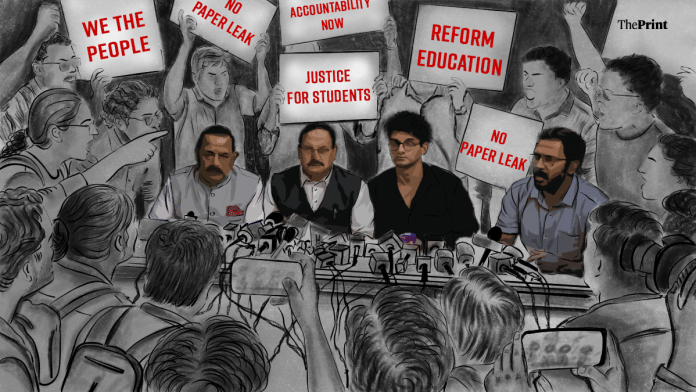

Depending on where your politics comes from you might see Jantar Mantar as a revolution, or as a passing sandstorm. My arguments won’t change any minds. I shall try, however, to say what’s happened and what hasn’t.
Certainly, what’s happened is the first public, in-your-face defiance and ridiculing of the Modi government. If they responded with such alacrity after the violence of 20 July, it was essentially because they realised that well over 95 percent of the protesting youth, or mostly children, were from the Hindu middle and upper-middle classes.
This is their core vote base. You can use the Gen Z label and continue to trivialise their revolt by shifting all discussion, especially on TV news, to their language, slang, gaalis and so on. Even a hundred ‘discussions’ on how differently ‘this’ Gen Z thinks won’t trivialise the defiance they demonstrated.
First of all, it was defiance in the face of much physical risk, evident in their resolve to return to Jantar Mantar even after the beatings on 20 July.
And second, a nearly reckless loss of fear as to what this might mean for their careers going ahead. This was the angriest student protest in New Delhi after the anti-Mandal agitation in V.P. Singh’s short tenure, that saw the Gen Z-equivalent of that period protesting and some even attempting self-immolation (Surinder Singh Chauhan, Rajeev Goswami died).
In both cases, the impulse was the same: career prospects, jobs and education. The first was avowedly ‘upper caste’, this one the relatively upper-middle English-speaking meme-making classes. Both generations, nearly four decades apart, showed no fear of the police or repression.
So, to sum up, this is what has happened. These young people broke the self-imposed silence among the elites not to speak a word critical of the Modi government, except whisper on the sidelines, looking left, right and behind. This was as in-your-face as it can be. And it isn’t going to stop. They also showed that there’s a large demographic that isn’t impressed with slogans of Viksit Bharat or Amrit Kaal. By 2047, the oldest Gen Z-er today will be 50. And the youngest 35. Their lives would’ve passed them by. Who has patience to wait that long? Definitely not this generation of Indians, or young people anywhere. Contrarily, it might work with a middle or upper-middle class BJP voter in the 50-plus age group. The target has been set too far in the future for the old to check out, so Modi government is safe. The children can’t look that far. We need to note that a child who was 3-years-old in 2014, when Modi first took power, will vote in 2029.
There was a touching notion among many Modi critics that India was having its own Colombo/Dhaka/Kathmandu moment. This showed a disrespect for Indian democracy, the robustness of its ‘system’, as well as a delusional view of how easy it might be to push an elected government out.
Also Read: Youth’s struggles won’t end with Dharmendra Pradhan’s resignation. Govt must decentralise education
All said and done, nearly 24 crore Indians voted for the BJP even if it got only 240 seats. That’s almost twice as much as the second largest vote-getter, the Congress. I was tempted to borrow that word ‘delulu,’ but it’s cliched already. I bet they’ve invented something new.
What they’ve done, however, is to open the door for Modi’s opposition just that bit. They’ve exposed more than a chink in the armour. It’s a widening gap between Modi government’s perception of its popularity among its most loyal base and the growing fatigue among a significant enough number of them.
This takes me back to a conversation we had (Prannoy Roy, Dorab Sopariwala and I) in a village during the 2018 Chhattisgarh elections. Why do you want change, we asked a villager, the Raman Singh (BJP) government is giving you so much.
“It’s been there too long,” he said, “don’t you get tired of eating the same sabzi (vegetable) each day even if it’s your favourite?”
In the televised discussion later that evening Prannoy asked me if I also won’t get fed up eating the same sabzi. Not quite, if it’s bhindi (okra), I said. That was for a laugh. The more serious outcome was the election result, sweeping the BJP out of power. The lesson: fatigue and boredom can afflict some loyal old voters too. At least those that aren’t ideologically committed.
This is what the protest underlined. It’s only because the BJP understood it that they sent out two of their most important faces, Health Minister and former party president for six years J.P. Nadda and Jitendra Singh, MoS in the PMO, and in charge of sensitive ministries like space, atomic energy, science and technology. This is also the reason their brief was to be gentle with the students, concede to all their demands and even hold a joint press conference.
Flexibility, the Modi government had displayed over land acquisition and farm laws. Now, we saw vulnerability. The latter is owed mostly to the fact that the protest was from its base. It’s also a fact that its base goes beyond this.
Which brings us to what this protest wasn’t. First, no revolution has broken out and you can give Faiz Ahmad Faiz’s invocation a break.
Also Read: BJP’s push for one-party state has a flip side. It could be Congress’s chance for revival
In a couple of days northern India will be choked with millions of kanwariyas. Many will have loud ‘DJs’, eat mostly ‘bhandaras’ set up by the faithful, have Uttar Pradesh government’s helicopters spray flowers over them. Most of them are also Gen Z. The short point is that there’s also a lot of loyal young with the BJP.
Competitive politics up to 2029 now will be about filling the breach the Gen Z has caused, or widening it. The BJP acknowledges its problem. That’s why the Prime Minister is now speaking on Instagram. But, how will he address voter fatigue, the challenge of the same ‘sabzi’ every day for 15 years?
Can he rejuvenate his government? In the Cabinet, the same cast has played musical chairs. Of the ministries that directly affect the young, Education has its fifth minister and will soon have the sixth. Skill development has seen four ministers and if the project had seen much success unemployment or under-employment would’ve been lower. And who are the four ministers? Rajiv Pratap Rudy, Dharmendra Pradhan, Mahendra Nath Pandey (who’s he?), Pradhan again, and now Jayant Chaudhary of Rashtriya Lok Dal. Rao Inderjit Singh of Haryana has been an MoS with one interruption (2009-14) since 2004. He now has Statistics & Programme Implementation and Planning. Of course, Modi government abolished the Planning Commission but the ministry is there. Jitan Ram Manjhi and H.D. Kumaraswamy helm MSME (medium, small and micro enterprises) and heavy industries, respectively. Each is critical for job-creation. Heard of them lately? The government needs to reinvent itself, and not just on Instagram.
The Opposition, that wants to widen the breach gifted to them, just has to remember that power doesn’t descend on you. I’ve said often that in India no powerful leader is defeated by a challenger. They have to defeat themselves. Indira Gandhi did so with the Emergency, Rajiv with his multiple blunders, from Shah Bano to Ayodhya, Vajpayee with an advanced election over the heady belief in ‘India Shining’. In 2014 Narendra Modi rose as a challenger. By then, Manmohan Singh’s UPA had been a lame duck for four years.
Yet, for each powerful leader to be defeated, the Opposition had to be helped along by somebody who built the groundswell. JP against Indira and V.P. Singh against Rajiv. In three of these reversals, Indira, Rajiv and UPA, the RSS was closely involved. The fact that the Congress has no such loyal infantry raises the handicap on them. They’ve got three years to work on this new opening. Just what the Modi-Shah BJP has got to reboot and rebuild.
Also Read: Five challenges await Modi. First, he must shake off the past and Nehru
The opinionist isn’t analysing the protest so much as writing the press release the CJP wishes it had sent out itself. He says “well over 95 percent” of the protesters were Hindu upper-middle-class kids, and he says it with the confidence of a guy quoting a survey that doesn’t exist. No data, no source, just vibes dressed up as sociology.
What he leaves out is the real story: Delhi Police ran facial recognition on the crowd and flagged 2,873 people with criminal records, 989 of them serious—murder, rape, dacoity, kidnapping, the whole rap sheet. Twelve of those murder cases were repeat offenders with ten or more prior cases each, and several of the flagged individuals kept coming back to Jantar Mantar day after day between July 20 and 25. Presence isn’t proof of guilt, sure, but a third of your crowd carrying that kind of record isn’t bad luck, it’s a pattern.
That fact was public before he sat down to write this sequel too. He drags in 1990s Mandal self-immolations and a Faiz couplet for filler, then tells us not to call this a revolution while spending 1,500 words insisting it basically is. An independent centrist?
Funny kind of centrism that can name four skill development ministers by name and count off five education ministers on his fingers, but can’t find a single line for the 989 criminals in that crowd or the political outfit that let them march under its banner. That’s not balance, that’s a pattern of omission wearing a neutral badge. Guess that data doesn’t fit the script he’d already decided to write. At this rate, he doesn’t need a byline, he needs a CJP membership card.
The protests brought to the fore, dramatically, what has been bubbling beneath the surface for a long time now. Failures of governance, whether it is women’s safety ( Bahut hua naari par vaar ) or the ability to conduct a flawless examination for millions of people, as China did a few days after NEET. Education and Employment are mirror images of each other, the state of the latter even more dismal. Not sure better communication ( there has been an unremitting blizzard for twelve years ) or switching to Instagram is going to make much of a difference. Or a Cabinet reshuffle, when few Ministers have agency. 2. Whether in Jantar Mantar in 2026 or the general election in 2029, that is what matters. A sober comparison between all that was promised on the campaign that started in late 2013 and what has been delivered. Some tough, very tough, questions to answer now.