





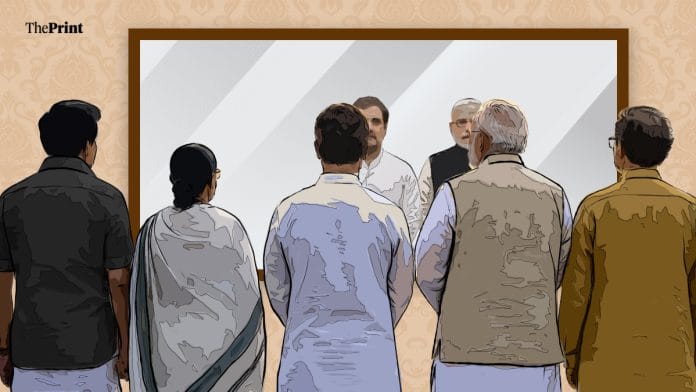


It was just two weeks back that National Interest underlined how the BJP, under Narendra Modi and Amit Shah, was moving India towards a single-party system despite being way short of a Lok Sabha majority.
The theory will be tested in the Monsoon Session beginning Monday. There’s a good chance it will affirm India’s evolution into a one-party state.
Of course there will be a flip side to it. It will also open up the possibility for a second party to rise, if it could sweep up the detritus of the vote banks of regional parties the BJP is currently decimating or subsuming.
This incredible win for the BJP will, ironically, also open up the space needed for the Congress to rediscover its mojo as the BJP’s only pan-national challenger.
I know this will draw much scepticism, even derision from both vicious haters and too-often-disappointed lovers of the Congress. But Modi, Shah and the BJP will agree. They understand that the only reasonable challenge to them comes from the Congress. Go back to Modi’s campaign speeches over the years. The party he attacks most is the Congress, the Gandhi family.
This pattern is seen even in states where the Congress is a cipher. In Andhra Pradesh he repeatedly said that because of its appeasement policy the Congress boycotted the Ram Mandir consecration.
Referring to the recovery of a cash stash in the home of a domestic help of a Congress minister’s aide in Jharkhand, he again asked where all the party had set up its cash warehouses. This was in Andhra too, where the Congress polled only 2.74 percent in the 2024 general election. Again in the same campaign in Odisha (also a blank zone for the Congress) he asked if the Congress “shahzada” (prince) was ‘reading from the same script as 2014’. In Bihar, where the Congress is a junior partner of the Yadav dynasty, he repeatedly targeted it for “appeasement politics”. In West Bengal where the only rival for the BJP was Mamata Banerjee’s TMC, he bundled Congress with her and said the two conspired to block 33 percent reservation for women.
Even if it’s a municipal election someplace where the Congress doesn’t exist, you’ll find the BJP targeting it. That’s an acknowledgement that Modi sees the Congress as his only likely challenger. He’s too sharp to dismiss it contemptuously as insignificant.
Also Read: Congress is ceding ground to BJP on nationalism. It’s pushing India towards one-party system
In the Monsoon Session, the supreme test of this argument will be if the BJP succeeds in collecting a two-thirds majority by defections, co-optation or abstention. And then pass the constitutional amendment needed to increase the size of Parliament, carry out a fresh delimitation and, wrapped within it, the women’s reservation bill.
A two-thirds majority of 362 or above, starting with a mere 240 of your own, will be a political miracle.
What will the BJP be looking at next? The Uttar Pradesh and Punjab elections earlier next year. And Gujarat later in 2027. The following year will be Karnataka, Madhya Pradesh, Rajasthan and Chhattisgarh. I’m only listing states with more than 10 Lok Sabha MPs.
In most of these states, Congress will be its main challenger. You would therefore expect the BJP’s anti-Congress rhetoric to rise. But the BJP is looking at 2029 and beyond. And who does it see as its likely rival? All regional and caste-based parties that reduced it to 240, except Akhilesh Yadav’s Samajwadi Party, are mostly finished.
The BJP has destroyed them either through splits, defections or multiple editions of Operation Lotus. No regional party has survived defeat at the BJP’s hands. The DMK may live on and retain its ideology, but then the BJP is no force in Tamil Nadu. In Andhra, Chandrababu Naidu’s Telugu Desam Party (TDP) has struck an iron-clad alliance. Even his rival, Y.S. Jagan Mohan Reddy’s YSRCP, won’t fight the BJP.
Also Read: Why many parties break up when out of power and some don’t
With so many of the INDIA bloc partners dead, dismembered or gasping, the Congress has both the challenge and luxury to look at the future afresh. Can it take a brave new leap as the solitary, or almost solitary challenger to the BJP? See it this way: The Congress has a committed vote of 21 percent. The BJP in 2024 got about 37 percent. The Congress doesn’t have to get to 37. Even if it adds another 5 percent, it can mess things up for the BJP.
You can presume that most of these additional votes will come from the BJP, because it’s in fights against the Congress that it has the greatest strike rate. A vote percentage of 30-32 percent will reduce the BJP to just about 200. The NDA it then leads will be very different. This is merely theoretical, but the BJP is very aware of this. That’s why the Congress is its enemy even when the rival is TMC, BJD or YSRCP.
Since we’re talking theory, an academic citation is in order. Read the paper by political scientists Edgar Șar and Pelin Ayan Musil in the July 2026 edition of Journal of Democracy published by Johns Hopkins University Press. The headline would read so frightfully counterintuitive in India where coalitions are accepted as the only way of defeating an entrenched incumbent. In the Congress era the BJP built NDA around it, and then the Congress responded with its UPA. The Șar-Musil paper, highlighted to me by ThePrint Political Editor D.K. Singh, turns the argument on its head, using examples of Hungary and Turkey.
“This essay,” the authors say, “overturns a consensus among scholars and strategists: that only broad, pre-electoral coalitions can unseat dominant parties in competitive authoritarian systems.” The evidence, they argue, is “two surprising reversals—Hungary in 2026 where the single Tisza party swept Orban’s Fidesz, and Turkey in 2024, where the Republican People’s Party (CHP), running alone, won landmark local elections.”
In Hungary, Fidesz dissident Péter Magyar built a new party and targeted Orban only on corruption. He is, if anything, about as Right-wing as Orban. In Turkey the CHP renewed itself and “absorbed the broader opposition electorate”.
That “broader opposition electorate” is a key point. It exists in every democracy, including India. So far the Opposition has tried to bring this vote together by forming multi-party alliances. Can the Congress now dare to do it alone?
Powerful incumbents can be defeated, as we’ve seen in Sri Lanka and Nepal. I don’t count Bangladesh as that election was held after banning the incumbent. In both Sri Lanka and Nepal, a new leader emerged with fresh ideas and a single-party challenge.
Can the Congress reinvent itself? A Left-Right binary won’t work because on welfare, distributive economics, public sector, subsidies, Modi is even more to the Left than the Congress. Just attacking or ridiculing Modi over everything, his policies to his penchant for foreign honours, language and style will get retweets, but won’t impress the roughly 15 percent additional vote that Modi brings to the BJP. The Congress needs a new idea and agenda. It says the BJP is surrendering to China and Trump, can’t fight Pakistan, is too friendly with Israel, but how will it handle each? What is the Congress’s foreign, strategic and economic policy for this changed world? It says Modi’s growth figures are fake. So how will it take India to 8-percent growth?
The greatest ironies come packaged in the harshest realities just as opportunities lurk under the debris of the grandest disaster. The mass destruction of the regional parties is one. This new single-party system can open up to a two-party contest. Just that the challenger has to have the guts, ambition, and a new idea to fight the entrenched incumbent by itself.
Also Read: Muslim voters no longer matter to BJP. Only a new Hindu-led coalition can challenge Modi-Shah
My Dear Mr Gupta,You seen to suggest that if the Congrss gets “even” 7-8 % more votes the BJP will be in trouble.You seem to forget that the BJP takes no prisoners.Even if the Congess get 40% of the vote they will still lose.Who controls the agencies,ECI,SCI,FINANCES,POLICE.BEAEAUCRATS?Methinks you need a reality check.What you write is possible in a ” “NORMAL” India..Normalcy ended in 2014.
A lot will depend on Mr Rahul Gandhi. When UPA was in office, each year the party faithful would turn up to celebrate his birthday ( in June ) but he would be vacationing abroad. Even now, although the family has been wealthy for generations, a three week summer holiday ( possibly in Europe ) somehow does not gel with the image he tries to project. 2. Treating senior Congress leaders with respect, acknowledging their legitimate ambitions, planning orderly succession, which was botched in Rajasthan and Punjab, seen through well in Karnataka. 3. None of this is said with lack of respect or goodwill. The country needs an effective opposition, whether it is a coalition of the UPA sort, when regional parties were a force to reckon with, or now, when the column makes the case that the way ahead is the Congress.
Gujrat model 101…..INC always gets a big chunk of votes. Never enough to surpass BJP , albeit.