







There are two aspects to the ongoing churn in national politics, and don’t worry, I’m not wading into the opium den speculation over a likely Cabinet reshuffle. Leave that to Capital’s under-employed ‘insider-gyani’ complex.
I’m interested in two things that look contrary, but aren’t. One, that the BJP has created a political miracle by making India almost a one-party state despite being well short of a Lok Sabha majority.
And second, that since much of this is being done by splitting, co-opting or destroying regional parties, Congress is the only significant Opposition that remains intact. Thereby, Indian politics has also become a two-party contest.
It should be a perfectly simple and linear equation. If only the Congress looked a convincing challenger. It can’t, with a strike rate of 10 percent or thereabouts against the BJP.
Such a two-party system will suit the BJP fine because they’ve only struggled when up against a strong regional party. Most are now decimated and Akhilesh Yadav’s Samajwadi Party will face its trial by Yogi fire.
Three questions arise. One, why does the Modi-Shah BJP find the Congress such a convenient rival? Second, what does the Congress lack that it can’t be a credible challenger? And third, how can the Congress pull itself up?
The answer to the first is simple: the BJP is propelling itself on four engines. Hard Hindutva, harder nationalism, efficient and fair welfare, and massive physical infrastructure visible to all. The Congress doesn’t have a credible counter, which also answers the second question. If all of what the BJP is doing is wrong, as the Congress says, what will it do if it came to power?
On economy, strategic issues and defence, how will it be different from the BJP? How will it deal with Pakistan, China, the US and West Asia? How will it spend on defence? What’s its vision for an alternative to the BJP? That the BJP is “corrupt, crony-capitalist, and compromising the national interest” are all opinions, which is fair enough in competitive politics. But, what will you do that’s different? If the Congress sees itself as a choice it wants voters to prefer over the BJP, how’s the product it’s offering different?
Also Read: Why many parties break up when out of power and some don’t
The Congress has to answer these questions first. And then counter the four engines we said are powering the BJP railroad. That we didn’t use juggernaut is deliberate. It would be factually wrong given the pace at which the BJP is moving and we’d rather avoid a metaphor from religious tradition.
The first, on Hindutva, the Congress shouldn’t even try competing with the BJP. That territory is taken and the Congress can’t dent it however many temples its leaders visit. Even the Shiv Sena gave up. Uddhav Thackeray, in fact, said to me once, sort of philosophically, that Balasaheb (his father) erred in shifting from Maharashtravad (Maharashtra regional appeal) to Hinduvad as it only enabled Narendra Modi to walk into Sena territory and take over. On welfare the Congress can promise the world. It’s done so successfully in Karnataka and Telangana. On infrastructure, it will have a problem. All of these years it has seemed to oppose too many marquee projects, Nicobar being the latest.
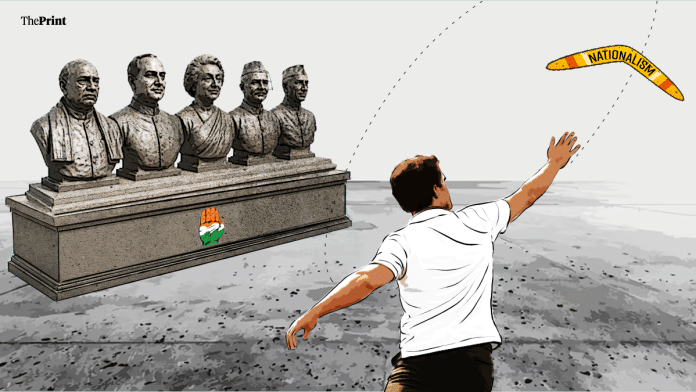
With religion out of reach and welfare/development being too anodyne to pack much emotion, the Congress is left with nationalism.
How the Congress has abandoned nationalism is the most intriguing aspect of its post-2014 politics. Parts of it might pretend to be like the European Greens, but the real Congress was never a party of bleeding heart pacifists. It’s the party that, under Indira Gandhi, defeated and dismembered Pakistan in 1971, and with Lal Bahadur Shastri as Prime Minister, won the 1965 war in the sense that it fully thwarted and threw back Pakistan, which had launched the war confident of grabbing Kashmir.
It also fought hard, even brutally, against Northeastern insurgencies, sent the IAF to strafe and break the siege of Aizawl (5 March, 1966) as the rebels looked poised to overrun the treasury, Assam Rifles battalion HQ and the Deputy Commissioner’s residence and, while it may not want to be reminded of it now, sent the Army into the Golden Temple complex in Operation Bluestar, following it up with Black Thunder 1 an 2.
The first two were under Indira and the last two under her son Rajiv. Subsequently, it fought back two of our bloodiest phases of terrorism and insurgency in Kashmir Valley and Punjab (1991-95). This was under P.V. Narasimha Rao. Even the war with Naga insurgents was fought with the harshest methods under Nehru, who also sent the forces to liberate Goa. The Congress may not like its non-Gandhi/Nehru prime ministers, but the fact is, it never produced a leader that was weak on national security. It’s amazing therefore to see how the original party of hard nationalism has lost its way.
Also Read: Five challenges await Modi. First, he must shake off the past and Nehru
Whether on the surgical strikes post Uri, bombing of Balakot after Pulwama, the East Ladakh/Galwan crisis and now Operation Sindoor, the Congress has greatly damaged its cause by only raising questions, seeking evidence. In some cases the hangers-on close to Rahul Gandhi have done it—Sam Pitroda on Balakot, Digvijaya Singh on the surgical strikes. Lately it’s Rahul himself.
His statement that ‘Chinese are thrashing our soldiers’ or have ‘occupied 2,000 km of our territory’ even earned him a Supreme Court rebuke even as the judges let him off in a defamation case. On Op Sindoor, his intervention in Parliament was more about how many planes India lost and why. Separately, he tweeted with a 17-second Jaishankar clip to ask why India told Pakistan it would confine itself to attacking terror bases and won’t attack its military installations. One of his party MPs from Punjab even waved what he claimed was the wreckage of an IAF plane.
How smart is all of this? I can give you an idea of how his grandmother would’ve handled these. Each time, she would’ve started out by heaping high praise on Indian armed forces, hailed their success and then attacked the Modi government for its multiple failures. The arrival of 300 kg of RDX in Pulwama, lack of protection at Pahalgam and may be too soft an approach initially in Op Sindoor.
She would then have said that our brilliant and indomitable armed forces performed a miracle despite “this incompetent and bumbling government, so thank you our soldiers and officers, pilots and airmen”. She would’ve clinically separated the armed forces and the government. The first she would praise, and attack the second. She would never ask if any planes were lost or talk loose and fast of territory “lost” to China merely on the evidence of tweets from your durbaris.
This Congress doesn’t have the footwork to walk back from an error. Contrast this with Modi. In his reply on the no-confidence motion in Lok Sabha on 10 August, 2023, Modi made what I then noted as three indiscreet statements: on Kachchatheevu, IAF strafing of Aizawl in 1966 and Operation Bluestar, or what he called “attack on the Akal Takht”. Now he did figure the downside in these statements. The Aizawl and Bluestar points, he never repeated again. Kachchatheevu came up on the eve of 2024 elections but has been forgotten. These were missteps he walked back. Each of these pertained to national security.
Indian nationalism is unique. It emerges from a shared sense of history: ancient, medieval and modern, freedom movement and the Constitution. The BJP has Hinduised it. That’s where the Congress can find an argument, or product differentiation. But if it’s going to persist with its current approach, insisting that India—and its armed forces—only keep losing to China and Pakistan, nobody is going to be impressed. This, I’m afraid, can easily take today’s two-party equation to an unquestioned one-party system.
Also Read: The Vishwaguru delusion, mine vs yours, is ruining our view of the world
Rahul Gandhi has been making a distinction between thr armed forces and the modi govt
It is the media, including the Print, that is obfuscating his points.
How in the world can one criticizer the govt without pointing out what India has lost. Last I checked the armed forces is under the union govt right?
I feel we are heading to a 2 party state like the USA
This piece is fundamentally disingenuous. The Congress never possessed a coherent, foundational doctrine of “hard nationalism.” By treating India as a blank slate created in 1947 rather than an ancient civilization reclaiming its sovereignty, they created a structural vacuum.
When Mr. SG laments that Congress is ceding ground to a dominant BJP, he writes as if it’s a minor tactical error in political “footwork.” It is not. It is the structural collapse of an elite, post-independence framework that consistently placed global validation, selective history-writing, and appeasement over hard national security. You cannot spend 80 years treating the country’s sacred geography, resources, and civilizational identity as negotiable assets and then act surprised when the regular Indian voter completely rejects you.
To call a leader strong just because they used the military inside the country against their own people is a joke. True nationalism means protecting the nation’s borders, its resources, and its history from both external enemies and internal threats alike. When you look at actual actions instead of empty political talk, the post-1947 ruling establishment has left a permanent record of weakness and surrender.
1) The Nehru Era
The Ladakh Surrender: When China stole thousands of square kilometers of Indian land in Aksai Chin, Prime Minister Nehru actually stood up in Parliament and dismissed the loss by saying it was a remote area “where not a blade of grass grows.” To a true nationalist, every inch of the motherland is sacred. To dismiss stolen land just because grass doesn’t grow there is a complete betrayal—and our soldiers are still paying the price for that laziness along the border (Line of Actual Control) today.
The Kashmir Blunder: Instead of letting the army finish the job and clear out invaders in 1948, Nehru stopped the military advance and dragged a purely Indian matter to the United Nations. By inviting international outsiders into our territory, he turned a clear case of foreign aggression into a permanent dispute, gifting Pakistan a political tool to drain Indian resources for decades.
The Indus Waters Treaty (1960): In an act of total weakness, Nehru signed a deal that gave away roughly 80% of the river water to Pakistan. India sat at the top of the rivers and controlled the water sources, yet Nehru willingly gave away that massive leverage. This lopsided deal legally blocked regular Indian farmers in Punjab, Rajasthan, and Jammu & Kashmir from getting the water and development they desperately needed, all so Nehru could look like a “peace-loving” leader to Western banks.
2) The Indira and Rajiv Eras
The Shimla Surrender (1972): After winning the 1971 war, India held all the cards: absolute military dominance and 93,000 Pakistani prisoners of war. Yet, Indira Gandhi completely choked at the negotiating table. She handed all 93,000 prisoners back to Pakistan in exchange for empty verbal promises to keep things peaceful. She turned a historic military victory into a total diplomatic surrender.
The Nuclear Freeze: After conducting India’s first nuclear test in 1974, Indira Gandhi backed down under foreign pressure. She refused to actually build nuclear weapons for decades, leaving India unprotected while Pakistan ran a secret, around-the-clock program to build their own bomb.
The 1988 Nuclear Deal: Rajiv Gandhi continued this policy of holding India back while Pakistan pushed forward. Right after the Indian military showed overwhelming strength during military drills, Rajiv signed a deal with Benazir Bhutto that legally banned India from striking Pakistan’s secret nuclear factories—essentially protecting Pakistan’s bomb-making facilities from our own military.
3.) The UPA Era
The Sharm-El-Sheikh Sellout (2009): The UPA government signed a humiliating joint statement promising that India would keep talking to Pakistan even after major terror attacks. Worse, they allowed Pakistan to officially write “Balochistan” into the document. This gave Pakistan a massive propaganda victory, letting them falsely claim to the world that India was causing internal trouble inside Pakistan.
Biryani Diplomacy: While Pakistan-backed terrorists were actively killing and beheading Indian soldiers on the border, the ruling elite in New Delhi were busy hosting lavish luncheons and “Cricket Diplomacy” matches for visiting Pakistani officials.
Finally, look at how this whole ‘Darbari media’ ecosystem operates. They rely on the exact same intellectual blind spots, over and over again, just to shield these massive historical failures and protect their old elite friends. It’s a convenient little setup that lets these commentators completely dodge holding past leaders accountable for literally giving away the store.
They throw around big words like ‘ancient civilization’ and ‘history’ as if they’re cheap ornaments, just because it’s trendy in today’s political climate. But the truth is, they don’t have the slightest clue what a real civilizational state actually demands. By reducing hard national security and our civilizational identity to a shallow public relations narrative, this traditional media crowd stays completely blind to reality. They just cannot understand why regular Indian voters have rejected that entire post-1947 political framework.
Congress does offer an alternative to BJP. It’s 90% reservation in private jobs for lower castes. He’s the most stupid politician alive.
One area for considerable improvement is defence procurement. Government prerogative, opposition has almost no role to play. 2. During the Kargil conflict, General V P Malik had said, We will fight with what we have. So many years later, Pakistan will be inducting fifth generation aircraft and submarines with Air Independent Propulsion before India does. 3. Defence PSUs. The world’s top foreign manufacturers. A growing cohort of credible private sector firms in India. Between these three entities, the government has to meet the requirements of the three services. A minimum purchase in fly away condition, more licensed manufacture in India, with increasing local content and transfer of technology. 4. Faster phase out of ageing platforms like MiG 21, Jaguars, AN 32, helicopters.
In a better world, a long serving incumbent would have sought to forge an all party consensus on national security and foreign policy. ( When requested, opposition MPs joined, even led, all party delegations to 33 countries after Operation Sindoor ). Two abiding, fused threats from China and Pakistan. 2. Growing isolation in South Asia, with Bangladesh clearly drifting away to China, even warming up to Pakistan. Pakistan, despite its rock solid alliance with China, now receiving exceptional US indulgence. Signed a Mutual Defence Agreement with Saudi Arabia, the natural leader of the Gulf, with a special place in the Islamic world. India’s relations with USA, our large black umbrella for a very windy, rainy night, at a thirty year low. 3. Foreign policy and national security are, of course, the government’s core function, the opposition, notably in the states, is not directly in the picture. Even so, forging a bipartisan consensus would be in the national interest.
What makes the task of the Congress incredibly difficult is that it is not playing on a level field. Each facet of the game.
Massive physical infrastructure, visible to all. What is also visible is very poor quality of construction. This is something the government might wish to reflect upon and rectify.
I keep repeating…Rahul hai toh Modi hai.
Else he won’t be in power. RaGa would thrive in place of Mamdani…not Modi
Have never understood how the Congress could be faulted on Nationalism. Mrs Gandhi sliced Pakistan like a watermelon in 1971. Asked R N Kao, Can you do something about Sikkim. Conducted the first nuclear test in 1974. Held India together, inheriting a traumatised nation in 1947. In 1972, when Time magazine asked Mrs Gandhi what India’s greatest achievement was over the last 25 years, she answered with modesty, I think we have survived as a nation. The party ruled India for half a century. Little of that time was a walk in the park. I am not a Dhurandhar sort of guy, do not equate nationalism with rippling muscles. There is a lot the Congress has done for India, made its share of mistakes, as all governments have. Maybe the Congress needs to communicate better.