





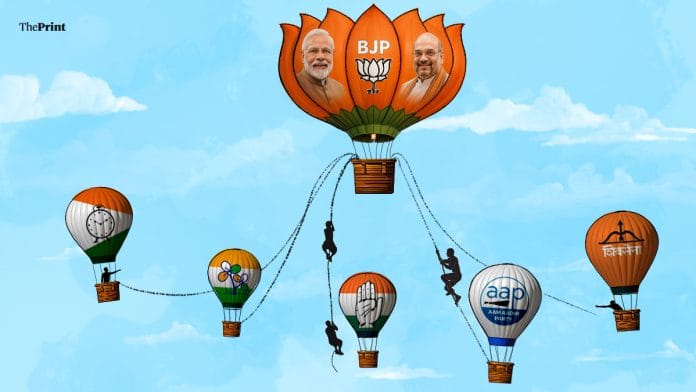


In this season of mass defections, all to the BJP, three interconnected political questions arise. Why do parties break up? Why do individuals defect? Do ideology, principle, even loyalty, matter?
All of these then lead to a central logical question: Why do some parties break up, or haemorrhage fatally, but some don’t?
Let’s first check out the broad scoresheet over these months of high ‘mobility’. The destruction of Mamata Banerjee’s Trinamool Congress (TMC), or rather coup from within, has been the standout headline. But there’s competition. The rump of the Shiv Sena with Uddhav Thackeray is splitting again. In Jharkhand INDIA MLAs have cross-voted for NDA-backed independent Parimal Nathwani. Congress can draw some consolation from D.K. Shivakumar getting some from NDA to cross-vote in the MLC election in Karnataka.
Aam Aadmi Party had already lost seven, Biju Janata Dal has ‘contributed’ three to the BJP/NDA kitty, in not so recent a past Y.S. Jagan Mohan Reddy’s YSRCP (Yuvajana Sramika Rythu Congress Party) has shed members too, all adding to NDA (read BJP) numbers. The Shiromani Akali Dal, despite its religious glue and unique ideology has seen departures, including Manpreet Singh Badal. There’s also Manjinder Singh Sirsa, now a minister in Delhi.
If I started listing the Congress people who walked across to the BJP, it would take up the entire length of this column. Let me, therefore, confine myself to those who’ve become chief ministers or central ministers with the BJP, or used to be chief ministers with the Congress. Chief minister, after all, is one of the highest positions a party can give.
At this point, three of the BJP chief ministers are imports from the Congress: Himanta Biswa Sarma (Assam), Pema Khandu (Arunachal Pradesh) and Manik Saha (Tripura). As was N. Biren Singh who ruled Manipur till the other day. Or ok, nobody has quite ruled Manipur under him or lately. All four held key positions in the Congress. In Modi’s Council of Ministers, you can count Jyotiraditya Scindia, Kiren Rijiju, Rao Inderjit Singh, Jitin Prasada and Ravneet Singh Bittu.
Nearly all come from illustrious Congress dynasties. And the list of former Congress chief ministers who defected to the BJP is a football team: Captain Amarinder Singh, Pema Khandu, Ashok Chavan, S.M. Krishna, Narayan Dutt Tiwari, Digambar Kamat, Kiran Kumar Reddy, Vijay Bahuguna, keep counting. Except Pema Khandu nobody has particularly got any benefit from the BJP except, maybe, protection. Or lack of harm.
Also Read: Five challenges await Modi. First, he must shake off the past and Nehru
It will be said that the BJP is a magnet for the losers from all parties because that’s where the spoils are. Further, that the BJP employs saam, daam, dand, bhed (persuasion, price, punishment and intrigue) to break rivals. Its laundromat politics for those it first confronts with corruption charges is key to this one-way movement. For engineering mass defections, the BJP has perfected the doctrine of the split. Get two-thirds to move and say you’re the real party. This leads us to two questions. One, is it only now that this phenomenon of breaking rival parties has begun? And second, the question we had raised upfront: why do most parties break or lose talent, but some don’t? This, despite long periods of being out of power.
The Congress had been a past master at the game. In fact, until the Supreme Court’s Bommai judgment (11 March, 1994), the Congress employed Article 356 like a walk in the park, to dismiss rival governments. The difference now is single-minded focus on expansion through acquisition. The BJP is doing this on an industrial scale.
Which brings us to our second question. Why do most parties break, but some don’t? I would list only three that don’t. The BJP of course, Akhilesh Yadav’s Samajwadi Party, and the Left spectrum. The Leftists had many arguments and splits, over Trotsky, Lenin, Beijing and Moscow, but stayed together in one front. Commitment to ideology indeed is the glue that keeps parties together. The Left is today completely out of power, at the lowest point in its history, but nobody is even exploring elsewhere.
The Congress’s lowest in Lok Sabha is 44 in 2014. In the 1984 general election the BJP was reduced to 2 seats and yet maintained cohesion. In fact, in the 75 years since the party was founded (originally as Bharatiya Jana Sangh, BJS), it had held power only for six years until 2014. But there was no split, and just one significant if short-lived defection, Shankersinh Vaghela in Gujarat. On the contrary the Congress broke so many times, they’d run short of letters in adding suffixes to the parent name.
The BJP has had some significant departures that need mention. The first was Balraj Madhok, the swayamsevak from Jammu who, as party chief, led BJS to his highest ever tally of 35 in the 1967 election. He fought with his peers, especially Atal Bihari Vajpayee and L.K. Advani because he wanted to align the BJS with other ‘Right-thinking’ forces on the economy, like the Swatantra Party. The RSS view was, ironically, closer to being Gandhian and Madhok saw it as Leftist, or too similar with Indira Gandhi’s. He was turfed out of the BJS in 1973, but sulked. He attacked his party leaders, especially Vajpayee, but never defected to a rival. Mrs Gandhi still saw him as a threat and jailed him during the Emergency.
Among the founders of Akhil Bharatiya Vidyarthi Parishad he died lonely, unsung at 96, a decade ago. In a 2010 interview he did say Mrs Gandhi had offered him a Cabinet position in 1980 but, as a swayamsevak, he wasn’t to be tempted.
Also Read: Muslim voters no longer matter to BJP. Only a new Hindu-led coalition can challenge Modi-Shah
Lately, we’ve seen revolts by former chief ministers Kalyan Singh, Uma Bharti and B.S. Yediyurappa. But they all returned to the fold. The only one who did it with some success, didn’t last out. Vaghela revolted with 47 BJP MLAs in 1995, blaming late Keshubhai Patel and Narendra Modi, then a party apparatchik, for his marginalisation and became chief minister in partnership with the Congress. That lasted exactly a year. Later, he merged his group with the Congress, won Lok Sabha elections on its ticket twice and became central minister (textiles) in 2004. Since then, he went downhill and faded away. He’s a lonely 85 now.
The BJP-Left cohesion through lifetimes of wilderness is matched, surprisingly, by the SP that Mulayam Singh Yadav founded. Of all the OBC-Muslim vote bank parties post 1992 (Babri Masjid demolition) it’s been the most durable. It has a fairly clear ideology and Akhilesh Yadav has kept his vote banks’ trust. So there’s a belief that one day power could return.
The political force that should be chewing on this is the Congress. So many regional parties, TMC, NCP, YSRCP are its splinters. Its own leaders have been constantly searching for opportunities. It’s evident that in the course of time power became its main ideology. Once it was gone, so were many of its people. As for the other regional parties, TMC and Uddhav-Shiv Sena included, these were simply one-family parties. When the family failed to win the votes, these broke down. The decline of the Akali Dal is also rooted in a party so steeped in religious ideology becoming a family enterprise.
Until now, the BJP has kept its ideological core. It often has dissensions, but no revolts. And the peer-pressure of shakha culture, guru-shishya relationship between cadre and the RSS keeps it together. It imported many dynasties and bred some of its own, but the power remains with home-grown leaders of ideological purity. It has ensured unity in power now, and for six decades out of it.
Also Read: INDIA has a Congress-sized hole. And the fix begins with a little humility
Fascinating tutorial on Indian politics. A cover story the Editor could have written for India Today at one time. 2. The BJP has changed, or modified, Indian politics. Relentless growth and expansion, both organic and inorganic. Have often felt over the last twelve years that this made possible governance of a much higher calibre than has been seen. Also truly transformative economic development. Why that has not taken place and what it could mean for its future could be the subject of another National Interest column.
Dear Print,
I see that all of you start lamenting only when the defections are to the BJP. When BRS was defeated in the Telangana elections and the MLAs defected to the Congress you were all quiet. It seems your conscience awakens only when the BJP is the beneficiary.
SP is also one family party supported by Yadavs and Muslims.
AIIM is taking away Muslim votes.