



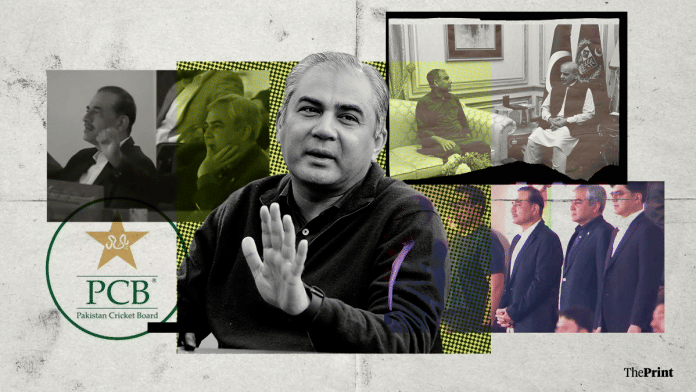
New Delhi: Some say Pakistan’s interior minister, Mohsin Naqvi, is a one-man army.
At 47, Naqvi wields extraordinary power: he oversees Pakistan’s internal security while simultaneously serving as chairman of the Pakistan Cricket Board (PCB) and president of the Asian Cricket Council. More recently, he was also Pakistan’s diplomatic emissary during the West Asia crisis, reportedly handling sensitive interactions that traditionally fall within the foreign ministry’s remit.
What also sets him apart is that he is the only Shia in Prime Minister Shehbaz Sharif’s cabinet, an identity he put to use during the West Asia war as well.
Few politicians in Pakistan have accumulated such influence without leading a political party, inheriting a political dynasty or winning a national election.
When US President Donald Trump met Army Chief Field Marshal Asim Munir for a White House lunch in 2025, the first high-level meeting in five years, Naqvi accompanied them.
In the West Asia war mediations, Naqvi was there. He delivered a letter from Pakistan’s army chief and prime minister to the Supreme Leader of Iran, Mojtaba Khamenei.
In a 2022 BBC Urdu article, Pakistani analyst Habib Akram said about Naqvi, “Anything is possible in this country. You just have to have good relations with certain people.”
The positions he currently holds, however, explain only part of his rise.
Increasingly, Naqvi is widely viewed in Islamabad as the civilian face of Pakistan’s military establishment and one of the closest political confidants of Army Chief Field Marshal Asim Munir.
In a 2024 interview, now jailed former Prime Minister Imran Khan referred to him as a “viceroy”.
In an interview given from jail, Khan claimed “the ‘king’ is covertly handling the affairs, while [interior minister] Mohsin Naqvi is operating as a viceroy” and that Prime Minister Shehbaz Sharif “commands no power”.
That perception grew stronger following two speeches by Naqvi last week that sent shockwaves across Pakistan’s political establishment. At the Pakistan Economic Summit, Naqvi declared that Pakistan’s governance system had “collapsed”, described the Pakistani youth as “cockroaches” and called for new provinces to handle the crisis in the country.
Two days later, he announced that investigators had uncovered what he described as the biggest corruption scandal in the country’s history, spanning more than two decades, allegedly involving judges, civil servants, politicians and bankers.
While he promised that every individual responsible would be prosecuted, he declined to identify them.
The remarks sounded less like routine ministerial observations and more an indictment of the political order itself.
“Criticism of governance is hardly new. What is rare is for a serving interior minister to declare that the state has already ceased to function as intended,” Pakistani columnist Arifa Noor wrote in an article in the Pakistani daily Dawn.
Analysts ThePrint spoke to labelled Naqvi a “messenger”. They said his statements hadn’t come out of the blue but were a “warning”.
His comments sparked speculation that the Shehbaz Sharif government was on its way out, because the minister seen as Munir’s man was calling them out. Moreover, experts said his comments on creating different provinces indicated that Munir was losing patience.
Pakistan’s military leadership, led by Field Marshal Asim Munir, has echoed a similar view, arguing that rapid population growth and mounting pressures on public resources have exposed the shortcomings of the country’s current provincial framework.
Last month, Pakistan’s health minister, Syed Mustafa Kamal, disclosed during a joint meeting of the Senate committee on National Health Services and the Senate Functional Committee on Human Rights that Shehbaz Sharif and Munir had convened a meeting to discuss population control measures, reflecting the seriousness of the issue, Dawn reported.
“Munir wants new smaller provinces and reversal of the 18th Amendment, meaning all the money in federal control and smaller units to be controlled on a Brigadier level,” a Pakistani analyst familiar with the matter told ThePrint.
The 18th Amendment in 2010 granted major legislative and financial autonomy to provinces and removed the president’s unilateral power to dissolve Parliament.
“What Naqvi’s statements reveal is that within six months, big changes are bound to happen because the files have been opened,” journalist Mansoor Ali Khan said in a video analysis Monday.
A second Pakistani analyst told ThePrint that Munir, through Naqvi, had administered “a public warning”.
“Munir is serious (about creating new provinces or another constitutional amendment) and if (Asif Ali) Zardari and Sharif delay, there might be consequences,” the analyst added.
But why is Naqvi being made the messenger? Analysts said it is because he is the closest to Munir in the government and acts as a pressure point to keep the Sharifs in check.
In a 2019 Pakistan Today column, Abdullah Niazi wrote, “His white hair and impish smile give him the appearance of a sweet old uncle that lives in your neighbourhood. But there is much more to him.”
Also Read: PCB chairman Mohsin Naqvi can’t explain empty stadiums at PSL. Drags India in
The man who could network
Naqvi’s journey differs markedly from that of Pakistan’s traditional political elite.
Unlike members of Bhutto or Sharif families, he did not inherit a political constituency or dynasty. His rise was instead built through journalism, entrepreneurship, personal networks and an ability to navigate the overlapping worlds of media, bureaucracy and power.
Orphaned at a young age, he was raised by his maternal uncle in Lahore. After graduating from Government College University, he moved to the United States, where he studied journalism at Ohio University. His networking skills were well known even then. “Famously, even as a young undergrad at GCU he somehow established a relationship with the chief minister,” the 2019 Pakistan Today column noted.
His career as a journalist began at CNN during a consequential time.
Following the September 11 attacks, Pakistan became central to global news coverage as the United States launched its ‘war on terror’. CNN expanded its reporting presence across South Asia, deploying journalists with regional expertise in Pakistan. Naqvi was at the right place at the right time and eventually rose to lead CNN‘s South Asia bureau, beginning as what the 2019 column described as CNN’s Pakistan “fixer”.
“As CNN’s man in Pakistan, he played a number of roles, one of which was being the fixer. If a journalist from CNN wanted to come to Pakistan and interview the chief minister, Mohsin Naqvi would be the man that made all the arrangements,” the column said.
Those years did more than establish his credentials as a journalist; they also gave him access. He transformed those relationships into a business. In 2009, he founded City Media Group, beginning with City42 in Lahore before expanding into a network of regional television channels across Punjab, Karachi and London.
The London operation was particularly significant. For decades, the British capital has served as an unofficial political headquarters for Pakistan’s exiled politicians and business elites, allowing Naqvi to remain connected to the country’s politics even beyond its borders.
His uncle, who had raised him, eventually became chairman of the media group.
Beyond politics
Beyond his media career, Mohsin Naqvi had long cultivated deep connections across Pakistan’s political establishment.
Naqvi is married into one of Punjab’s most influential political families, the Chaudhrys of Gujarat. He is the son-in-law of the late Senior Superintendent of Police Ashraf Marth and is related through marriage to senior politicians Chaudhry Parvez Elahi, the current Pakistan Tehreek-e-Insaf (PTI) chief, and Chaudhry Shujaat Hussain, former Pakistan prime minister, placing him within one of Punjab’s most entrenched political networks.
His relationships have not been confined to a single political camp.
The same Parvez Elahi accused Naqvi of being a “culprit behind stealing the mandate of the citizens following the 2024 elections”.
The 2024 general election in Pakistan followed two years of political turmoil after Imran Khan was ousted through a no-confidence vote, jailed on corruption charges and barred from contesting elections. His party, Pakistan Tehreek-e-Insaf, was also stripped of its electoral symbol before the vote. Despite the crackdown, PTI-backed independent candidates emerged as the largest bloc in the National Assembly, winning 93 seats, ahead of Pakistan Muslim League-Nawaz (PML-N) with 75 and Pakistan Peoples Party (PPP) with 54.
The military establishment faced widespread allegations from PTI and others of manipulating the electoral process in favour of the PML-N to sideline Khan, allegations the military has denied.
Naqvi later went on to become the Interior Minister in the coalition government despite not being a senator and never having contested elections.
To retain a full federal cabinet portfolio, Naqvi contested the 2024 Senate elections as an independent candidate, backed by the ruling coalition, including the PML-N, the PPP, the Pakistan Muslim League-Quaid (PML-Q) and the Istehkam-e-Pakistan Party (IPP).
Following his victory, he was sworn in as a member of the Senate.
Naqvi is also regarded as being close to President Asif Ali Zardari.
In an interview with Geo News journalist Hamid Mir, Zardari described Naqvi in unusually personal terms. “I still call him my son,” Zardari said.
Political rise
Political observers have credited Naqvi with playing an important behind-the-scenes role during the negotiations that brought the Pakistan Democratic Movement (PDM) coalition together in 2020 to challenge the government of then-Prime Minister Imran Khan.
His political profile expanded dramatically in January 2023, when the Punjab Assembly was dissolved after Imran Khan called for fresh elections. The Opposition, led by Hamza Shehbaz, nominated Naqvi as one of two candidates for caretaker chief minister. Pakistan’s Election Commission ultimately approved his appointment.
The decision immediately became a flashpoint. Imran Khan opposed Naqvi’s appointment, accusing him of being aligned with his political rivals. He argued that Naqvi had caused more political damage to the PTI than the Pakistan Muslim League-Nawaz itself.
“The PML-N has always chosen its own umpires,” Khan said at the time. “But what is astonishing is that the Election Commission selected someone who is effectively an ally of the PML-N and an opponent of PTI to serve as Punjab’s caretaker chief minister.”
Naqvi’s tenure as caretaker chief minister further elevated his standing within Pakistan’s power structure.
Even so, it does not fully explain Naqvi’s remarkable ascent for many trace the answer to that question to Rawalpindi.
A PPP leader once called him “Rawalpindi’s man”, a reference to the Pakistan Army.
In 2024, a senior PML-N leader quoted in The Express Tribune said Naqvi’s election as Interior Minister “would be nothing short of a joke”.
The Munir connection
Mohsin Naqvi’s growing influence cannot be explained without a mention of his relationship with Field Marshal Asim Munir. Across Islamabad’s political circles, Naqvi is widely regarded as Munir’s closest civilian ally. His appointments have reinforced that perception.
He first gained national prominence as caretaker chief minister of Punjab during one of Pakistan’s most politically sensitive transitions.
Soon afterward, he became interior minister while also assuming control of Pakistan’s cricket administration—an unusual consolidation of authority for a civilian politician.
His influence has extended beyond domestic affairs.
During the West Asia conflict, where Pakistan played the role of a peacebroker, Naqvi reportedly played a role in sensitive diplomatic engagement, a responsibility traditionally associated with Pakistan’s foreign ministry.
In Pakistan, perceptions of power often become political facts.
Today, Naqvi is widely seen as more than a cabinet minister. He is increasingly viewed as the civilian expression of the military establishment’s priorities.
That perception helps explain why Naqvi’s remarks at the Pakistan Economic Summit attracted such unusual attention. The conference itself was unremarkable—a gathering of business leaders discussing Pakistan’s economic challenges. Naqvi’s speech was not.
He argued that Pakistan’s governance system had already collapsed and suggested that decades of administrative centralisation had made effective governance nearly impossible.
Welfare programmes, cash transfers and laptop distribution schemes, he implied, could not substitute for structural reform.
His solution was ambitious. Pakistan, he argued, should create additional provinces, strengthen local governments and bring administrative authority closer to citizens.
Within a day, Pakistan military spokesman Lt. Gen. Ahmed Sharif Chaudhry publicly echoed many of those themes, linking governance reform to national security. The sequence did not go unnoticed.
After a two-day silence, leaders of the Pakistan Peoples Party accused Naqvi of undermining the constitutional order by effectively endorsing Pakistan’s “hybrid system”—the term commonly used to describe the country’s power-sharing arrangement between elected governments and the military.
More striking was the criticism from within the federal cabinet itself. Defense Minister Khawaja Asif publicly described Naqvi as perhaps the government’s most powerful minister, remarking that “in many matters, he doesn’t even answer to the prime minister”.
It was an unusually candid acknowledgment of Pakistan’s informal distribution of authority.
Within Islamabad, few disputed what Asif meant.
Commentators shifted from analysing Naqvi’s proposals to interpreting what they revealed about Pakistan’s direction.
In The Express Tribune, journalist Fahd Hussain viewed the speech as evidence that Pakistan’s establishment had concluded that incremental governance reforms were no longer sufficient. Structural changes, including stronger local governments, administrative reorganisation and a reconsideration of fiscal arrangements between the federal government and the provinces, were increasingly being presented as unavoidable.
Whether those proposals ultimately materialise remains uncertain. What is clear is that they would redistribute political authority in fundamental ways.
Noor, in her article for Dawn titled ‘Politics is upon us’, argued that the “hybrid system” was now set for “a tug of war”. “What now seems inevitable is another amendment to the Constitution, even if there is little clarity on what it will bring,” she wrote.
She then followed up with a more important point: “But while the powers that be have perhaps made their intentions clear, the silence from the parties means they are still to put together a strategy. Will they simply try to win over some concessions as they did during the previous two amendments? Will they drive a hard bargain? Or is the time and space for compromises over?”
Pakistan has repeatedly experienced periods in which narratives of corruption, administrative paralysis and governance failure have preceded significant institutional change. Imran Khan was one such case. Naqvi’s speeches fit within that historical pattern.
Whether they foreshadow constitutional amendments, administrative restructuring or simply a more assertive version of Pakistan’s hybrid political system remains an open question.
But Mohsin Naqvi’s rise tells a broader story than that of one ambitious politician.
It illustrates the emergence of a new kind of power broker in Pakistan, one whose influence rests not on electoral legitimacy or family inheritance but on institutional confidence, personal networks and the trust of the country’s most powerful establishment, the army.
In another political system, he might simply be regarded as an unusually influential cabinet minister. In Pakistan, he has become something more consequential: the civilian figure through whom the country’s evolving balance of power increasingly speaks.
(Edited by Sugita Katyal)
Also Read: Pakistan bans Al Jazeera over PoK reporting, accuses it of ‘yellow journalism’