



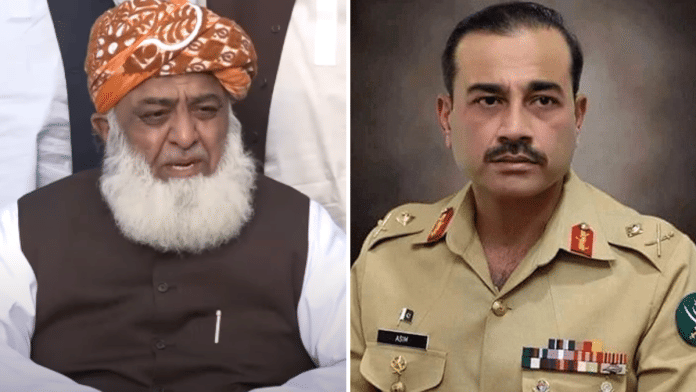
New Delhi: Pakistan’s leading religious-political leader Maulana Fazlur Rahman has mounted one of his fiercest attacks yet on the country’s powerful military establishment and its Field Marshal Asim Munir.
He accused the army of abandoning its own soldiers during the 1999 Kargil conflict and exploiting their sacrifices to shield itself from criticism. In stinging words, the Jamiat Ulema-e-Islam (Fazl) chief advised Munir to take care of his uniform if he wanted to shape the country’s politics.
“The insult, humiliation and contempt you have done to your martyrs has not been done by anyone else. You try to hide behind the martyrs to hide your crimes,” Rahman said Sunday at the Islamabad Bar Association Convention.
For an insider who has spent decades navigating Pakistan’s civil-military establishment, Rahman’s criticism carries political weight, suggesting that dissatisfaction with the military’s role is no longer confined to its traditional opponents.
The remarks have created a mini storm in Pakistan with multiple cases registered against Rahman. Defence Minister Khawaja Asif and other ministers demanded an apology. Punjab Assembly Speaker Malik Muhammad Ahmad Khan also called for a Senate committee to examine whether the MP should formally explain his remarks.
Invoking one of Pakistan’s most sensitive military controversies, Rahman had accused the army of initially refusing to receive the bodies of soldiers killed in Kargil.
“We received the funeral of Colonel Sher Khan after India’s insistence. You handed over your martyrs to the Hindus. You were not ready to receive their funerals. You handed over your martyrs to the Hindus and a statement came from there that we buried them in an Islamic manner,” he said.
He was referring to the Kargil conflict in which Pakistan refused to take over the bodies of its soldiers. The Indian Army buried them in Indian territory with Islamic rituals.
Rahman alleged that Pakistan had accepted Sher Khan’s body only after India’s insistence. “Did you ever tell the nation how many were martyred in Kargil and how many bodies were received? You were not even ready to receive the bodies of your own martyrs.”
He further accused the military establishment of invoking the sacrifices of soldiers whenever it faced criticism while failing to honour them in practice.
Also Read: Pakistanis are saying Asim Munir is losing control. Coordinated attacks by BLA, TTP
Shift in tone
Rahman’s remarks represent a striking departure for a politician who has spent decades working within Pakistan’s civil-military order, rather than openly confronting it.
As head of one of Pakistan’s largest Deobandi Islamist parties, he has alternated between cooperation with military rulers and criticism of their policies. He has served in coalition governments, maintained working ties with successive army chiefs and often acted as a political broker. During the passage of Pakistan’s 17th Constitutional Amendment, his support was crucial for the Pakistan Muslim League (Nawaz) in securing the numbers it needed.
Even during periods of cooperation, Rahman occasionally questioned the military’s dominance over national security policy, including Parliament’s limited role during operations in the former Federally Administered Tribal Areas. But those criticisms stopped well short of directly challenging the army’s institutional authority.
That has now changed. At a public gathering earlier this month, Rahman directly challenged Munir’s political role.
“If you want to do politics, take off the uniform and contest elections. Then we will see how many votes a man in uniform gets,” he said.
Rahman accused the military of prioritising political control over its constitutional responsibilities.
“All energies are being utilised solely to strengthen the political grip,” he said, arguing that reminding the armed forces of their constitutional role should not be treated as an attack on the military.
“Did I create these circumstances? Understand the core of my argument; I merely made everyone realise their jurisdictions. If I have drawn your attention toward your responsibilities, my parents did not give birth to me to surrender.”
Rahman also criticised proposals to involve civilians in armed militias amid worsening security conditions, warning that they could create lasting hostility against the state.
Drawing parallels with the 1971 war, he recalled the formation of the Al-Badr and Al-Shams militias in erstwhile East Pakistan, now Bangladesh.
“In East Pakistan, the public was told to form militias, and Al-Badr and Al-Shams were created. They fought shoulder-to-shoulder with the army, and that enmity still exists today. So, are you now creating enemies for us too?”
He argued that soldiers accepted the risks of military service as part of their profession and that their sacrifices should not be used to shield the establishment from public scrutiny.
“If a Pakistani soldier makes a sacrifice, that is exactly what he was recruited for. I will go and speak across all four provinces.”
Rejecting demands for an apology, Rahman instead demanded one from the military.
“My demand is that the general from whose office the propaganda was unleashed against me must apologise,” he said. Despite his criticism, he insisted his party was not seeking confrontation.
“We pray for well-being and do not wish to face the enemy; however, when the situation arises, standing firm is the ultimate principle.”
Rahman has also criticised Pakistan’s regional policy. In a speech last December, he questioned Islamabad’s justification for carrying out cross-border strikes in Afghanistan while condemning India’s Operation Sindoor.
“If you justify attacking Afghanistan by claiming you are targeting your enemy there,” he asked, “then why object when India says it is targeting its enemy inside Pakistan?”
(Edited by Tony Rai)