





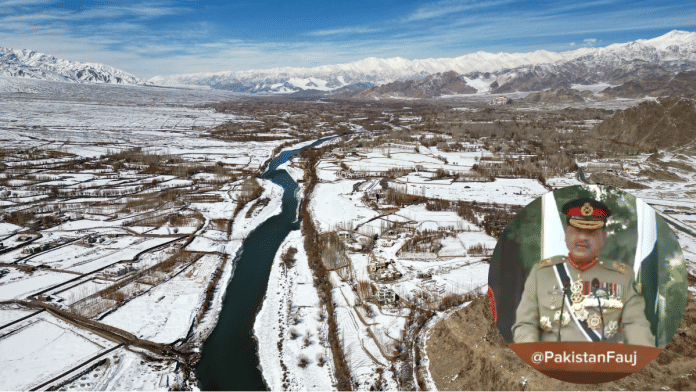


New Delhi: Pakistan Field Marshal Asim Munir Monday threatened to undertake “all measures necessary” to get Pakistan its “rightful share” of water under the Indus Waters Treaty. The comments were made at the 276th Corps Commanders’ Conference, chaired by Field Marshal Munir at the general headquarters in Rawalpindi.
“The forum expressed resolute commitment to undertake all measures necessary to ensure availability of Pakistan’s rightful share of water as per the directives of the government and aspirations of the people of Pakistan,” the Inter-Services Public Relations (ISPR) statement read.
India has held the transboundary water agreement in abeyance since the April 2025 Pahalgam terror attack.
The intervention by Pakistan’s military comes months after the civilian government in a National Security Committee in April post the Pahalgam terror attack rejected India’s move as a unilateral violation of a binding international agreement brokered by the World Bank. It had then threatened that any attempt to stop or divert waters allocated to Pakistan under the treaty would be regarded as an “act of war” and would invite a response “across the complete spectrum of national power”.
The military said the conference had reaffirmed guidance issued by Pakistan’s National Security Committee in 2025.
For more than six decades, the Indus Waters Treaty was regarded as one of the world’s most resilient international water-sharing agreements, surviving multiple wars and prolonged political hostility between the two nuclear-armed countries. Signed in 1960 with the World Bank acting as broker, the treaty allocated the eastern rivers Ravi, Beas and Sutlej to India while granting Pakistan rights over western rivers Indus, Jhelum and Chenab, which account for roughly 80 percent of the basin’s water.
The agreement also established a Permanent Indus Commission to facilitate technical cooperation and created a structured dispute-resolution process involving neutral experts, international arbitration and the World Bank. The treaty contains no provision allowing either side to suspend it unilaterally.
Asim Munir’s comments also come a day after the chairman of the Water and Power Development Authority in Pakistan, Lt Gen (R) Muhammad Saeed in a piece in Dawn wrote, “these developments can severely threaten Pakistan’s long-term water security”.
“Pakistan’s response must be guided by confidence rather than complacency. The country should continue to defend the treaty through diplomacy, technical engagement and international law, with the firm expectation that India will have to return to its obligations under the treaty, while sustaining its long-standing national requirement of investing in strategic water infrastructure, expanding storage capacity, improving irrigation efficiency and adopting modern technologies for basin management,” he added.
Pakistan’s political brass has repeatedly targeted India over the IWT being held in abeyance despite Pakistan lacking proper infrastructure to handle its water shortage. In response to Saeed’s article, Pakistan’s I&B minister too doubled down on IWT.
“Pakistan’s right to water under the IWT is its inalienable right, it is our lifeline which we will protect. India’s unilateral failed attempt of holding IWT in abeyance has no legal or moral standing. This act has caused India nothing but embarrassment. It is a clear violation of ‘One Water-One Vision’ principle endorsed by the United Nations,” he wrote on X Monday.
Pakistan defence minister Khwaja Asif too made similar points in response to the article and added, “Come what may, Pakistan will defend and preserve the Indus Waters Treaty at all costs, InshaAllah.”
“This is not merely a legal obligation. It is a matter of Pakistan’s water security, food security, energy security and national survival. No unilateral action, no illegal suspension and no pressure tactic can erase a international treaty that has safeguarded regional stability for more than six decades,” he wrote on X.
In April, Pakistani President Asif Ali Zardari chaired a high-level meeting on water resources, and described the abeyance of IWT as the “weaponisation of water”, as he directed officials to pursue diplomatic and legal measures to safeguard Pakistan’s rights.
In June, Pakistan’s climate minister Musadik Malik declared, “If anyone lays a hand on Islamabad’s share of water, we’ll cut off that hand.”
(Viny Mishra)
Also read: Inside the second partition of India-Pakistan—the full story of the Indus Waters Treaty