








What happens when the lunatics take over the asylum? I guess we may find out because something like that could be happening.
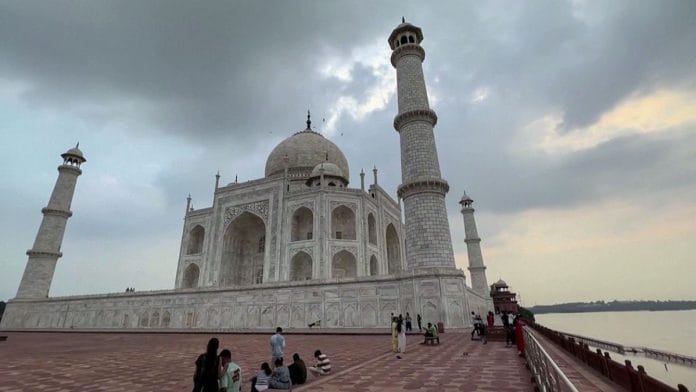
A few days ago, the Allahabad High Court finally took a petition about the origins of the Taj Mahal seriously and asked the Archaeological Survey of India and the central government to respond to it. The petitioners had been trying, since 2015, to get the case going, only to have court after court dismiss it.
Why did the courts refuse to take it seriously? Well, it could be for the same reason that most sensible people have regarded its basis as nonsense: the petition enshrines an old conspiracy theory about the Taj Mahal that has consistently been laughed out of historical circles.
According to this theory, the Taj is actually a Hindu structure that was appropriated by the Mughals. The petitioners not only subscribe to this theory, but they also want the courts to authorise inspections inside the building and eventually to bar Muslims from offering prayers there.
I will spare you the details of the ‘arguments’ in favour of this demand except to tell you that very little about the claim is new. It is so outlandish that the Archaeological Survey of India has opposed it, as has the Government of India, which, everyone will concede, is hardly run by Hindu-haters determined to give undeserved credit to the Mughals.
Also Read: PIOs or Muslims—who is Modi govt aiming at when it says passport isn’t citizenship proof?
The fantastic tales of the fringe
I first heard the claim about the Taj many decades ago when, as a credulous schoolboy, I came across the work of PN Oak, who was head of a society called the Institute for Rewriting Indian History.
At that age, conspiracy theories hold a certain fascination. Just as I was taken with Erich von Däniken’s view that our gods were actually astronauts from faraway planets, or that the Bermuda Triangle opened the door to another dimension, or that Paul McCartney was dead and had been replaced by a double, I wondered about the Taj.
Then I read more of Oak and others like him and noticed that he had many other conspiracy theories, including the claim that Fatehpur Sikri was actually a Hindu city.
Almost all the theories I read were dedicated to a peculiar worldview in which hardworking Hindus built many glorious structures, all of which were appropriated by nasty Muslim rulers who renamed them and took the credit.
Even as a child, you learn which conspiracy theories to take seriously and which to dismiss as lunacy. So, I was prepared to believe that Netaji Subhash Bose did not die in an air crash or that Lee Harvey Oswald did not act alone (actually, I still believe that one). But I made a distinction between those theories and the one that said Shakespeare was really an Indian called Sheikh Peer, or the views of Shastriji, my Sanskrit teacher, who told us that ancient Indians invented the aeroplane but that Westerners denied Indian civilisation the credit.
And later, I was able to laugh off the claim that Buzz Aldrin, the Apollo 11 astronaut, had become an Islamic holy man. The story was that when Aldrin landed on the moon, he heard a sound. It was only after he returned to Earth that he discovered what the sound was. It was the Muslim call to prayer. And so he became an Islamic preacher. (I have since met Aldrin and discussed his moon voyage with him. He was certainly no converted Muslim holy man.)
But the lunatic fringe loves its theories. Aldrin became the subject of another one when it was alleged that he and Neil Armstrong faked the moon landing in a Hollywood studio.
Some questions are worth asking
In recent years, there has been a growing confusion between conspiracy theories and the rewriting of history. I have no objection to serious historical research that contradicts what we believe.
Let’s not forget that until Mohenjodaro was discovered and excavated in the early part of the 20th century, we had no idea that the history of Indian civilisation began several centuries before historians believed it did.
Even the claim, advanced repeatedly by Murli Manohar Joshi when he was HRD Minister, that the Harappan civilisation was not built around the Indus but the Saraswati river, deserves to be investigated.
And there are questions about the Harappan culture that are still unanswered. Who were the Harappans? Were they the ancestors of today’s Dravidians? Did they have a formal religion? Why have we still been unable to solve the mystery of their language?
Also Read: Modi, Amit Shah or Yogi never pretended to be liberals—the ‘secular’ politicians did
The mainstreaming of lunacy
The problem is that bigotry and politics have invaded what should be the realm of serious historians. The Hindu right is committed to claiming that the Harappan people were Hindus despite the absence of any compelling evidence to this effect. The Hindutva lobby is worried that if it can be demonstrated that these people followed another religion, then Hinduism is not the original religion of India. Which means that Hinduism entered India later, perhaps through a migration of people.
This may sound fine to you and me. After all, Christianity got to Europe long after it reached Kerala. It’s not crucial to know which religion sprang up when. The Pope is still the Pope no matter when Rome became a Christian city.
But the primary argument offered by Hindutva supporters for treating Muslims as outsiders is that they came to India from outside and converted people. So there is a problem if it turns out that India had an advanced non-Hindu civilisation before Hinduism spread, perhaps because Hindus migrated from elsewhere and brought their religion with them.
It may seem like a stupid distinction to sensible people: we are all Indians now, citizens of a diverse, pluralistic nation. But if you believe that Muslims are no more than horrible invaders who came to India and took over our monuments, then, of course, the distinction matters.
Which is why the line between lunatic conspiracy theories and historical questions has been deliberately blurred. Hindutva extremists have to re-establish again and again how much Hindus suffered because of Muslim invaders. They have to reassert that Muslims made no great contribution to Indian culture; that every single one of their achievements was based on theft of Hindu heritage and culture.
Once again, this is not a new development. There has always been a lunatic fringe that subscribes to this view. The difference is that it’s not a fringe any longer. It has come dangerously close to the mainstream. History has been junked in the pursuit of bigotry.
That’s why it is important not to give outlandish and extreme positions the respect they do not deserve, and not to let the truth be consumed by hatred. A lie repeated often enough becomes truth. A society that distorts and devalues the past in an effort to promote the politics of the present damages itself and all those who live in it.
It can never be a good idea to let the lunatics take over the asylum.
Vir Sanghvi is a print and television journalist and talk show host. He tweets @virsanghvi. Views are personal.
(Edited by Asavari Singh)
Thank you for the article!
Because they are UPA 3 and pseudo-secular…just like asok and daisy
Thought of P V Oak when I started reading this column. In those days, these things felt like a lark. Much more serious now.
Balanced and logical write-up indeed, as usual. There is a problem – one cannot convince a lunatic and another one – the lunatics are increasing by the hour.