





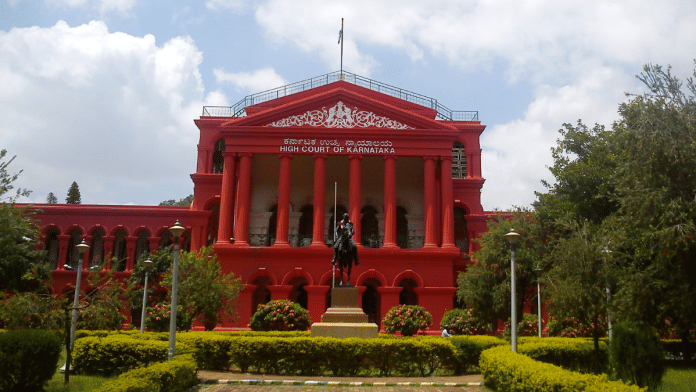

New Delhi: Every woman who renders services to her family members at home is liable to be regarded as a ‘homemaker’ irrespective of her educational qualification, the Karnataka High Court held Wednesday, while also noting that the term ‘homemaker’ is gender-neutral. “A homemaker thus can be male or female,” it said.
“Even a working woman or a professional can be considered to be a homemaker so long as such woman renders services at home taking care and looking after the welfare of the family members,” added the bench of Justice Chillakur Sumalatha.
Significantly, the bench clarified that to consider a woman as a homemaker is not necessary to project or establish that “she is illiterate or she stays at home 24×7 or that she attends only household work and nothing more”.
“Any individual who tirelessly strives, showers unconditional love, sacrifices personal comfort at times and ultimately becomes a pillar for (a) happy and stable family is a homemaker. These qualities are illustrative but not exhaustive,” it said. The definition, the High Court held, also covers a working person or breadwinner or wage earner.
Also Read: ‘Nation-builders, not dependents’: Strong SC judgement endorses homemakers as economic contributors
The legal battle: KSRTC vs Pampapal
This interpretation arose during the adjudication of cross-appeals involving the Karnataka State Road Transport Corporation (KSRTC) and a claimant named Pampapal.
The case originated from a motor vehicle accident in October 2013, which resulted in permanent physical disability for the claimant, a 25-year-old woman at the time holding a Master’s Degree in Biotechnology and having been a guest lecturer at a college from August 2012 to March 2013, earning a salary of Rs 35,000 per month.
The primary dispute centered on whether she was entitled to compensation for loss of future earnings. The KSRTC argued that because she was highly educated and not employed at the time of the accident, she could not be regarded as a homemaker, and thus no compensation should be awarded under that head.
The motor accident claims tribunal (MACT), where the compensation was initially claimed, had declined to award any sum for loss of future earnings. The High Court noted how the tribunal, without considering the educational qualification and the ability of the claimant to earn, held that she was not entitled to any compensation towards loss of future earnings.
Moving the High Court in 2018, the claimant contended that even if the argument that she was not working as a guest lecturer by the date of accident is to be taken, in light of the permanent disability, she was now a homemaker and should be compensated for the role.
Statutory entitlement or contractual benefit?
Beyond the definition of a homemaker, the case addressed whether medical insurance reimbursements should be deducted from accident compensation.
The KSRTC contended that since the claimant’s medical bills had already been reimbursed by ICICI Lombard General Insurance Company Limited, awarding the same amount again would constitute an unfair “double benefit”.
Justice Sumalatha, on 4 August, rejected this “double benefit” argument by distinguishing between contractual and statutory rights.
Quoting a Supreme Court precedent, the Karnataka High Court held: “the amount received as part of Mediclaim/medical insurance is not deductible from compensation as calculated by the concerned Tribunal…These two stand on a different footing – one is statutory while the other is contractual.”
It reasoned that insurance reimbursements are the “fruit of amounts already paid in the past” through premiums and cannot stop a claimant from seeking their statutory entitlement under the Motor Vehicles Act.
In its final judgment, the High Court recognised the claimant’s services as a homemaker despite her qualifications and fixed her notional income at Rs 8,000 per month. Applying a multiplier of 18 based on her age at the time of the accident (25 years) and accounting for a 10 percent whole-body disability, the bench awarded Rs 1,72,800 for financial loss and an additional Rs 24,000 for loss of services during her recovery. Consequently, it enhanced the total compensation by adding Rs 1,96,800 with 6 percent annual interest, dismissing KSRTC’s appeal and ordering the corporation to deposit the sum within eight weeks.
(Edited by Amrtansh Arora)
Also Read: Unpaid domestic work of women amounts to 7.5% of GDP, latest SBI report says