







New Delhi: The Supreme Court Thursday delivered a strong judicial endorsement of the economic and social value of unpaid domestic labour by women, describing homemakers as both an “economic entity” and a “nation builder.”
The judgment came in a motor accident compensation appeal arising from the death of a homemaker in 2001, in which her family challenged the amount awarded by the Motor Accident Claims Tribunal (MACT) and by lower courts.
Examining how the law values the contribution of women engaged in unpaid domestic work, the bench of Justices Sanjay Karol and N.Kotiswar Singh rejected the long-standing tendency to treat homemakers as dependents rather than contributors.
“It is ironic to describe a homemaker as dependent on earning members, when, in reality, the household’s functioning depends substantially on the homemaker. The earning members are in fact solely dependent on the homemaker…,” it said, lamenting that this reality has historically failed to receive the recognition it deserves.
The pronouncement is the latest in a trend of rulings in recent years that has moved away from treating homemakers as “non-earning” dependents and towards recognising them as economic contributors whose labour sustains households and enables wage earners to participate in the formal economy.
Homemakers, the top court said, are responsible for shaping the social values, emotional stability and educational foundations that allow future generations to flourish.
“These are the people responsible for laying the foundation stones” beneath the endeavors of everyone from “high flying business persons” and politicians to ordinary workers, it observed. Their contribution, the court said, is often either “entirely invisible or just partially visible” despite being essential to the functioning of society.
The bench called out the unfortunate invisibility of these efforts in discussions of India’s economy. “Tasks that are considered ‘everyday’ such as cooking, cleaning and other similar activities … undoubtedly support the paid workforce by enabling economic productivity, yet they are in themselves not recognised as productive activities for the purposes of measures such as GDP.” it observed, noting that, contrary to what many believe, “women’s unpaid caregiving work is estimated to contribute 15-17 percent of India’s GDP.”
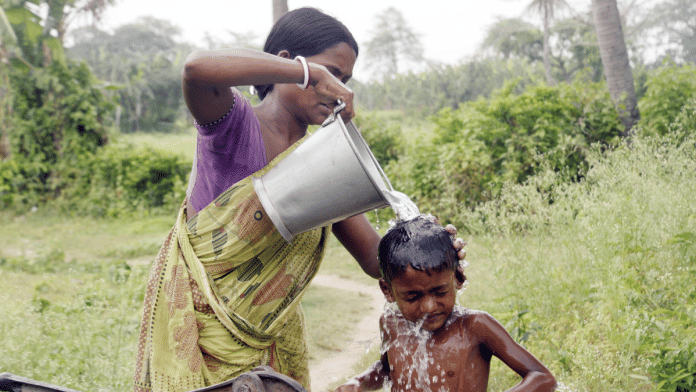
It drew attention to the work of rural wives, including those “walking kilometres for pails/matkas of water, transporting mounds of hay atop their backs on a daily basis,” an exertion that often goes unacknowledged by urban residents.
“To put it directly and yet indirectly, a homemaker is like the potter and a home itself is a lump of clay,” the court said in a figurative way, highlighting the centrality of a homemaker’s work in shaping a household.
Some of the pointed observations come at the end of its observation on unpaid domestic labour. “The ‘homemakers’, to put it directly, actually are the ‘nation builders’ and they ought to be recognised as such,” it said, adding that it was “high time” for the law to make visible the value of their efforts.
Although it acknowledged that men, in some circumstances, perform the role of homemaker, the court clarified that in the present case, it was addressing the more common, gendered reality of women’s unpaid domestic work.
Also Read: Inside India’s public defender experiment: The lawyers fighting for those who can’t afford one
Compensation benchmark
The court also attempted something previous decisions had largely avoided: assigning a concrete monetary value to unpaid domestic labour. Concluding that existing compensation law failed to adequately account for a homemaker’s contribution, the bench created a separate compensatory head called “loss of domestic care”.
It fixed Rs 30,000 per month as a basic “stand-in” for the economic value generated by a homemaker in cases where there is no direct monetary income to measure.
Until now, courts have stopped short of putting a precise monetary value, given the peculiarities of every individual case. The Supreme Court has in the past made it clear that the amount cannot be minimal. In February 2024, it criticised the compensation awards of a lower court, asking “How can a homemaker’s income be treated as less than that of a daily wager?”
Previously, compensation for ‘non-earning’ persons was generally calculated at Rs. 15,000 a year under the Second Schedule to the Motor Vehicles Act. Tribunals often lumped homemakers and housewives into this category, leading to sparse compensation awards that were widely criticised.
In 2017, the Supreme Court in National Insurance Co. Ltd. v. Pranay Sethi declared the Second Schedule obsolete in light of inflation and the rising cost of living. Later, Parliament responded by amending the Second Schedule in 2019 (with effect from 2022).
Some guidance already existed. For instance, in 2010, the Supreme Court in the Arun Kumar Agarwal vs National Insurance Co case rejected the Allahabad High Court’s low valuation of an accident victim’s labour as a homemaker, remarking that “the contribution made by the wife to the house is invaluable.”
The current trend solidified in 2021 with the landmark Supreme Court ruling in Kirti v. Oriental Insurance Co. Ltd. The case arose from a motor-vehicle accident in which a couple died, leaving behind minor children. The issue was how to value the wife’s contribution as a homemaker when calculating compensation.
The court rejected the characterisation of the wife as a “non-earning member” of the family, criticising the undervaluation of homemaker labor “a problematic idea that has persisted for many years and must be overcome.”
While acknowledging that “there can be no exact calculation or formula” to precisely define homemaker value, it directed there be attempts to determine “the truest approximation of the value added by a homemaker.”
The Kirti approach of treating homemakers as economic contributors rather than “non-earning” dependents has since been adopted by High Courts in compensation cases. In 2024, for instance, the Madras High Court heavily increased a compensation award to a motor accident victim by relying on the Kirti standard, as did the Rajasthan High Court in 2025. District courts, too, have increasingly cited the Kirti standard when adjudicating motor accident claims.
This strain of jurisprudence has permeated in matters related to maintenance proceedings, even as such cases do not cite Kirti directly, since it was, technically, limited to compensation claims. They do, however, increasingly reflect its substantive logic.
For instance, the Delhi High Court, while awarding maintenance in a divorce proceeding in February, noted that a homemaker does not “sit idle”. “The law must recognise not only financial earnings but also the economic value of the contribution of the wife within the home,” it said.
On Thursday, the SC went further than any previous judgment in attempting to articulate a concrete benchmark. By fixing a monthly notional value and characterising homemakers as “nation builders”, it moved beyond the symbolic recognition of domestic labor and towards its quantification.
Taken together, the trajectory from Arun Kumar Agarwal to Kirti and now to Thursday’s ruling reveals a remarkable shift in judicial thinking. A legal system that once classified homemakers as “non-earning persons” for compensation purposes increasingly treats them as economic contributors whose labour sustains households, enables wage earners to work, and generates value that cannot simply be excluded from legal calculations.
Sahaj Sankaran is a TPSJ alum, currently interning with ThePrint.
(Edited by Tony Rai)