







New Delhi: A sunny Tuesday afternoon finds Reena Yadav hurrying down the dusty hallways of Tis Hazari, a sprawling court complex in North Delhi. She dodges and weaves around the crowd of harried litigants and black-robed lawyers with practiced ease, a bulging file folder clutched to her chest.
Yadav has spent three hours bouncing between five courtrooms. “Four matters in one court, three matters in another court, one in a third court. I’m always running,” she explains, between breaths. “Usually it’s even more.” Two judges are on leave today, or it would have been seven courts.
Yadav is an Assistant Legal Aid Defense Counsel (LADC), a full-time lawyer for criminal defendants who can’t afford private legal representation.
Three years ago, her job did not exist.
Today, 3,000 lawyers like Yadav form the backbone of one of the most ambitious legal-aid experiments in India’s history, launched three years ago: an attempt to build a nationwide public defender system for the country’s poorest defendants.
By the end of 2025, Union Law Minister Arjun Ram Meghwal told Parliament that LADCs had been deployed in 680 of India’s 800-odd districts. And Rs 1,000 crore was earmarked for the scheme over three years, substantially increasing the National Legal Services Authority’s (NALSA) existing budget of around Rs 200 crore a year.
The scheme has handled over a million cases already, and some LADCs say it’s made a difference.
“Now, there is someone in the court taking care of those who don’t have lawyers, who have never seen the face of a lawyer in their lives,” said Assistant LADC Tanvi Sharma at Delhi’s Saket courts. “It’s made a tremendous difference.”
But three years after its nationwide rollout, the LADC scheme’s lawyers also complain of crushing workloads, inadequate staffing, and most of all, an uncertain future.
Also Read: Youth Congress launches legal aid campaign for social media users as govt crackdown intensifies
Legal limbo
At the start of the LADC experiment, many lawyers greeted the scheme with enthusiasm. Others were less than thrilled.
In 2022, the Bar Association of Bharatpur, Rajasthan, warned members that it would suspend anyone who became an LADC. The controversy eventually reached the Supreme Court, which threatened the association’s leaders with criminal contempt proceedings.
This February, lawyers of the Ludhiana Bar Association went on strike to protest the introduction of the scheme in the district, arguing that the removal of panel lawyers from criminal defence work would deprive young advocates of valuable experience.
Yet the larger threat comes from uncertainty surrounding the LADCs themselves. Most were hired on two-year contracts with a one-year extension, and many remain unsure whether they will be allowed to continue beyond that period.
In April, several Delhi LADCs approached the Delhi High Court seeking greater clarity about their tenure. Around the same time, NALSA said that a committee had been constituted to review the scheme.
On 25 April, NALSA informed LADCs that recruitment would be frozen pending the committee’s recommendations. Existing LADCs have had their tenures extended until a decision is made. No timeline has been announced.
The developments have left many LADCs anxious about the future shape of the system. Lawyers already in post do not know how long they will remain there. For those who leave, there will be no replacements.
A promise in search of a system
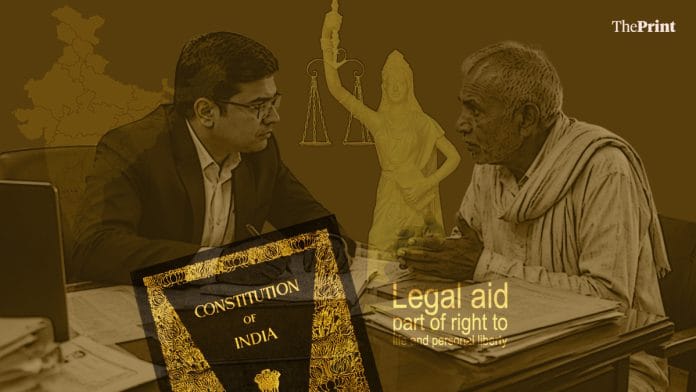
India is one of the few countries whose Constitution explicitly recognises legal aid as part of the right to life and personal liberty.
Critics say that for much of the country’s history, the promise existed largely on paper. Free legal services came from a patchwork of legal-aid societies and occasional pro bono lawyers.
Parliament attempted to fill that gap through the Legal Services Authorities Act of 1987, which established the framework for a nationwide legal aid system. When the NALSA became operational in 1995, its principal tool was a panel of lawyers willing to represent indigent defendants.
The arrangement solved one problem: there was always someone theoretically available to represent poor defendants. But critics argued the promise was largely honoured in the breach.
“Panel lawyers had no bar on private practice,” said Madan Kurhe, a former Pune LADC. “So lawyers on the legal aid panel system were not interested in doing legal aid work seriously or dedicatedly.”
Yadav puts it more bluntly: “They would leave court and go to their private cases. People in custody wouldn’t get proper representation.”
As the shortcomings of the panel system mounted, NALSA began looking for alternatives. After a trial in a dozen districts in 2020, the scheme began a national rollout towards the end of 2022. LADCs have been hired on full-time contracts, forbidden from private practice, and tasked solely with criminal defence.
According to official data, since the scheme’s rollout, LADCs have been assigned 1.26 million criminal cases nationwide. By September 2025, they had disposed of almost 800,000 cases.
NALSA’s statistics reveal that in each quarter of 2025, LADCs were involved in over 40,000 bail matters that were disposed of.
Quietly, India has spent three years attempting to build a public defender system for its poorest defendants.
The first line of defence
In the days of the panel system, a defendant might not meet their assigned lawyer until they had been remanded and spent weeks in jail. These days, their first glimpse of an LADC is usually the moment they are hauled into a district courtroom by the police.
Tanvi Sharma spends much of her time dealing with those moments. The new complex, with its high-vaulted lobby and modernist facade, feels worlds away from Tis Hazari. Inside the spacious courtrooms, however, the reality of India’s justice system reasserts itself; stacks of files are steadily colonising every inch of space.
Multiple times a day, Sharma is summoned to court when a newly arrested defendant is produced before a magistrate. Sometimes, she is mid-argument when constables escort arrestees in.
On one afternoon while ThePrint accompanied Sharma, court staff alerted her to two newly arrested men who had just been produced before a magistrate. As she spoke to them, she noticed fresh injuries on their bodies. They told her they had been beaten by the police and forced to sign blank confessions.
Sharma immediately requested a medico-legal examination, which confirmed the injuries were recent. Armed with that finding, she argued that the arrests had been conducted illegally and sought their release.
The magistrate agreed and ordered their release. Within an hour of entering the courtroom, the two men were free to leave.
Those who do not encounter an LADC in court usually find one in prison shortly afterwards. As panel lawyers are moved off criminal defence, jail visits have increasingly fallen to LADCs.
“My first duty was jail visits for the first month,” recalls Ridam Arsh, an Assistant LADC at the Karkardooma Courts in East Delhi. “I went to jail for 20 days in a row. I had to interact with inmates for four hours every day.”
According to the National Crime Records Bureau’s Prison Statistics Reports, almost three in four of India’s 510,000 prisoners are undertrials. Delhi’s jails are the most crowded in the country; the infamous Tihar complex houses roughly twice its capacity.
For many undertrials, bail is a simple application away—but nobody ever told them how to access legal help. The LADC frequently becomes their only reliable point of contact with the justice system and outside world.
“We are a link between the accused, the courts, the families… everyone,” said Arsh. “Sometimes even their family members abandon them. They don’t support them. We have to represent them no matter what.”
One of Sharma’s clients had been incarcerated since April. He had never applied for bail because he did not know he was entitled to free legal representation. His case eventually found its way to the LADC office, where Sharma began preparing a bail application.
“Know what he’s accused of? Stealing 50 rupees,” said Sharma.
Elsewhere in the courthouse, defendants who had already secured bail orders remained in prison because they could not satisfy the conditions required for release.
“The people behind bars are usually very poor,” said Sharma. “Sometimes they can’t even give surety to get released on bail.”
Sharma places these matters before the magistrate, arguing that her clients should instead be released on personal bonds. Each application is granted; a handful of people soon walk out of prison.
According to many LADCs, one key goal of the system is to reduce the number of incarcerated undertrials. NALSA’s online LADC dashboard shows that most of an LADC’s caseload consists of bail and remand work.
But a bail order is not an acquittal. Every undertrial will still have their day in court. The other half of an LADC’s work involves the trials themselves.
The criminal defence playbook
At Tis Hazari, an LADC is in a quandary. Sitting in the new LADC office, on a chair with the plastic wrapping still on, he is reviewing grainy CCTV footage frame by frame. On a deserted road, two men on a bike cut off a lone traveller and robbed him at knifepoint. They are the defendants in one of his cases.
“Their faces are right at the camera,” he laments.
In open-and-shut cases, the best option is often to convince defendants to plead guilty. The LADC can then argue that the months already spent in prison suffice as punishment, given the low value of the theft and lack of injury.
As the footage scrolls forward, the LADC points out the robbers briefly returning to the victim. “They came back, returned his phone and bike keys,” he notes wryly. “That will help.”
But outright guilty pleas remain rare in India, even though plea bargaining is formally recognised.
In practice, LADCs describe most cases as falling into one of two categories: defendants who are clearly innocent, and defendants whose guilt is difficult for the prosecution to prove.
LADCs allege the former are often pulled in by police looking to close unresolved cases, charged with offences like petty theft or illegal knife possession under the Arms Act.
“The police sometimes falsely charge innocent persons in order to discharge their pendency of untraced or unidentified accused,” Yadav says.
On that busy Tuesday at Tis Hazari, Yadav represented two fruit vendors accused under Section 354 of the IPC, which deals with assaulting a woman.
Her reading of the case diary suggested a different story.
According to eyewitnesses, the pair had attempted to intervene in a dispute between a married couple and a belligerent e-rickshaw driver. When police later failed to locate the driver, they instead charged her clients.
She argued as much before the judge, who gave the prosecution until August to decide whether it wished to oppose their discharge.
Pulling the prosecutor aside on her way out, Yadav chided him for hauling the pair into court in the first place. He was unmoved.
“Okay,” Yadav replied. “Go ahead and oppose. I’ll appeal, and I’ll get my discharge.”
Many cases turn not on innocence but on weaknesses in the prosecution’s evidence.
“It’s more about the prosecution being shoddy about what they file in court,” Sharma says. “There should be at least one point that makes them acquit this particular accused.”
LADCs routinely attack procedural errors, gaps in the chain of custody, forensic evidence, or the authenticity of video footage.
“They’re overburdened too,” says Yadav of the police. “So they might write their report only 10 days after the crime. But that’s against procedure.”
Technical questions of law can also become battlegrounds.
“In one of my cases, the defendant bit someone during a fight, with his teeth,” says Yadav. The man was charged under Section 118 of the BNS, which deals with causing deadly harm using an “instrument”.
“Are his teeth an instrument?” she asks incredulously. The trial judge believes so. Yadav disagrees and is researching precedent to persuade him otherwise.
“One loophole is enough,” says Sharma. “The burden of proof is on the prosecution to prove their case beyond reasonable doubt.”
To her, the job is about creating that reasonable doubt. “We are not judges. We’re representing our clients.”
As the old lawyer’s adage goes: when you have the facts, argue the facts. When you have the law, argue the law. The approach can be remarkably effective. In less than two years, Sharma says she has secured more than 100 acquittals and over 120 bail orders.
Not every case is so morally clear. LADCs are exposed to disturbing incidents of assault, domestic violence, and worse. At Tis Hazari, Yadav recently had to watch CCTV footage of a brutal murder with the defendant plainly visible.
“The case is sometimes so gruesome that you don’t want to represent them,” admits Arsh. “But you have to; it’s your job. Somebody has to be there for these people as well.”
Why become an LADC?
What attracts people to become LADCs varies.
For some, it is the pay. Assistant LADCs, who are sometimes hired straight out of law school, earn Rs 45,000 a month.
“Freshers, first-generation lawyers are getting only Rs 10,000-15,000 a month in chambers,” said Yadav, referring to the common practice of spending a year or three assisting a senior lawyer. “The pay is fair.”
For others, the economics were never an attraction. Sharma spent six years building an independent civil and commercial practice that was considerably more lucrative than her current salary.
To many LADCs, the main lure is experience.
Junior lawyers working under seniors often handle only fragments of a case—research, precedent searches, and paperwork. The most consequential work remains the preserve of senior advocates.
An LADC has no such safety net. “This is a scheme in which you have to frame charges, make arguments on discharge, do the trial yourself, review the evidence, conduct cross-examinations, make final arguments on your own,” said Yadav. “Nobody is going to spoonfeed me.”
For some, the job is, at its heart, a calling. Kurhe says he became interested in legal aid while still in law school after reading about the shortcomings of India’s existing system. When the first recruitment notices appeared, he applied immediately.
“You have to be committed to the Constitution,” he said. “You have to understand that free legal aid is part of Article 21.”
Many also see the scheme as a rare opportunity to enter parts of the profession that can otherwise be difficult to access.
“Women do not get to be criminal defence lawyers in this country,” said Sharma. “In the corridors of criminal justice, all you encounter is men.”
Bar Council of India data from six states showed in 2023 that five in six Indian lawyers are men. In Sharma’s view, becoming an LADC is one of the few ways for women to break into criminal defence work and build a reputation of their own.
Heavy caseloads
LADCs say the sheer volume of work is heavy.
A single LADC is expected to handle more than 200 matters at once; according to LADCs ThePrint spoke with, carrying 250 matters is not uncommon.
Most handle every stage of a case themselves: researching the law, preparing applications, drafting arguments, conducting cross-examinations, and making final submissions. They do this while juggling multiple court appearances, jail visits, and newly assigned matters.
Many take work home, reading case files and researching legal questions well past their official hours.
“Sometimes two to three weeks at a go without even a single break, without even Sundays,” says Yadav.
Every LADC develops their own way of coping. At Tis Hazari, Yadav maintains a meticulous calendar of appearances in both a diary and a smartphone app. Throughout the day, her eyes dart to her phone as messages from court staff alert her when her matters are about to be called.
“You have to develop a support system among the court staff,” says Sharma, who relies on a similar network at Saket, where the court staff themselves juggle hundreds of files each, as an investigation by ThePrint revealed in January.
The constant stream of appearances leaves little time for preparation.
Bail applications, cross-examinations, and final arguments require careful study of case files and lengthy chargesheets. Yadav’s constant companion is a thick binder of reading material, which she flips through whenever she finds a spare moment.
“It’s difficult for us to represent them properly, examine every witness, plan a proper strategy,” she says. “That doesn’t really happen due to workload.”
For defendants, time pressures can have serious consequences.
In one case, Yadav realised too late that the school her client was accused of robbing had CCTV cameras. “If I had got the file earlier, I could have made the school a party and shown the CCTV footage in court,” she says.
The workload is also unevenly distributed. West district, based out of Tis Hazari, has four Assistant LADCs spread across 27 magistrate courts. South district, based in Saket, has six for roughly 30 courts. Meanwhile, North-East district at Karkardooma has six serving only 10 courts.
Because LADCs are contracted to specific districts, there is no mechanism to transfer lawyers to busier jurisdictions where they are needed.
Understaffing remains a problem as well.
Private criminal lawyers rely on a small army of assistants, interns, and junior advocates to conduct research, draft briefs, and handle routine filings. A lawyer at Tis Hazari told ThePrint that he has at least three assistants working on every single criminal defence case.
According to NALSA’s own dashboard, fewer than 2,000 support staff are spread across the system nationwide, less than three per LADC office on average.
“We are managing,” says Yadav with a weary laugh, her exuberance finally flagging after a dozen court appearances. “We don’t have any other choice.”
At Tis Hazari, her day is finally drawing to a close. The afternoon’s hearings have bled into the evening. A pile of files still sits on her desk waiting to be reviewed before tomorrow. Somewhere in Tihar’s packed cells, a prisoner is waiting for bail. In another courtroom, a trial has been adjourned to a new date, pencilled into an already crowded diary.
But clocking out doesn’t mean the work is over. Yadav will spend the evening poring over tomorrow’s cases. Sharma will be writing arguments in defence of her clients. Many LADCs will remain on call through the night for late arrests, some appearing on video chat at two or three in the morning.
Three years after its nationwide rollout, the LADC scheme remains a work in progress. Even its strongest supporters do not claim it has solved India’s criminal justice crisis.
Courts remain clogged, prisons overcrowded. The lawyers tasked with defending the poor are often stretched to their limits.
Still, supporters of the scheme say something has changed.
Every day, hundreds of arrestees are brought before courts and thrust into the criminal justice system. Today, they have someone on their side from that very moment.
Whether that experiment survives remains unclear. NALSA’s review is ongoing, recruitment has been frozen, and many LADCs still do not know whether they will have jobs a year from now.
For Yadav, the clearest evidence of change is public perception.
“Before the scheme came, people had this perception that legal aid counsels would stand in court, take another date, and leave,” she says. “People who have got representation have restored their faith in the legal aid system.”
She pauses.
“People now feel that even a government lawyer can bring you justice.”
Then her phone lights up with a message. Gathering her files, she disappears into the bustling corridors of Tis Hazari.
As usual, she was due in another courtroom in 15 minutes.
(Edited by Sugita Katyal)
Also Read: After TDP, ally JSP plans membership drive, offers card-carrying members accidental cover, legal aid