



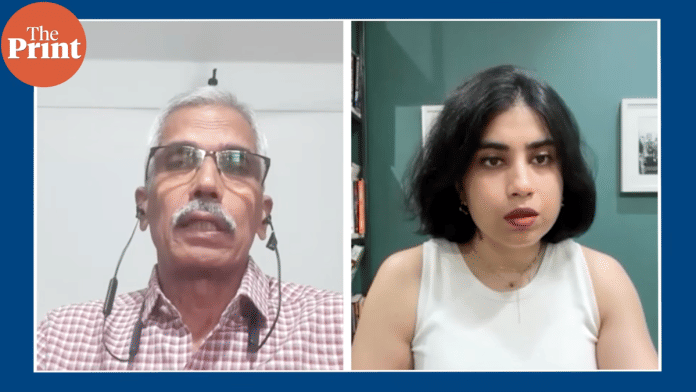

New Delhi: The idea behind some of the questions in the 40 notified by the Ministry of Home Affairs last week seems to be to collect information for a National Population Register, former Deputy Registrar General of India K. Narayanan Unni told ThePrint in an interview.
“There are a number of new questions—names, names or particulars of parents, parents’ address. These are not going to give you any data, because you’re not going to tabulate how many people have the same surname. So, that’s not going to come out of the census… So what I can visualise is that the idea behind this is to get this information to use for the National Population Register,” Unni, who was also a member of the Technical Advisory Committee for the 2011 and 2021 census exercise, said.
In March this year, Registrar General of India Mrityunjay Kumar Narayan had clarified that no decision had been taken on the updation of the National Population Register. This was before the first phase of the exercise began on 1 April.
The second phase of the census exercise is set to begin next month. Among other things, the new questions included in the list include spouse name, nationality as declared, parents’ names, SC/ST/Caste, literacy/digital literacy, highest educational level attained and stream/discipline, place of Covid-19 vaccination, total number of bank accounts, mobile number (if available), Aadhaar number (if available), voter ID number (if available), passport number (if Indian passport holder), and availability of driving licence.
The Citizenship (Registration of Citizens and Issue of National Identity Cards) Rules, 2003 provide for a National Register of Indian citizens, defined as the register containing details of persons usually residing in a village or rural area or town or ward or demarcated area within a ward in a town or urban area.
Unni says that the issue of NPR was also discussed by the Technical Advisory Committee for the 2021 census.
“The committee members generally felt that it should not be part of the census at all. If at all it is necessary to canvass the data, it can be done in the first phase of the census, as was done in 2011. That is also if it is extremely necessary. The general feeling was it should not become part of the census at all,” he said.
The NPR conundrum
NPR was first initiated alongside the house-listing phase of the 2011 Census, and was subsequently updated in 2015. While there was discussion to undertake NPR exercise along with the houselisting phase of the 2021 Census, the process did not take off due to the Covid-19 pandemic.
However, the furore over the contentious Citizenship Amendment Act in 2019-2020 had given way to concerns that the NPR exercise might be a precursor to a nationwide NRC (National Register of Citizens) exercise.
Rule 3 of the 2003 Rules talks about a National Register of Indian Citizens. Subclause 4 of this rule says that the central government may “decide the date by which the Population Register shall be prepared by collecting information relating to all persons who are usually residing within the jurisdiction of local registrar”. These rules, therefore, link the population register with the NRC exercise.
While Home Minister Amit Shah had clarified in 2019 that the NPR is not linked to the NRC in any way, state governments and civil rights activists had raised alarm over an NPR, alleging that it may target vulnerable citizens and minorities.
Unni explains that as per the definition of census, it is an activity for collection of data on the population.
“The whole idea is not to identify an individual and get this specific information, separately… When it comes to NPR, the whole thing changes. You need specific information with respect to names, addresses, relationships for NPR. In a census, the name is only just a placeholder… In fact, the databases which have been created from the previous censuses, we do not have the name. The name was there in the schedule, but is not entered into the database because that is immaterial,” he says.
“Names have never been part of the census database. When it comes to an NPR, you not only need names, you need the correct spellings, whatever language it is written in… if any small mistake comes in the database, it makes a lot of difference because this goes to a legal record. NPR becomes a legal record,” he added.
Unni further explained that the training necessary for those undertaking the exercise would also be different, because for an NPR, the focus is on the exactness of the spellings and exactness of the information collected. As compared to this, in a census, you don’t need the names as exactly.
‘Foolish’ to expect too much
On caste census, Unni told ThePrint that it would be “foolish” to expect too much from this census exercise.
Highlighting the concerns that may arise in terms of a caste census, Unni said, “The caste data is being collected after a long long period… The difficulties have only increased now. The number of people moving across states used to be very few… Today, thousands of people move across states. And when I say a caste name from a faraway place, the enumerator may not even recognise what that caste is.”
The difficulty, he also said, emerges from what a person perceives as a caste name.
“Many people will tell you the sub caste names… So that makes it difficult,” he said, adding, “what I feel is that technically, if you want to perfect this methodology of data collection of caste, it will take more than one census. So we should not expect too much from the caste census this time. That would be foolish.”
(Edited by Viny Mishra)
Also read: Who wants caste census—PM Modi, Rahul, Akhilesh? Everyone and none