




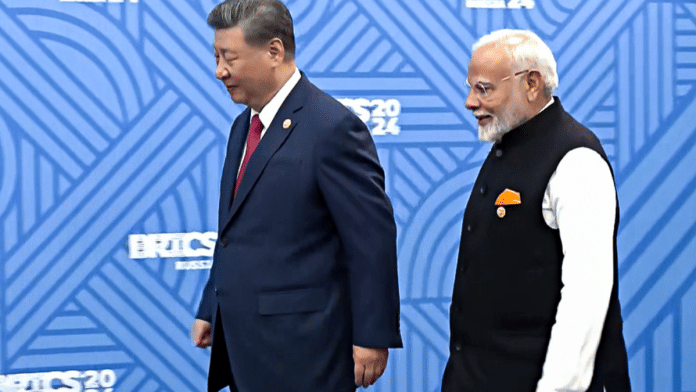

Chinese President Xi Jinping is most likely to travel to New Delhi to attend the 18th BRICS Summit on 12 and 13 September, marking his first trip to India in seven years. Chinese commentary, ahead of the summit, sheds light on Beijing’s assessment of India’s BRICS chairmanship, its strategic positioning, and the prospects for India-China engagement.
For Chinese observers, the summit is important because it marks the 20th anniversary of BRICS and comes amid geopolitical uncertainty and growing disorder in global governance. Wang Youming, a researcher at the China Institute of International Studies, argued that the summit will allow BRICS members to demonstrate their capacity and direction for reshaping the international order. For India, he suggested, it also offers an opportunity to expand its diplomatic role in the Global South amid cooling relations with the US.
Other Chinese commentary has focused more directly on India’s diplomatic manoeuvring ahead of the summit. A Sohu commentary described New Delhi as building a series of leverage points by strengthening energy ties with Russia, addressing border issues with China, attracting technology and investment from Japan, and drawing capital from Canada and the US. The question, it suggested, is whether these efforts will translate into tangible outcomes at the BRICS summit.
This emphasis on India’s balancing act also appears in another commentary, which contrasted India’s perceived failure to host the long-awaited Quad summit with its success in hosting the BRICS Leaders’ Meeting. The commentary portrayed this contrast as instructive of India’s position in the global order: while it may enjoy a prominent role within BRICS, it remains, in the commentator’s words, “at someone else’s dinner party”, ultimately a guest who can be asked to leave at any time.
Another commentary took this argument further, claiming that “whoever holds the power to decide the agenda is the true host”, while portraying India as a country that has been “brought in”. In this reading, India’s opportunity to host the BRICS summit is evidence that the grouping represents its “true home turf”, particularly after the failure to hold the Quad summit.
India is hedging between competing powers
This scepticism extends to India’s ambitions within BRICS. A Baijiahao commentator argued that India is using its chairmanship to advance strategic autonomy and strengthen its Global South role without turning BRICS into an explicitly anti-Western bloc. Its proposal to promote interoperability among BRICS central bank digital currencies was presented as a way to reduce reliance on the dollar and SWIFT while supporting rupee internationalisation.
Another commentary characterised India’s approach as multi-directional hedging. Closer ties with the US, it argued, allow India to leverage American technology and capital while containing China; closer ties with China and Russia, meanwhile, prevent Washington from using India as a pawn and help New Delhi maintain its standing among Global South countries. The commentary suggested that India’s approach to hosting the summit is highly calculated, as it seeks to reinforce its position as a leader of the Global South while using the BRICS platform to address domestic economic pressures, including rupee depreciation and the trade deficit.
Yet Chinese observers also question how far India is willing to take this agenda. Victor Gao, Chair Professor at Soochow University and Deputy Director of the Center for China and Globalization, lamented that India faces several deep-rooted problems, some of which, he suggested, India itself is not fully aware of. Another commentary characterised India’s position as one of participating in “low-risk de-dollarisation cooperation while rejecting systemic restructuring that would require sharing costs”.
Xie Chao, an associate research fellow at Fudan University’s Center for South Asian Studies, offers a possible explanation for this cautious approach. He argues that India’s earlier reluctance toward BRICS monetary cooperation was aimed at avoiding being seen by the US as a promoter of de-dollarisation. With US-India relations deteriorating, however, Xie suggests that New Delhi is beginning to shift its position. Its consideration of linking central bank digital currencies, he argues, reflects an effort to use the collective weight of BRICS to signal a new stance towards Washington by promoting wider international use of the rupee while avoiding measures that could invite further US trade and diplomatic pressure.
India’s challenge, according to Chinese commentary, is compounded by the difficulty of coordinating the expanded 11-member grouping. The failure to issue a joint communiqué at the May foreign ministers’ meeting was cited as evidence of these coordination problems, alongside growing China-India competition within BRICS.
One headline went further, claiming that “Indian Prime Minister Modi has already taken sides” and arguing that, whether within BRICS or the SCO, he no longer stands with the majority of developing countries against the US.
Also read: Lines on a map won’t resolve the India-China conflict. It began as a Cold War contest
Can India-China tensions be kept out of BRICS?
The same tension appears in Chinese assessments of India’s engagement with China. A Chinese commentator described India’s approach as “two-faced diplomacy”, pointing to the contrast between its territorial dispute with China and its continued high-level engagement. The commentator highlighted National Security Advisor Ajit Doval’s 25 August visit to Beijing for the special representative talks. It also noted the relative quiet in India’s political and media discourse over Xi’s upcoming visit compared with previous rounds of high-level India-China dialogue.
The implication is that India does not want bilateral distrust with China to overshadow the BRICS summit in New Delhi. For another commentator, this engagement is directly linked to India’s BRICS ambitions. As the 2026 chair, India’s greater concern, it argued, is the possibility that the summit will be overshadowed or ignored. In this telling, Doval’s Beijing visit was aimed at securing China’s cooperation and preventing the summit from becoming dominated by the India-China border dispute.
Chinese commentary is portraying India’s BRICS strategy as an exercise in balancing rather than issue-based alignment. Beijing appears to view the summit as a platform India is using to strengthen its position in the Global South and pursue strategic autonomy, but also as a test of whether New Delhi can reconcile its competing relationships with China, Russia and the US.
For India, however, participation in multiple and sometimes competing platforms is central to its strategy of multialignment and strategic autonomy. What Chinese observers interpret as hedging or inconsistency, New Delhi views as essential to preserving strategic space across different groupings.
Sana Hashmi, PhD, is a fellow at the Taiwan-Asia Exchange Foundation. She tweets @sanahashmi1. Views are personal.
(Edited by Saptak Datta)