



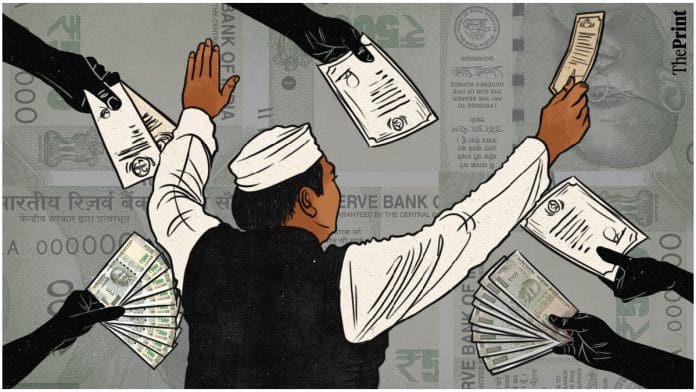
New Delhi: Electoral donations of over Rs 10,000 crore between 2022 and 2024, up from Rs 4.37 crore in 2015-16—the audit and contribution reports of several unknown political parties in India have increasingly exceeded donations even to national parties in the country.
In fact, just 5 unrecognised political parties in Gujarat, together reported an income of Rs 2,316 crore between 2019 and 2024.
These unknown parties are called Registered Unrecognised Political Parties or RUPPs. A RUPP is a party that is formally registered with the Election Commission of India (ECI) but does not qualify for the status of a recognised state party or national party.
These parties, like other political parties, enjoy income tax exemptions. And that’s where the gap lies. As per an October 2025 notification by the ECI, there are over 2,000 such parties registered with the ECI.
Over the years, the ECI has attempted to reign them in, by “delisting” parties that failed to fulfill the essential condition of contesting even a single election in the last six years, and whose offices could not be physically located.
After the delisting, ECI also refers these cases to the Central Board of Direct Taxes (CBDT) to investigate the tax exemption claims by such parties. However, despite continued media scrutiny as well as delisting, the opacity around the finances of RUPPs has persisted due to low compliance with the requirement to file audit and contribution statements, and the lack of power to actually “deregister” such parties.
Former Chief Election Commission S. Y. Quraishi says that the concept of RUPPs has existed for several years now.
“But we have no way to track what they are getting, how much money they are earning. They are supposed to submit their returns, but even if they don’t, we can’t do anything because we have no power to deregister them. This was an old 2002 decision of the Supreme Court saying the ECI cannot deregister parties,” he explains.
Quraishi asserts that the government should have brought in a law allowing the ECI to deregister parties.
The ECI has “delisted” several such RUPPs over the years, taking such parties off the register containing a list of such unrecognised parties. But Quraishi questions the impact such delisting may have.
“There is no such term called ‘delisting’ in the Rules. About 4-5 years ago, because of so much public hue and cry, they said they were delisting such parties, but that, according to me, means nothing. It does not amount to deregistering,” he says. “We should be able to deregister them but we cannot. We know they are collecting money but what can we do?” he asks.
Anjali Bhardwaj, co-convener of the National Campaign for People’s Right to Information, pointed out that another way in which corruption can happen is with registration as a political party.
“It can be a way for money laundering, including through the use of shell companies. There is massive potential for corruption of different kinds,” she explains.
The questions that arise, according to her, are: “What are the regulators doing? What are agencies like the Lokpal, ED and CBI doing?”
“These political parties are clearly filing their income tax returns. They are submitting their reports to the Election Commission. They are, after all, registered political parties. If journalists can see this, if citizens can see that there is a cause for concern, what are the regulators doing?” Bhardwaj, who is also the founding member of Satark Nagrik Sangathan, asked. “Why is there no scrutiny of the kind of money that they are amassing and their political footprint, which is apparently disproportionate?”
Unrecognised versus recognised parties
Quraishi points out that it is “easy” to register as a political party. Earlier it needed 30 persons, now it needs an association of at least 100 registered electors as members.
“It is very, very easy. Registered parties then contest elections and on the basis of their electoral performance, they are recognised as a national party or a regional party,” he explains.
A party becomes a recognised state party if it meets specific voting thresholds—securing at least 6 percent valid votes in an Assembly election, and winning at least two seats in the same Legislative Assembly, or winning 3 percent of the total seats in the Assembly.
For national party recognition, a party needs to secure 6 percent vote share in four or more states during Lok Sabha polls, and win at least four seats in the Lok Sabha or win 2 percent of total Lok Sabha seats from three different states.
Currently, there are six national parties and 60 regional or state parties.
Section 29C of the Representation of People Act 1951 requires all political parties to furnish their contribution reports as prescribed under the Conduct of Election Rules 1961. Such contributions received by the parties are also 100 percent exempt from Income Tax as an incentive to the parties.
Section 29A(9) mandates every political party to communicate any change in its name, head office, office bearers, address, PAN number to the ECI without delay.
Political parties are also mandated to furnish their annual audit statements to the ECI, and are under a statutory obligation to furnish a return of income for each assessment year to be eligible for exemption from income-tax.
According to the guidelines on ‘Transparency and Accountability in party funds and election expenditure’, as published by the ECI in August 2014, all unrecognised parties have to file audit reports, contribution reports and election expenditure statements with the Chief Election Officers of their respective states.
However, RUPPs often fail to file their returns. For instance, a report by the Association of Democratic Reforms (ADR), published in July last year, said that in 2019-20, 219 RUPPs claimed tax exemptions worth Rs 608 crore, but 66 of them did not submit mandatory contribution reports. It also claimed that as per ECI data, only 5 percent RUPPs submitted donation reports between 2013 and 2016.
As per guidelines for registration of political parties, if a party does not contest elections continuously for six years, the party shall be taken off the list of registered parties.
Thousands of crores without electoral support
It has been seen through consecutive ECI records that RUPPs have amassed considerable wealth over the years, while displaying little to no electoral support on the ground.
An ADR report, dated 18 July 2025, recognised the top 10 RUPPs that declared their income from FY 2019-20 to FY 2023-24, and found that Gujarat-based parties alone account for 73.22 percent (Rs 1158.1154 crore) of the top 10 parties’ declared income of Rs 1581.7517 crore between FY 19-20 and FY 23-24.
Bharatiya National Janata Dal, registered in Gujarat in February 2009, declared the highest total income of Rs 957.4454 crore (31.76 percent of total) between FY 2019-20 and 2023-24. Of the top 5 parties in this list, three—Bharatiya National Janata Dal, New India United Party, Satyawadi Rakshak Party—were registered in Gujarat.
Of the top ten, five were registered in Gujarat, two in Bihar, two in Haryana and one in Delhi.
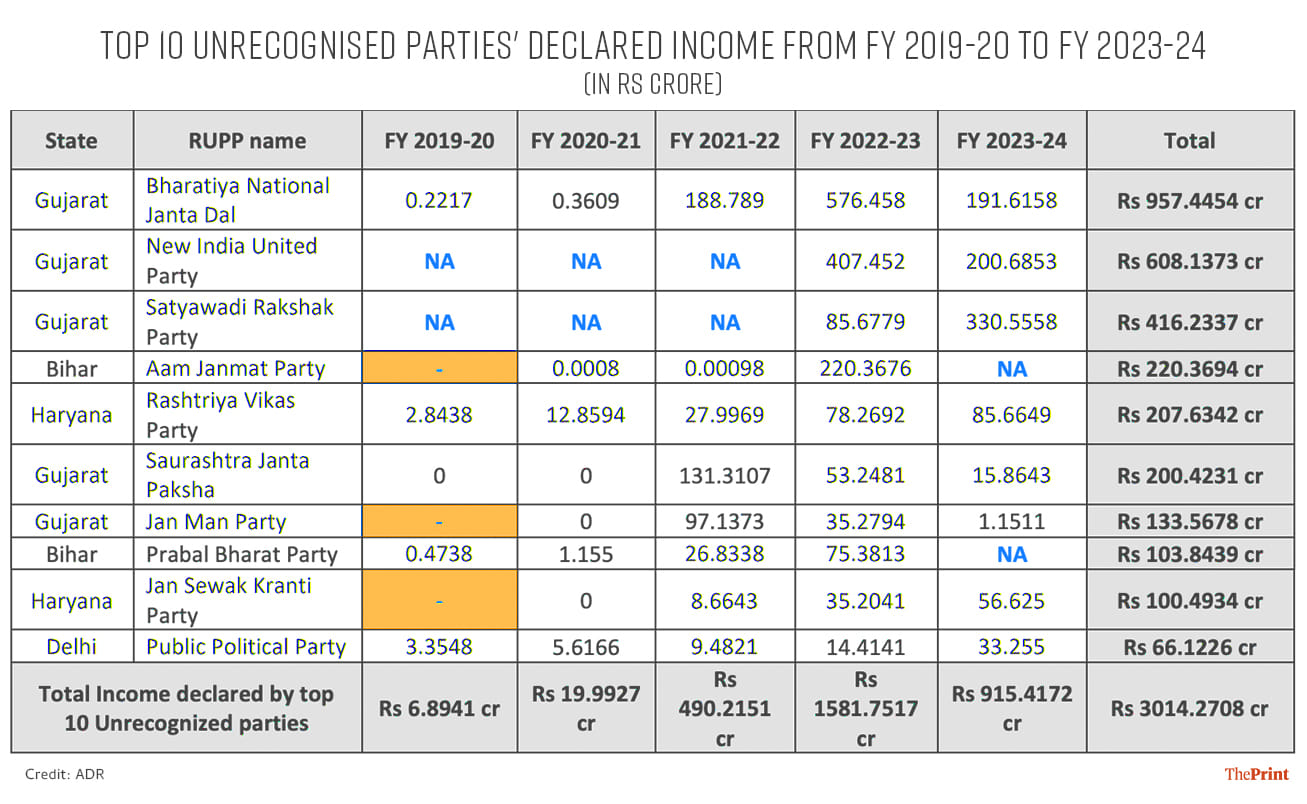
The ADR report had noted that there was a dramatic increase in declared income of RUPPs starting from FY 2021-22 (Rs 490.2151 crore), which then rose by 223 percent in FY 2022-23 (Rs 1581.7517 crore), and remained high in FY 2023-24 (Rs 915.4172 crore).
As per a report in The Hindu Businessline in November 2025, the CBDT had even unearthed an organised network involving RUPPs, chartered accountants and intermediaries engaged in laundering money worth Rs 9,169 crore, by getting tax exemptions for political donations to these RUPPs.
In December 2025, a PIB release also said that fake donation claims to political parties were under the tax scanner, and said that “huge amounts of bogus claims have been made on account of donation” to RUPPs.
The crackdown
Back in December 2016, the Indian Express had conducted an investigation of political parties delisted by the ECI following a review, finding that many of these parties only existed on paper.
For instance, it had found that those behind the establishment of such parties included a homoeopathy practitioner based in a three-storey bungalow in Gurgaon, and another party was found to have the office of the J&K CID listed as its registered address. Another party had a lawyer’s chamber in Patiala House courts listed as its registered address, and the address of a fourth party was the residence of an employee of the Delhi Development Authority (DDA).
It was after this that the ECI decided to delist around 200 political parties and send their names to the CBDT. Officials suspected that these parties were money laundering operations, since they had not contested any election since 2005 and existed only on paper.
In 2022, the ECI initiated action for enforcing due compliances by RUPPs, under Sections 29A and 29C of the RP Act 1951. It had noted with concern that out of a total 2,796 RUPPs, over 92 percent RUPPs had not filed their Contribution Report in 2019. It had noted that 199 RUPPs had claimed Rs 445 crore IT exemption in 2018-19, and 219 RUPPs claimed Rs 608 crore IT exemption in 2019-20.
However, out of these 219, 66 RUPPs had claimed income tax exemption without submitting contribution reports in Form 24A as mandated under section 29C of the Act. And in 2019, out of 2,354 RUPPs only 623 contested elections
The ECI found 87 RUPPs were not even in existence. When physical inspection by the respective Chief Electoral Officers did not find these parties at their registered addresses, their names were deleted from the register of unrecognised registered political parties.
Since then, the ECI has done this delisting exercise several times. For instance, in June 2025, the ECI had started proceedings to delist 345 RUPPs, asserting that they had failed to fulfill the essential conditions required to continue as a registered state party.
The CEOs of respective states and UTs were asked to issue show-cause notices to these parties, giving them an opportunity for hearing, post which, it said, a decision would be taken by the ECI.
In August last year, 334 RUPPs were delisted, and in September 2025, another 474 RUPPS were delisted. In October, the commission once again notified a list of RUPPs, containing details of 2,049 such parties, and since then, it has continued to notify and add to this list.
‘The fountainhead of corruption’
Experts view political party funding as the source of opacity and corruption.
“It has been recognised very widely that political party funding has been the fountainhead of corruption in our country. The kind of data that came for electoral bonds made it very clear that there was a very large scale potential quid pro quo and extortion that was happening. It showed how political party funding can lead to corruption,” Anjali Bhardwaj told ThePrint.
Bhardwaj points out that there has been a longstanding demand to bring political parties under the purview of the Right to Information Act.
In June 2013, the Central Information Commission (CIC) declared six national political parties—the INC, BJP, CPI(M), CPI, NCP and BSP—to be “public authorities” under the RTI Act. What this meant is that political parties were, therefore, required to make disclosures and provide information under the law.
However, in March 2015, the CIC admitted that it was powerless to enforce its own ruling, calling it a case of “wilful non-compliance” by political parties. The ADR and RTI activist Subhash Chandra Agrawal then approached the Supreme Court in 2015, demanding that all the national and regional political parties be brought under the ambit of the RTI Act. This case is pending before the court.
Bhardwaj points out that political parties have neither got a stay from the courts, nor have they challenged the CIC order, so the order stands. But the parties, she says, are in “uncivil disobedience” of the order.
“There is a lot of public interest in people knowing about these political parties that claim to work for the public, that are collecting money from the public, and are, therefore, also in many ways, substantially financed by taxpayers’ money because they are getting income tax benefits and exemptions and other kinds of benefits. All of them should be under the RTI law so that people, citizens, can also monitor them,” she asserts.
(Edited by Viny Mishra)
Also read: Priyank Kharge is right about RSS transparency. He should ask the same of political parties