




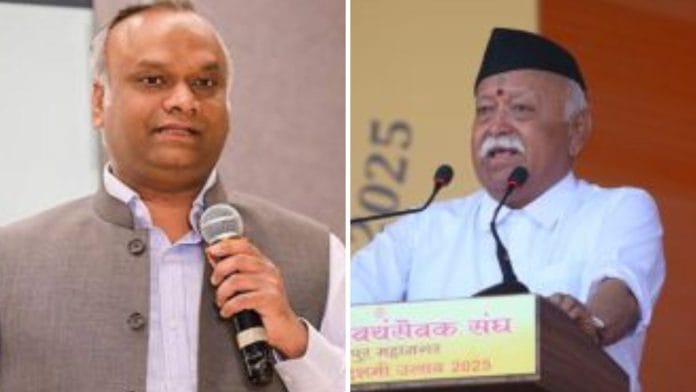

Karnataka Home Minister Priyank Kharge has written an open letter to RSS chief Mohan Bhagwat. Citing extensive figures about the RSS’s diverse activities, he questioned how an organisation conducting public activities on such a large and regular scale could be described as a private or informal entity. Since the RSS is not registered anywhere in official government records, questions arise regarding its legal status, financial transparency, tax accountability, and compliance with laws.
Kharge has asked the RSS to publicly release the following information: sources of donations, contributions and income; details of expenditure and assets; and whether applicable taxes are paid in accordance with the law.
“An organisation that regularly evokes nationalism, discipline and duty must also demonstrate these values through transparency, compliance and respect for the Constitution of India. The RSS cannot ask ordinary Indians to follow rules while exempting itself from the same standards. If workers, small associations, religious institutions, NGOs, trusts, companies and citizens are expected to register, disclose, audit and pay taxes, then the RSS too must set an example by abiding by the rules of the land,” Kharge wrote in his letter to Bhagwat.
Kharge’s questions are valid and deserve answers. However, what is interesting is that most of these questions also apply to political parties.
Also read: Why Dalit HM Priyank Kharge concerned about RSS functioning? asks BJP MP
What about political parties?
On one hand, even a small shopkeeper is required to account for every rupee of income. Yet within the same system, how is it that political parties enjoy the freedom to receive invisible domestic and foreign funds without ever having to account for them? This is a serious question.
To borrow George Orwell’s language, in India all are equal before the law, but political parties—and the RSS—are more equal than others. When even large deposits into an ordinary citizen’s bank account attract scrutiny, it is absurd that political parties can conduct transactions worth crores and billions of rupees without any accountability.
Political parties spend enormous sums in elections, from local contests to national ones. Several parties spend hundreds of crores of rupees in a single election. Finance Minister Nirmala Sitharaman has remarked that the money spent by candidates during elections is not money they themselves possess. In other words, she is aware of the kind of money being used. Consider the amount of money political parties spend in contesting hundreds of seats and fighting elections. Is there no need even for constitutional institutions to know where such money comes from?
Remarkably, those in power appear to believe exactly that—and openly so. On 11 April 2019, the Union government officially argued before the Supreme Court that: “People do not need to know where political parties receive donations from”; “One must consider the realities of the time”; and “Transparency should not be turned into a mantra.”
These were official arguments advanced by the executive branch of the Government of India.
Also read: RSS-backed IAS institute has been quietly grooming ‘nationalist’ civil servants since 1986
Pathway to endless corruption
What do these statements really mean? Simply that political parties should be allowed to keep their financial arrangements hidden from public view. They should be free to engage in secret and unaccounted transactions and potentially serve unknown individuals, agencies, or interests from within India and abroad—and the public should not concern itself with the matter. Does one need to be a rocket scientist to understand the consequences of such a system?
These concerns have also been raised by the Election Commission of India. In an affidavit submitted to the Supreme Court on 25 March 2019, the ECI said that transparency regarding domestic and foreign donations received by political parties had declined. It further warned that changes introduced through the Finance Act of 2018 could enable foreign companies to influence Indian politics. Consider the significance of that warning.
The Election Commission also described the electoral bonds system as flawed because political parties were exempted from disclosing details of such donations. As a result, it became impossible to determine whether they had violated Section 29B of the Representation of the People Act, which prohibits political parties from accepting donations from government companies and foreign sources. If disclosure itself is not required, how can violations ever be detected?
The ECI had conveyed these concerns to the law ministry even before approaching the Supreme Court. It also objected to changes introduced through the Finance Act of 2016, which opened a route for foreign companies with substantial stakes in Indian firms to donate to political parties. According to the ECI, this effectively permitted political parties to receive unrestricted foreign funding.
If no one is required to account for any of this, then the system effectively grants political parties a pathway to endless corruption and monopoly power. They appear exempt from any meaningful financial transparency.
Also read: SC ruling on bonds good but transparency problem in election expenditure still untouched
From CIA to KGB
This situation did not arise accidentally. The tendency emerged soon after Independence. Parliamentary debates in 1956 already contained discussions about a political party receiving illegal funds from an important foreign country. Those in power were aware of it but remained inactive, allowing the problem to grow.
By the 1970s, prominent journalists such as Inder Malhotra and Raj Thapar had written about leading political figures receiving suitcases filled with currency notes.
Former US Ambassador to India Daniel Patrick Moynihan’s book A Dangerous Place (1978) mentions the CIA providing money to one of India’s major political leaders. Ironically, this information emerged from inquiries initiated by Moynihan himself when allegations surfaced that the CIA was funding opposition parties in India.
In 1990, reports from the Soviet Union claimed that its government regularly provided annual financial support to several political parties around the world, including one Indian party. When demands arose in India for an investigation, the party’s General Secretary responded that all political parties’ finances should be investigated if theirs were to be examined. The matter subsequently faded away.
Evidence of secret foreign funding of Indian political parties also emerged from The Mitrokhin Archives: The KGB and the World (2005). Written by a former KGB officer, the book was a severe indictment of India’s political system. Two chapters (pages 312–340) describe extensive KGB penetration of Indian politics and allege that individuals associated with several political parties were working on its behalf.
It is worth noting that India’s rulers never ordered any investigation into these claims, nor did any political party demand one. Why? The answer lies in the official argument presented before the Supreme Court on 11 April 2019: “Why do people need to know where political parties get their money from?”
Is it any surprise, then, that many parties have engaged in activities that compel them to remain silent about the activities of others? At most, they raise token objections. All political parties remain silent about this fundamental problem. Do they share an unspoken consensus to preserve their privileged arrangement, regardless of which party is in power?
What India must do
All this makes one thing clear: political parties in India appear exempt from financial accountability, taxation on income, and transparency. What kind of system is this? Generally speaking, only those things are concealed that cannot be justified openly—whether by the RSS, the BJP, or the Congress.
Therefore, if accountability, taxation, and transparency are truly important, political parties should be the first to demonstrate them. After all, they sit on top of the entire governing structure. Parliament and the executive are directly controlled by political parties.
These problems can be addressed.
First, India should study the best practices of established democracies and create a firm separation between party and state. At present, the two are intertwined in a manner resembling communist systems.
Second, political parties should be subjected to the same transparency and accountability standards regarding income and expenditure that apply to other institutions.
Third, Members of Parliament should be guaranteed genuine freedom to speak and participate in parliamentary proceedings according to their own judgement as representatives of the people, rather than being subjected to censorship in the name of party discipline, as occurred in communist countries. It should be remembered that the original spirit of the Constitution envisioned complete intellectual freedom for legislators. Political parties were not even mentioned in the Constitution.
Today, political parties stand above everything else, beyond financial accountability and public scrutiny, functioning almost as owners of MPs. As a result, the state increasingly risks becoming hostage to political parties, their managers, and their activists. The possible consequences can be understood by examining the experience of the Soviet Union.
Therefore, Priyank Kharge’s questions should not be confined to the RSS alone. India’s political parties have also acquired powers and privileges that would be difficult to imagine in Europe or the United States. Is that not equally worthy of scrutiny?
Shankar Sharan is a columnist and professor of political science. He tweets @hesivh. Views are personal.
(Edited by Prashant Dixit)