



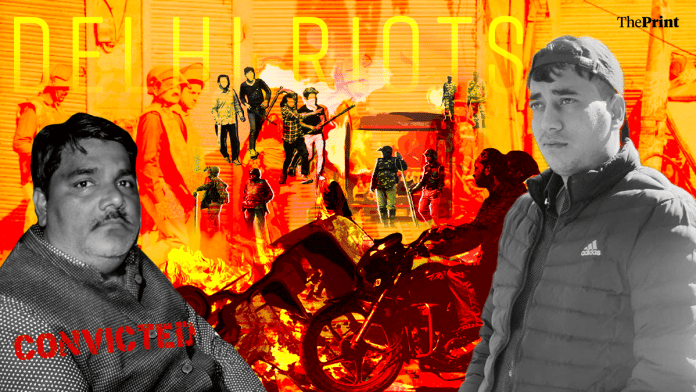
New Delhi: Ankur Sharma was on the roof of the family residence in Khajuri Khas when riots broke out in North East Delhi. He saw vehicles being torched and homes burnt but the sight seared into his memory is that of the mutilated body of his younger brother Ankit being recovered from a drain in Chand Bagh Pulia area.
Ankit, 26 at the time, was an officer with the Intelligence Bureau (IB).
“His eyes were popping out, face disfigured, neck slit with a knife, and face burnt with acid,” Ankur said. More than six years later, Ankur still finds it hard to believe this was the same neighbourhood he and his brother grew up in. “We played cricket on these streets. This was our mohalla, why would they kill him so brutally?”
Ankit’s body was recovered from a drain, barely 200-300 metres from his house, with 51 ante-mortem injuries. He was one of 53 killed in the riots. His killing found mention in Home Minister Amit Shah’s speech in Rajya Sabha on 12 March 2020. The government, said Shah, is “committed to bringing the perpetrators to justice irrespective of their religion, caste, creed or political affiliation”.
On Monday, a Delhi court convicted former Aam Aadmi Party (AAP) councillor Tahir Hussain and four others in Ankit Sharma’s killing, while also acquitting six others. The exhaustive 320-page court order found that not only was Tahir part of an unlawful assembly but he also instigated the mob that assaulted and killed Ankit before dumping his body in a drain in Chand Bagh Pulia area.
The court of Additional Sessions Judge Praveen Singh of the Karkardooma courts will proceed with the sentencing of the convicts from 23 July. For Ankit’s family, however, the verdict brings no celebration, just glimpses of the brutality he had to suffer. He was targeted because he was an IB officer and a Hindu, say family members who had to flee the neighbourhood to stay away from the media glare.
ThePrint traces the sequence of events surrounding IB staffer Ankit Sharma’s killing, the subsequent investigation and the family’s long road to justice.
Also Read: Riots changed Hindu-Muslim dynamics in NE Delhi. For some, it’s ‘hateful beyond repair’ now
A riot in the city
Ankit Sharma’s family migrated to Delhi about 20 years ago from Muzzafarnagar in Uttar Pradesh. His father was employed with the Ministry of Home Affairs (MHA). The family eventually laid down their roots in Khajuri Khas in North East Delhi.
“When we came to Delhi from a small city, we were excited. I was 8 and my brother was 7. We didn’t have a car, but roamed the city on a bike,” said Ankur.
Ankur then recalls how their neighbourhood plunged into chaos on 23 February 2020—a cloud of smoke hovering above, people being attacked indiscriminately, homes and shops set ablaze. Most residents had already fled, fearing for their safety, others locked themselves inside their homes.
“I was on the roof when my locality was burning. I was just sitting there and wondering about the safety of people, then I heard Ankit return home. It was around 4.30 PM. He had come back from the IB headquarters in Chankyapuri. My family was worried for him, so my mother Sudesh asked him if he was safe, but Ankit, during a brief conversation, told her he would have to leave to check what was unfolding in the neighbourhood,” Ankur told ThePrint.
Clutching her cell phone, their mother waited for Ankit to call and inform her that he was safe and on his way back home. The call never came.
When they did not hear from Ankit, mother Sudesh and father Ravinder checked with neighbours and nearby hospitals. Nothing came of it. They then lodged a missing persons complaint at Dayalpur police station. After returning home at around 1.30 AM, they decided to carry out a search in the area with the help of neighbours. They were then told that Ankit was dragged into Tahir Hussain’s camp office and that the then AAP councilor was responsible for their son’s death.
“We were told that Tahir and his men dragged my brother and two others to his office and killed him. The people also told us that they saw the men throwing the bodies in the drain,” said Ankur. At 7 AM the next day, the family went to Dayalpur police station again and requested the police to search the drain.
Ankur said a police party finally arrived at 10 AM and recovered Ankit’s mutilated body. “How can a human being be so cruel,” Ankur recalled asking himself.
‘Tahir instigated mob that killed Ankit’
After they recovered Ankit Sharma’s body from the drain, Delhi Police launched an investigation into the killing. As part of the probe, police personnel and Forensic Science Laboratory (FLS) experts inspected Tahir Hussain’s residential building on Main Karawal Nagar Road in Khajuri Khas on 28 February.
“A lot of debris and stones, bricks, broken bottles, some glass bottles with liquid, bullets and burnt articles were found lying scattered in front of Tahir Hussain’s house,” Delhi Police said in its investigation report. The report added that the residence “had been used by rioters/miscreants/accused persons for stone and brick pelting, hurling petrol bombs and acid bombs.”
Police also recovered petrol bombs, acid bombs, and a catapult on the third floor and the terrace of the building. Witnesses further testified that the mob used these weapons to target property owned by Hindus.
Further, according to the investigation report, Tahir conspired to kill Ankit as he was a “familiar face in the area”. Though he did not kill Ankit, the then AAP councillor “planned the murder and got it executed,” said police, adding that Tahir was constantly getting updates on the phone and his Call Detail Records (CDRs) show he was in the adjacent building when Ankit was killed.
An officer who probed the case had earlier told ThePrint that Tahir had instigated the mob, on 24 and 25 February, in Chand Bagh Pulia area.
During the course of the trial, the prosecution produced several “natural” witnesses whose presence near the crime scene was corroborated by their local business or residence. One of them was Priyanka Gaur, an advocate residing in the area. She testified to seeing Tahir instigate the mob to move towards the Dayalpur side.
Another witness was Vikalp Kochar, owner of the nearby Bunny Bakers which was looted and burnt. While he did not initially identify Tahir in the mob that gathered at the scene of crime between 3 PM and 6 PM, the court noted that Kochar’s testimony established the timeline and brutal nature of the killing of the “IB guy”.
The court also heard the testimonies of brothers Akash and Bharat, who said they were near Chand Bagh Pulia when they saw Tahir making inflammatory speeches—claiming Hindus had “vandalised and burnt Muslim houses and shops and had molested Muslim women”—exhorting the mob to “teach them a lesson”. Akash even testified to seeing Tahir holding a knife and participating in the assault.
Police witnesses Head Constables Rahul and Praveen Kumar, too, “deposed about the presence of an aggressive, communally charged, and heavily armed mob”.
The judgment noted that Pradeep Verma, Akash, Bharat, Vikalp and Priyanka, besides Head Constables Praveen and Rahul, “categorically deposed that they saw Tahir Hussain actively instigating the mob and upon his instigation, the rioting mob became more violent and killed Ankit Sharma” and “delivering inflammatory speeches and exhorting the mob to attack Hindus and their properties”.
Also Read: Delhi riots conspiracy case trial is caught in a loop—500+ dates, 160+ adjournments and counting
Ankit Sharma’s post-mortem report
Ankit Sharma’s post-mortem report revealed he was stabbed multiple times and sustained 51 ante-mortem injuries, including 13 “lacerated wounds”, mostly on his head and face.
“If a person has sustained a lacerated wound, it means he was hit by a blunt object forcefully which often first damages the skin tissues and then the muscle,” a forensic expert, who did not wish to be named, told ThePrint.
“These injuries too can leave an impact, leading to a depression on the flesh, but these are not stabs or cuts,” he added.
The post-mortem report also mentions that Ankit sustained seven “railway track contusions”, which were “red to purple” in colour and were 14×2 cm in size. These were mostly on his upper body and thighs. These, too, are injuries a person sustains when assaulted using a “cylindrical, elongated object”, said the forensic expert.
“These injuries, when inflicted, leave a blue, purple or red mark on the body. These are basically patterned contusions or in layman’s language they are called bruises,” he explained.
Apart from these injuries, Ankit also sustained four “contusion injuries”, five “L and V shaped contused lacerated wounds” and four sets of “multiple abrasions”. While most contusions were found on Ankit’s thighs, legs and shoulders, the contused lacerated wounds were concentrated on his face and head.
Long road to justice
In its verdict convicting Tahir and four others, the court said that “any prudent person, being a member of this assembly, would have known that as this unlawful assembly, which was heavily armed with dandas, stones, petrol bombs and swords etc. and was clashing continuously with a rival assembly, it was likely that in such clashes which were based upon communal hatred, it was likely that a person belonging to the opposite community could be killed in achieving the common object of causing damage to person and property of the members of the rival community”.
The court, therefore, held Tahir liable for murder (Section 302) and abduction (Section 365), even if he did not strike the fatal blow himself.
The court also noted how during the course of the trial none of the accused claimed that they were innocent bystanders or curious onlookers, or that they did not share the common object of the unlawful assembly.
“Even a suggestion on these lines was not given to any of the prosecution witnesses to at least indicate an intent to set up such a defence. On the contrary, by the nature of the assembly and the activities it was engaged in and the situation which existed at the relevant time, it is less than likely that any person who was a part of this assembly would have been a mere curious onlooker,” read the judgment.
“This was a lengthy trial. Eleven accused, more than 60 witnesses, and six years on,” Rajiv Mohan, counsel for Tahir Hussain, told ThePrint. “It is important to remember that the prosecution has to prove the case, and not that the defence has to prove their innocence,” he maintained. Mohan said when he began arguing the case, his key focus was discrepancies in registration of the FIR and the probe.
Delhi Police Commissioner Satish Golchha, who led the investigation into Delhi riots-related cases, told ThePrint that “every effort was made to collect credible evidence and bring those responsible before the law”.
“With the court delivering its judgment, I feel satisfied that hard work and professionalism of the investigating team stood the test of judicial scrutiny. We remain committed to bringing all those responsible for crimes committed during the 2020 riots to justice through due process of law,” he added.
Ankit’s brother Ankur said the judgment gave the family a sense of relief, but also brought back a “traumatising memory, that we hope nobody gets to live.” They now hope that justice will be brought to all those guilty of inciting the riots.
“We dealt with loss, anger, grief, and numbness for months, years. We didn’t miss any hearing. We fought hard for justice for my brother,” said Ankur. “It was long overdue, but finally, we have been heard.”
Also Read: 4 yrs after Delhi riots, why ‘larger conspiracy’ case against Umar Khalid & others is still in limbo
‘Ankit wanted to work for India’
Ankit always wanted to join the fauj (Army), said brother Ankur. “He was all about joining the Army, or the police. He wanted to work for India.”
The two brothers, with a gap of one year between them, studied at Delhi University; Ankit at Hansraj College, and Ankur at Shyam Lal College. Ankit cleared the IB entrance exam in 2016, and subsequently joined the central agency in 2017.
Ankur said Ankit had so many friends they would sometimes lose count. “He would make friends with anybody, some we don’t even remember. He had friends from the neighbourhood, in college, and then work. He would be present to help out anybody who was in need,” Ankur told ThePrint. Even on the day Ankit went missing, the family initially assumed he would be at a friend’s residence.
“All his friends still call us. They are there for us, whenever we miss bhai. He built this world for us, where we can retain such fond memories,” said Ankur.
The family, having left Khajuri Khas in the months following the riots, have since tried to move on, but Ankit still finds mention in every other conversation.
“We miss him, especially when we are taking selfies. There is a void. It cannot be filled,” said Ankur, adding that the family misses Ankit most on Rakshabandhan. “My sister finds it difficult to come to terms with the loss. My parents too. It’s just that we had never imagined the brutality of the crime,” Ankur told ThePrint.
He added that Ankit loved the mountains, particularly Uttarakhand, Kashmir, and Himachal. “I miss my brother pestering me to ride a bike in ethe mountains. It was so scary. My brother had so much to see, so much to travel. He was gone too soon.”
(Edited by Amrtansh Arora)
Also Read: 4 yrs since Delhi riots — ‘shoddy probe, erroneous charge sheets’, 183 acquittals & 75 discharges
A man is known by the company he keeps. So, to know Tahir Hussain, one should understand the company he belonged to..Aap, Mim etc
All convicted should receive the maximum sentence allowed under law.
All convicted should receive the maximum sentence allowed under law.