





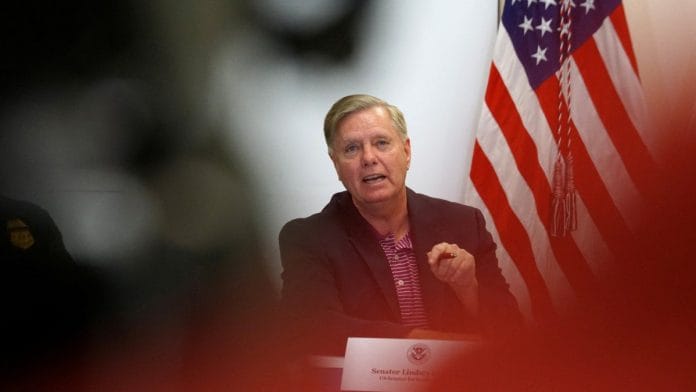


New Delhi: From pushing for 500 percent tariffs on India to threatening to “tear the hell” out of India for buying Russian oil, South Carolina Senator Lindsey Graham was known for his combative stance towards India. He died Saturday at the age of 71 in Washington, D.C.
Graham was a US Senator for more than two decades and was one of the Republican Party’s strongest advocates for US military intervention, tariffs and sanctions. He was also vocal in his support for US allies like Israel and Ukraine, and had returned from Kyiv a day before his death, after talks on measures to put pressure on Moscow.
He was an outspoken supporter of imposing US tariffs on countries buying Russian oil, including India, saying the tariffs were justified as the “cost for supporting Putin”. He said that the goal of tariffs was to “crush” Vladimir Putin’s customers—India, China, Brazil.
Graham accused India, along with Brazil and China, of indirectly financing Russia’s war in Ukraine by paying “blood money”. The long-serving Republican Senator had been critical of India’s energy policy, arguing that the purchase of Russian oil was aiding Moscow to sustain its military operations by providing export revenues.
In one of his appearances on Fox News in 2025, he said, “Here’s what I would tell China, India and Brazil: If you keep buying cheap Russian oil to allow this war to continue, we’re going to tear the hell out of you, and we’re going to crush your economy, because what you’re doing is blood money.” He urged Prime Minister Narendra Modi to use diplomatic influence with Russia to help end the Russia-Ukraine conflict, arguing that it would be “one of the most consequential things” India could do to improve relations with the US.
Graham, along with Democratic Senator Richard Blumenthal, co-sponsored the Sanctioning Russia Act of 2025. The legislation sought to authorise the US President to impose at least 500 percent tariffs on countries importing Russian oil, including India. The proposed legislation has at least 84 co-sponsors in the 100-member Senate.
During the Munich Security Conference in February, he claimed that the threat of heavy tariffs from the US had persuaded India to “dramatically” reduce its imports of Russian crude. According to him, economic pressure would compel countries to choose between access to the US market and commercial ties with Russia. Graham used this claim to strengthen his argument for the Sanctioning Russia Act. India, however, rejected the claim that pressure from the US had any influence on its energy decisions.
In July 2026, Graham, along with Senators Richard Blumenthal, Jeanne Shaheen and Roger Wicker, released a statement announcing that an agreement had been reached with the Trump administration to move forward with the proposed legislation.
The statement said, “As Russia intensifies its slaughter of civilians, it is imperative that the legislative and executive branches work together to create tools to exact a heavy price on those who buy Russian oil and natural gas, fuelling the Putin war machine.”
India’s imports of Russian oil surged after Western sanctions reshaped global energy markets in 2022. Despite US criticism and tariffs, India maintained that the purchases were driven by commercial considerations.
New Delhi has repeatedly said that its decisions were “guided by the evolving dynamics in the global market as also the imperative to secure affordable energy for our 1.4 billion people through diverse sources to meet their energy security needs”.
Bhuvan Gaur is an alum of ThePrint School of Journalism, currently interning with ThePrint.
(Edited by Sugita Katyal)
Good he died! Instead of looking into his country for their role in bloodbath worldwide whether Vietnamese war or korean war or indo pak war or Afghan war or syria war or role in pushing ukrain for war against Russia, he must be in hell for misdeed!