






New Delhi: Even though Pakistan reached out through the Director General of Military Operations (DGMO) hotline on the morning of 10 May 2025 seeking a ceasefire, India deliberately kept Islamabad waiting until later that afternoon because “half of our planned strikes had still not happened”, recently retired Chief of Defence Staff Gen Anil Chauhan has revealed.
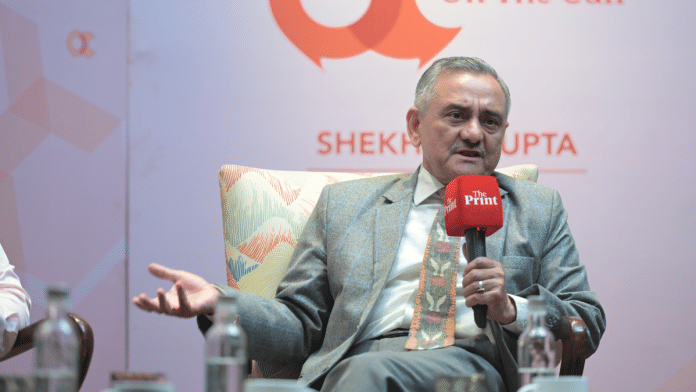
Speaking about Operation Sindoor at ThePrint’s marquee event Off The Cuff, Gen Chauhan said India was determined to secure a decisive military outcome before agreeing to halt operations.
He also said that Pakistan’s decision to seek a ceasefire was driven by its belief that its own strikes on Indian targets had been successful and it wanted to freeze the situation before India escalated. At the same time, Islamabad had witnessed the impact of Indian Air Force (IAF) strikes carried out on the night of 9 May and early hours of 10 May, prompting it to seek an end to the conflict before India could inflict further damage.
However, India’s military leadership had already planned additional waves of strikes for the day to demonstrate that no military installation in Pakistan was beyond reach.
“The biggest surprise to me was on 10 May, when Pakistan picked up the phone and said they wanted to talk. This was because on 9 May, the kind of rhetoric emerging from their side was that they would sort India out in 48 hours. Within about eight hours, they picked up the phone. We had not even executed half of our plans,” Gen Chauhan, who headed Operation Sindoor as CDS, said while responding to a question on the biggest surprise during the conflict.
He said India’s operations were still underway when Pakistan initiated contact.
“I think that was the biggest surprise. The second thing, which probably wasn’t a surprise but reflected our capability, was that we had better battlefield transparency than the adversary,” he said.
Elaborating, Gen Chauhan said Indian commanders were able to assess the effects of both Indian and Pakistani strikes much faster than their counterparts across the border.
“We knew what our attacks had achieved, what Pakistan’s attacks had achieved, and because we were all looking at the same picture, we could make decisions faster. War is about taking decisions faster so that the enemy is always on the receiving side. We were able to do that,” he added.
Also Read: Pakistan’s military revamp a ‘remedy’ for ‘deficiencies’ laid bare by Op Sindoor—ex-CDS Gen Chauhan
Pakistan believed it could match India’s deep strikes
Asked whether Pakistan had achieved what it intended through Operation Bunyan-un-Marsoos, Gen Chauhan said the operation began around 1 am on the night of 9 May.
According to the former CDS, Pakistan believed it could replicate India’s deep-strike campaign by launching attacks from well within its own territory. “We did take out a large number of radars, but we had not gone in for the airfields. So they thought that if they could carry out operations in depth, as we had done, and with speed, they would be able to cause substantial damage.”
However, the Indian response quickly altered the battlefield. “I think the reason why they picked up the phone around 9 or 9.30 on the morning of 10 May was because of the air power,” he said.
Gen Chauhan said the IAF struck key Pakistani airbases, including Sargodha and Noor Khan in the early hours of 10 May, severely disrupting Pakistan Air Force operations.
“A couple of these airfields were hit around midnight, 4 or 5 in the morning,” he added, noting that with airstrips gone, they could no longer generate sorties.
According to him, Pakistan realised that its ability to sustain air operations was rapidly diminishing. At the same time, Pakistani military planners believed that the attacks they had launched between 1 am and about 9 am had inflicted significant damage on India.
“They thought they would have done enough damage and now it was better to talk. Otherwise, it would go beyond that,” Gen Chauhan said.
India had a far clearer picture of the battlefield
“We knew what had come in from Pakistan, what we had intercepted, what had got through and what damage, if any, had been caused,” Gen Chauhan said. “They knew that if the conflict continued, they would lose faster and further. And why did we not accept at 9.30 but carry on till the afternoon? Because we wanted the victory to be more decisive.”
He added that India therefore pressed ahead with the third wave of strikes. “We continued the third wave of attacks at about 10.30 and again around 1 o’clock. The last two airfields were Bholari and Jacobabad. It had to be decisive.”
(Edited by Gitanjali Das)