





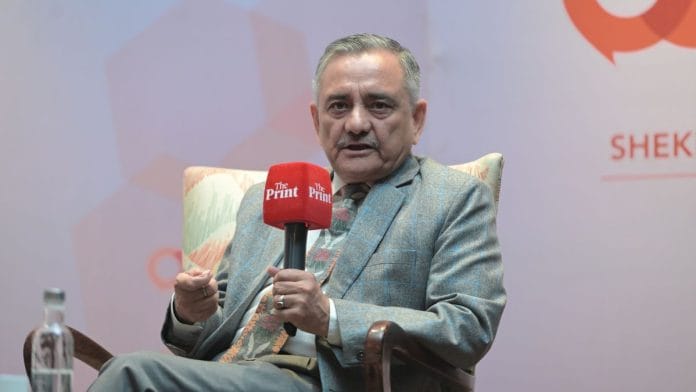

Gurugram: The constitutional amendments in Pakistan and the sweeping restructuring of its military command last year were less a modernisation drive than an admission that its forces had failed to function effectively during the 2025 conflict with India, former Chief of Defence Staff General Anil Chauhan (Retd) has said.
Gen Chauhan, who retired from service as the CDS in May, was speaking at ThePrint Off The Cuff, where he elaborated on his previous comments on Pakistan’s changed policies post Operation Sindoor, adding that it was a “remedy” to fight the “deficiencies” that they realised they had during the conflict.
In January this year, Gen Chauhan had said that the military and constitutional changes introduced in Pakistan after Operation Sindoor amounted to an implicit acknowledgment of the vulnerabilities the conflict had laid bare.
He explained Saturday, “Obviously they found deficiency in the system to be organised to fight and take decisions… and they tried to remedy this by a constitutional amendment in which they created this post of CDF (Chief of Defence Forces), Field Marshal, to gain some kind of privileges for everyone together… Basic things like jointness integration which we are trying to do.”
Under Pakistan’s 27th Constitutional Amendment in November last year, the country abolished the post of chairman of the Joint Chiefs of Staff Committee and replaced it with a Chief of Defence Forces, a position that can be filled only by the sitting army chief—currently held by Field Marshal Asim Munir. The restructuring has drawn scrutiny in India for concentrating land operations, joint operations, strategic forces and Pakistan’s newly created rocket force under a single officer.
In July, Lt. Gen. Aamer Raza was promoted to the rank of a four-star general as the first Commander of the National Strategic Command, putting him in charge of the country’s nuclear and strategic forces.
But General Chauhan argued that the new structure carries an inherent weakness. “There is a fundamental flaw,” he said. “Like a CDF will always be the army chief. So the other two services will always feel slighted.”
However, the former CDS also pushed back on the idea that the restructuring was purely a reaction to the conflict, noting Pakistan had already begun addressing gaps in its missile forces before the constitutional changes took effect.
“Even before this constitutional amendment, they realised this problem of missiles, and that’s why they created that army rocket force even before that constitutional amendment,” he said. “So they were forced to carry out these reforms which we had done for a long period of time.”
He also said that Operation Sindoor highlighted the need to fundamentally rethink how future wars would be fought, arguing that the nature of warfare had evolved beyond the conventional conflicts for which previous generations of soldiers had been trained.
“Operation Sindoor was in some manner a different kind of war than all the past wars which we have fought. It was a kind of contact, non-contact in that domain due to kinetic and non-kinetic forces. So, we need to work out how we will fight in future at our tactical level and operational level… and how to use force in future for attainment of political objectives, that is at the strategic level,” he elaborated.
Further, reflecting on his four decades of military service, he argued that the model of formally declared wars has become increasingly obsolete.
“At 40-45 years of service, the kind of wars which I was trained for… they don’t exist anymore,” he remarked, noting that while India and Pakistan fought a declared war in 1971, States today continue to pursue the same political objectives through undeclared conflicts, special operations and other forms of military force.
“So, at the top level, this thinking about war, warfare needs to change. And at the operational and tactical level, we need to incorporate those lessons of future warfighting.”

(Edited by Mannat Chugh)
Also Read: China never considered India an equal, and it still doesn’t—ex-foreign secretary Vijay Gokhale