





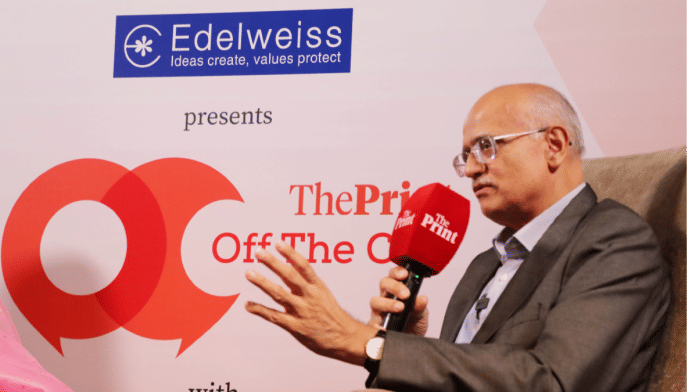

New Delhi: China has never regarded India as an equal or ever been sensitive to New Delhi’s concerns, former foreign secretary and Indian ambassador to China Vijay Gokhale said at ThePrint’s Off The Cuff event in Mumbai Tuesday.
“After Xi Jinping took over in 2013, they had economically, militarily and diplomatically gained so much ground over India that they didn’t need to be sensitive to India’s concerns anymore,” said Gokhale, who served as the ambassador from 2016 to 2017.
“At a much more basic level, China never considered India an equal, and it still does not consider India an equal,” he added.
Gokhale was in conversation with ThePrint Editor-in-Chief Shekhar Gupta and Consulting Editor for International Affairs Swasti Rao.
Gokhale added that while India was slow in reading Chinese foreign policy posture vis-a-vis India in the beginning of the 21st century, it had developed an understanding by the second decade.
According to him, there were three factors behind the shift.
“One, of course, was Russia was back in the game once President Putin assumed office. So once again, China was playing within a triangular balance of power: the United States, Russia and China. Secondly, China made huge diplomatic inroads globally, and, therefore, the need for us became less and less as it developed its own relations with other neighbours, ASEAN, Japan, Russia itself, and so on and so forth. And thirdly, of course, there was a phenomenal growth gap in the GDP. By 2010, we were at 1.2 trillion, but China was at 7 or 8 trillion,” Gokhale said.
“So for all these reasons, the Chinese, I think, came to the conclusion that they did not have to be as sensitive to India’s concerns anymore. And so what you see after 2005 is a steady backtracking of commitments they made. The peak was the year 2005, when we signed the agreement on the principles for settling the boundary. But subsequently, you see in 2007, first the description of Arunachal Pradesh as South Tibet. Then, in 2008 and 2009, you see the introduction of visas for people born in Arunachal Pradesh, and Jammu and Kashmir. And then from 2013, you see incidents on the border,” he added.
Gokhale also noted that the old framework governing India-China ties had collapsed, and peaceful coexistence as previously understood was no longer possible.
While not ruling out the possibility of China ever using force against India, Gokhale said that for the rational, educated and cadre-based leadership of the Chinese Communist Party (CCP), doing so made little sense for a variety of reasons.
“Number one, of course, is 1962 is not 2026. For China, they have to have a decisive victory to call it a victory. In our case, we don’t have to lose, and we win. Now, I don’t think that there is any clear path to them having a decisive victory over us,” he noted.
Economically, too, a war with India does not make sense for China, according to Gokhale.
“If their goal is to topple the United States from the perch of the number one economy, can you afford to ignore the Indian market? And the answer is no,” he said.
“Because if you are going to leave a billion people out, or let’s say half a billion people–because the purchasing power of the other half a billion or 700 million may not be enough–I don’t think that you can actually get the number one status in the global economy. So economically, it makes no sense either,” he said.
Finally, he noted that China’s existential threat comes only from the US, and that a scenario China would want to avoid is one in which India joins hands with the US in a two-front war.
On the other hand, according to Gokhale, China would continue to want to keep India under check.
One way of doing that is China’s strategy of grey-zone coercion, “which effectively means that along this entire line of actual control stretching over 3,000 km, you make small military or quasi-military actions, which keep the Indian troops in a defensive and constantly anxious state of affairs, so that you debilitate India financially as well as militarily”.
The second instrument, he said, is Pakistan, which China can use “on and off to keep us in check”.
“And I think that’s the broad Chinese strategy,” he said, predicting that India should expect “greater grey-zone coercion on the line of actual control” over the next decade.
Even so, he maintained that a major war remained unlikely. “I don’t think that there’s going to be a major conflict of any kind because it doesn’t suit the Chinese,” he said.

(Edited by Sugita Katyal)
Also Read: China sees Indian democracy as threat, ‘armed coexistence’ will define bilateral ties—Vijay Gokhale
I would still hope for a harmonious modus vivendi between India and China. Not spending the next sixty years frozen in hostility, diverting resources to defence for which there are competing claims for a developing country. China is in its own space now.