





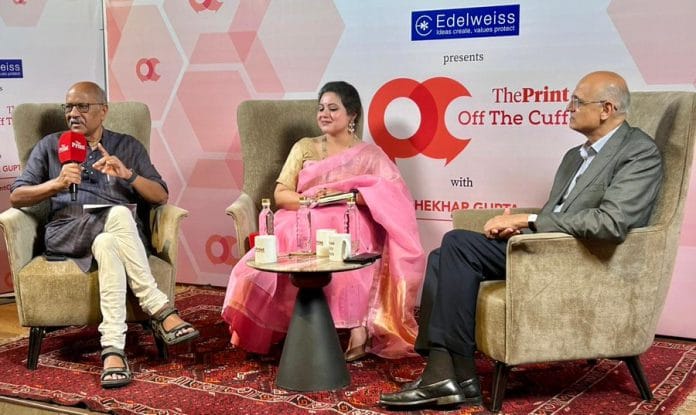


New Delhi: Vijay Gokhale, former foreign secretary and Ambassador to China, said Tuesday that India’s democratic system poses an “ideological threat” to China.
He also argued that the framework governing bilateral ties between New Delhi and Beijing has “irretrievably broken down” post Galwan standoff.
Speaking at ThePrint ‘Off The Cuff’ in Mumbai, Gokhale said China’s anxieties about India extend beyond geopolitics and stem from the success of a democratic political system coexisting with economic growth. “India poses an ideological threat. For China, which is a single-party state that has told its people that democracy is not necessary for progress, it becomes difficult after a point to explain how another neighbour, equally large, diverse and complex, can elect its leaders and continue to grow,” Gokhale said.
He added, “They see Indian democracy as a longer-term ideological problem. Their idea of diminishing India, embarrassing the government and humiliating the people is, in some way, an attempt to ensure that Indian democracy never poses a challenge.”
At the same time, Gokhale said China’s confidence about indefinitely widening the economic gap with India appears to have weakened as India’s growth prospects improve and the Chinese economy slows down.
“That linear growth that we saw between 2000 and 2020 is over,” he said.
Also Read: China reacts to Quad’s deepening Indo-Pacific cooperation, says it opposes ‘exclusive cliques’
‘1962 is not 2026’: Vijay Gokhale
Vijay Gokhale also spoke at length about the future of India-China relations, arguing that the assumptions that underpinned India-China ties before the Galwan clash in 2020 have collapsed, and New Delhi now faces the politically fraught task of constructing an entirely new relationship with Beijing—one that is bound to be defined by an “armed coexistence”.
“A clear, peaceful coexistence, as we previously understood it with a lightly armed and lightly equipped boundary, is no longer possible. It is going to be a heavily armed border with huge financial implications for both the exchequer and the public,” he said.
The larger challenge for India, he added, is strategic rather than purely military, given that China remains both India’s largest trading partner and its principal geopolitical rival in Asia.
“Even with a relatively modest annual growth rate of 5 to 6 percent, India is likely to become “the world’s second or third-largest market by 2050,” Gokhale said.
“For a China that wants to overtake the United States as the world’s dominant economy, excluding India’s vast consumer base makes little sense,” he added.
Despite the tensions unleashed by the border crisis in eastern Ladakh, Gokhale argued that Beijing has little incentive to pursue a major war with India.
“1962 is not 2026,” he said, adding that for China, anything short of a decisive victory would not qualify as success. “In our case, we don’t have to lose, and we win.”
Nor, he argued, would China want to risk a two-front confrontation while its principal strategic rivalry remains with Washington in the Pacific. “Their existential threat comes from the east—from the United States. Do you want a two-front war when you’re already dealing with an existential challenge from the US? The obvious answer is no,” he said.
‘Grey-zone coercion’ strategy
Gokhale described what he called a sustained strategy of “grey zone coercion” along the Line of Actual Control separating the two nations, a concept he discusses more of in his new book, China’s Wars: The Politics and Diplomacy Behind Its Military Coercion.
The objective, he said, is to keep India militarily pinned down and financially strained through constant low-level pressure rather than open conflict.
He traced this approach’s evolution through a series of confrontations: the 2013 Depsang standoff, the 2014 Chumar incident during Chinese President Xi Jinping’s visit to India, the 2017 Doklam crisis and the four-year military confrontation that followed the 2020 Galwan clash.
“What you see is a prolongation of the pressure,” he said. “Depsang is a very tiny point. Chumar went for a couple of weeks. Doklam went for a couple of months. And then Galwan went for four years.”
The pattern, he argued, reveals a Chinese strategy aimed at constraining India’s rise and confining it largely to South Asia. Beijing’s discomfort, he suggested, has been sharpened by India’s increasingly close strategic alignment with Washington and participation in the Quad grouping alongside the United States, Japan and Australia.
“They don’t look upon you as a threat,” he said of China’s leadership. “But when you tilt towards one or another major power, you become an adjunct threat.”
In Vijay Gokhale’s view, both Doklam and Galwan carried the same underlying message from Beijing: that India’s strategic partnership with the United States would invite retaliation along the border.
He concluded that the best realistic outcome for India is not friendship or partnership with China, but a “stable and predictable relationship” that allows New Delhi to continue focusing on economic growth while managing a permanently militarised frontier.
“I don’t think we are ever going to be friends,” he said, “or partners in the sense that we are with Japan, or even with the United States.”

(Edited by Harini TS)
Also Read: China sends India a message ahead of Tibetan leader-in-exile’s Dharamshala swearing-in