



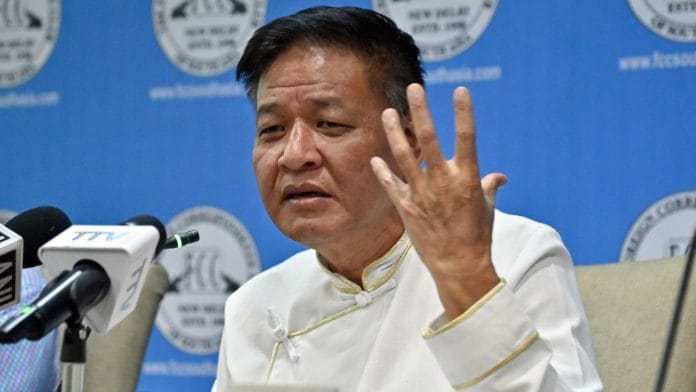
New Delhi: Ahead of the 27 May swearing-in of the new ‘political leader’ of the Central Tibetan Administration, China has urged India to “refrain from providing any platform” for activities advocating “Tibetan independence”, saying the Tibet issue is “purely an internal matter of China”.
Current Sikyong (president/political leader) Penpa Tsering, who has been reelected, will officially start his second five-year term on Wednesday from an event in Dharamshala, where the 14th Dalai Lama is expected to be present, according to a statement from the The Tibetan government in exile, which is called Central Tibetan Administration in India.
Sikyong is the political leader of the Kashag, part of the executive branch of the CTA. Sikyong is the President of CTA. Penpa Tsering is the second democratically elected Sikyong of the Central Tibetan Administration in India.
Yu Jing, a spokesperson for the Chinese Embassy in India, Sunday dismissed the legitimacy of the Tibetan administration in exile, saying it was “not recognised by any sovereign country” and lacked authority to speak for the Tibetan people or oversee the reincarnation process of the Dalai Lama.
“The issue of the Dalai Lama’s reincarnation is purely an internal matter of China and should not be subject to external interference. The so-called ‘Central Tibetan Administration’ is not recognised by any sovereign country, and its leadership has neither the legitimacy to represent the Tibetan people nor the authority to make claims regarding the reincarnation process,” she wrote on X.
The reincarnation of the Dalai Lama follows long-established religious rituals and historical conventions that have, for centuries, required the approval of China’s central government, she added . “It is worth noting that the 14th Dalai Lama himself was recognized through this established process.”
The reincarnation of the Dalai Lama follows long-established religious rituals and historical conventions that have, for centuries, required the approval of China’s central government. It is worth noting that the 14th Dalai Lama himself was recognized through this established… pic.twitter.com/EHXKpWJceq
— Yu Jing (@ChinaSpox_India) May 24, 2026
India has made clear commitments on issues relating to Tibet, she said. “It is sincerely hoped that India will continue to honor these commitments, refrain from providing any platform for activities advocating ‘Tibetan independence’, and avoid interference in the reincarnation of the Dalai Lama. Such an approach would contribute positively to the overall stability and constructive development of our bilateral ties,” she added.
Also Read: Dragon’s armour: How Xi reshaped China’s military with theatre commands a decade before India’s push
‘Reincarnation of the Dalai Lama’
The comments came amid renewed international attention on Tibet after Penpa Tsering was invited by the United States to attend an event in New Delhi commemorating the 250th anniversary of American independence.
In 2024, a bipartisan delegation of US lawmakers had met with the Dalai Lama in India and pledged support for Tibetan religious freedom, asserting that China must not interfere in the spiritual traditions of Tibetan Buddhism.
On 12 June 2024, the US Congress passed the Resolve Tibet Act, which counters Chinese disinformation about Tibet, and calls for direct dialogue with the Dalai Lama and Tibetan leaders to peacefully resolve the dispute. It affirmed Tibetans’ right to self-determination and recognises their distinct cultural, religious and historical identity.
Beijing dismissed the Resolve Tibet Act, reiterating that Tibet is an integral part of China, and warning against any foreign interference.
Last year, on his 90th birthday, the Dalai Lama announced that the institution of the Dalai Lama would continue after his death and said that Chinese authorities would have no role in identifying his successor. Authority over the process, he said, would rest solely with the Gaden Phodrang Trust in consultation with his office.
“No one else has any such authority to interfere in this matter,” his office said at the time.
That process, he added, would be conducted according to centuries-old religious traditions, in consultation with senior Tibetan Buddhist leaders and spiritual protectors, further challenging Chinese claims that reincarnation of lamas—especially the Dalai Lama—is a matter of State policy.
The Chinese foreign ministry, however, had then asserted that the future reincarnation needs to be approved by the Chinese government, adding that the succession must comply with Chinese laws and regulations as well as “religious rituals and historical conventions”.
In making the claim that it has a say in the matter of succession, China cites a tradition dating back to the Qing dynasty in 1793, when a golden urn ritual was introduced to select high-ranking lamas. The Dalai Lama countered these persistent claims, reinforcing a position that he has held for decades.
In 1969, he had said that the continuation of his institution should be left to the Tibetan people. In 2011, after stepping down from his political role in the Tibetan government-in-exile, he had formalised this stance, saying that the responsibility for recognising his successor would rest entirely with the religious leadership of the Tibetan community.
In response to the Dalai Lama’s statement, the MEA said that the Indian government does not take any position on matters concerning practices of faith and religion.
MEA spokesperson Randhir Jaiswal said the government has always upheld freedom of religion for all in India and will continue to do so.
“The government of India does not take any position or speak on matters concerning beliefs and practices of faith and religion,” Jaiswal had said.
(Edited by Ajeet Tiwari)
Also Read: India was king of religion, China king of divination—how ancient Tibetans saw their neighbours