



New Delhi: Within four months of its launch, Bharat Taxi, the ride-hailing platform backed by the Ministry of Cooperation is looking at expanding its presence to 100 cities and towns across the country by the end of FY2026-27.
It has already accelerated driver onboarding and is rolling out services in some of these new markets.
“We are targeting to reach 100 cities and towns across India in the current financial year,” a senior official at Bharat Taxi told ThePrint requesting anonymity.
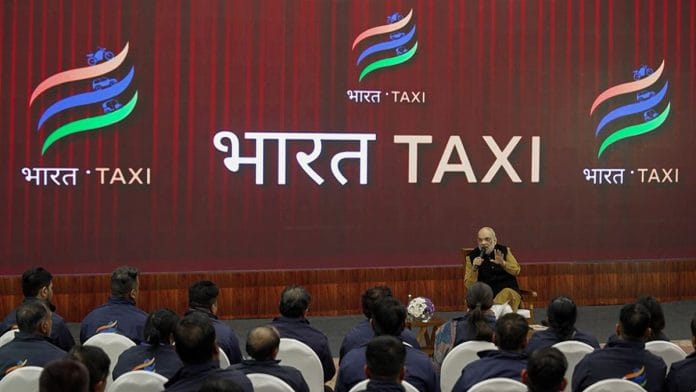
The platform, formally launched by Union Home and Cooperation Minister Amit Shah in February this year, currently operates in Delhi-NCR, Gujarat, Lucknow, Chandigarh, Jaipur and Mumbai. It plans to enter several more cities over the coming months.
The expansion push comes as Bharat Taxi scales up its driver network. The platform till date has onboarded around 4.5 lakh drivers or ‘sarathis’ across its operational markets.
Bharat Taxi recently launched its services in Mumbai and nearly 30,000 drivers have already registered on the platform.
According to the official, driver registration is currently underway in Kanpur and Pune, with commercial operations expected to begin by July or August.
The cooperative is also preparing to launch services in Ranchi, Patna, Bhubaneswar and Guwahati by August and September. A second phase of expansion is planned between October and December which will cover cities such as Bhopal, Indore, Nagpur and Kolkata.
The focus on tier-2 cities is central to Bharat Taxi’s expansion strategy. The official said the cooperative expects strong demand from smaller urban centres, where two-wheelers are often the preferred mode of transport. “Launching services in tier-2 cities will result in easier access to transport services,” the official said.
Bharat Taxi is also exploring inter-city ride services as its network expands. The official said the platform plans to introduce rides between Mumbai and Pune once operations begin on both cities.
The platform’s vehicle fleet is currently dominated by four-wheelers, which account for nearly half of its fleet. Two-wheelers make up around 28 percent, while auto-rickshaws account for the remaining 22 percent.
To support expansion to new cities, Bharat Taxi has been conducting outreach programmes and meetings with drivers to explain the benefits of joining the platform, particularly its no commission and cooperative ownership model.
Bharat Taxi was set up under Sahakar Taxi Cooperative Ltd, a multi-state cooperative society registered under the Multi-State Cooperative Societies Act, 2002. The platform seeks to position itself as an alternative to private ride-hailing aggregators by operating on a cooperative ownership model.
The platform does not charge drivers a commission on rides, instead it levies a nominal subscription fee or per-ride fee to cover operational expenses.
Under the cooperative model, the drivers become members and owners of the cooperative society, which makes them eligible to participate in profit-sharing and get representation in the cooperative’s board of management.
With plans to enter dozens of new markets over the next few months, Bharat Taxi is betting on its cooperative structure and driver-centric approach to carve out space for itself in India’s highly competitive ride-hailing market, which is dominated by private aggregators.
(Edited by Viny Mishra)
Also read: Amit Shah launches Bharat Taxi, the govt-backed alternative to Ola, Uber. Drivers will be ‘owners’