



New Delhi: Strongly pitching its KC-390 Millennium as the right choice for the Indian Air Force’s multi-billion-dollar Medium Transport Aircraft (MTA) programme, Brazilian aviation major Embraer has said it plans to make India a regional manufacturing and Maintenance, Repair and Overhaul (MRO) hub if the aircraft is selected.
Speaking to ThePrint, Caetano Spuldaro Neto, Vice President for Sales and Business Development for the Middle East and Asia Pacific at Embraer Defence & Security, also said the KC-390 was the “cheapest” option in terms of both operational and life-cycle costs, while also being the platform best aligned with India’s requirements.
“We are competing with traditional players. Of course, we respect them and their heritage, but we are positioning ourselves in India to offer the best aircraft available in the market nowadays. And why we believe so is because our airplane has been designed in the 21st century,” he said.
Neto added that the aircraft, which made its maiden flight in 2015 and already has 12 customers with orders for around 60 aircraft, was developed by factoring in lessons from older transport platforms, their shortcomings, and areas needing improvement.
The Indian Air Force is expected to issue a Request for Proposal (RFP) later this year for the MTA project.
Under the proposed acquisition, the IAF is looking to procure between 40 and 80 aircraft to eventually replace its ageing An-32 fleet, and possibly part of the Il-76 fleet as well.
The IAF is seeking an aircraft with a payload capacity between 18 and 30 tonnes, and had issued a Request for Information in 2021. Initially it was looking at a 18-27 tonne capacity which was then revised to 18-30 tonnes.
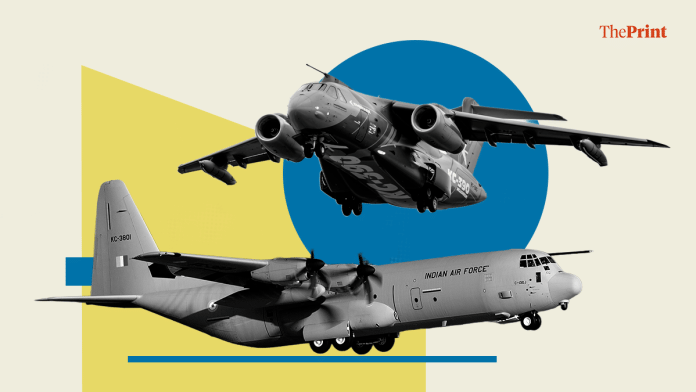
Three contenders are currently in the fray, though each falls into a different payload category. Lockheed Martin’s C-130J Hercules meets the lower end of the requirement with a payload capacity of around 19 tonnes. The KC-390 sits near the upper limit with a payload capability of 26 tonnes, while the Airbus A400M exceeds the specified requirement with a payload capacity of 37 tonnes.
“We designed an aircraft that offers a lower operational cost,” Neto said. Asked whether he was comparing the cost with the larger A400M, Neto clarified: “Our head-to-head competitor is the C-130J. But in this market, other players also play a role. A400M is also a competitor, although it’s a slightly bigger airplane. We almost consider the A400M to be in another category.”
“But even with the C-130, when you think we offer 26 tonnes of payload while they offer 19 tonnes, and while we offer a dual-jet engine aircraft that flies faster and therefore completes the mission quicker, it still offers around a 30 per cent reduction in operational cost per mission,” he said.
Asked specifically whether this meant a 30 per cent lower operating cost compared to the C-130J, Neto replied in the affirmative. “Yes, and with modern avionics, modern mission equipment, a full self-protection system and a modern cargo handling system. So it is the aircraft for the next 50 years. It’s not the aircraft from the past 50 years,” he said.
One issue that the IAF is expected to closely examine is high-altitude operational capability. While the IAF’s C-130J has already landed at the Daulat Beg Oldie Advanced Landing Ground at an altitude of nearly 17,700 feet, the KC-390 is currently certified for operations up to 14,000 feet.
“We have operated above 13,000 feet in South America with no issues and we are confident we can operate above that level as well,” Neto said.
Another point of debate is the choice of engines. While both the C-130J and the A400M are turboprop aircraft, the KC-390 uses jet engines. Critics argue that turboprops are better suited for sandy, unpaved forward airstrips.
The Embraer executive dismissed the concern. “We don’t see that as an advantage. In terms of operating in harsh environments, the aircraft was designed in such a way as to avoid, for example, FOD (foreign object debris) ingestion,” he said.
“You can see we have been flying this airplane across all continents. Recently, we conducted a full harsh-environment campaign in the Middle East. That helped us secure the order in the United Arab Emirates. It’s hot and sandy, and has unpaved runways that require short take-off and landing capability,” he added.
Neto further said the aircraft had also operated in extreme winter conditions in Europe at temperatures touching minus 30 degrees Celsius.
Speaking on other aspects of the aircraft, he said that the KC-390 was meant for a multi-mission role. He said that the transport aircraft can be converted into a mid-air refueller through a plug-and-play system in under four hours.
Neto also stressed on the fact that if India selects its aircraft, the country will not only become the second manufacturing hub for the Brazilian firm but will also become the regional MRO destination.
Embraer is in talks with Indian companies and has signed Memoranda of Understanding (MoUs) with some with regard to the project. Embraer has teamed up with Mahindra group for the manufacturing of the military transport plane in India while it has tied up with Adani for the civil versions of the aircraft. It has also signed an MoU with Hindalco Industries to conduct exploratory activities to assess potential business opportunities in India.
Neto claimed that the sourcing from India by Embraer has gone up but refused to get into specifics.
(Edited by Nardeep Singh Dahiya)
Also Read: AMCA tender issued, HAL sits out as private sector takes centre stage