



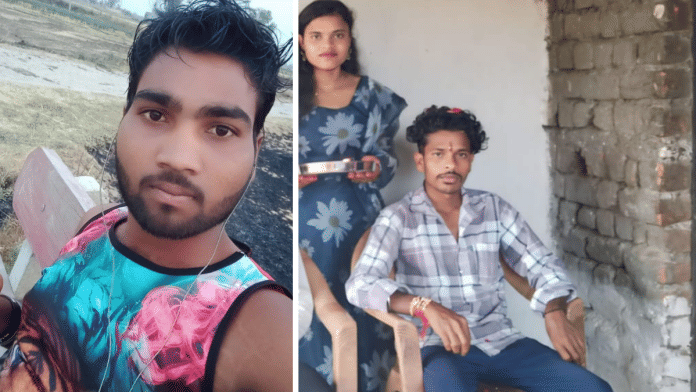
New Delhi: Migrant labourer Deepak Ratray had an unfinished work back home at Hardidih village in Chhattisgarh’s Bilaspur district. Having shouldered the responsibility of bringing food to the table from a very young age, Ratray had started building a house in his maternal village.
The family had shifted to Hardidih village after his father died by suicide when he was just four. Ratray, the sole male breadwinner for the family, also had to cover for his disabled younger brother.
That safety cover is now gone for Deepak’s family, which includes his mother, wife, and brother. Terrorists shot the 24-year-old right outside his shanty at Keellam village in South Kashmir on Friday evening.
Bhupendra Bhaina, a fellow worker from the same district, succumbed to injuries at a Srinagar hospital. This was the second such terror attack in little over a week, after a head constable was killed 22 July in Anantnag.
“Deepak was the guardian of the house, and he was the main breadwinner,” his uncle Dilharan Sande told ThePrint over the phone from Bilaspur. “It was because of his pursuit of a ‘pucca’ (brick and mortar) house in the village that Deepak said he would go for this season in Kashmir and return home with money.”
Chief Minister has strongly condemned the dastardly killing of two labourers in Kulgam and expressed profound grief over the loss of innocent lives.
He announced ex-gratia relief of ₹10 lakh each from the Chief Minister’s Relief Fund for the next of kin of the deceased. This…
— Office of Chief Minister, J&K (@CM_JnK) August 1, 2026
Jammu and Kashmir (J&K) Chief Minister Omar Abdullah on Saturday announced an ex gratia of Rs 10 lakh each for the next of kin of the two slain migrant labourers.
The Resistance Front (TRF), a proxy of the Lashkar-e-Taiba (LeT), has claimed responsibility for Friday’s killings. The same terrorist outfit had carried out the massacre at Pahalgam in April, 2025.
Sources in the J&K Police said that they have zeroed in on the suspects behind the gruesome killing and are working to engage them.
“At least two suspects have been zeroed in… One of them is a senior armed cadre of the TRF, while the other conducted a recce of the area where migrant labourers were staying and provided logistical support to the killers,” a Jammu and Kashmir Police officer told ThePrint.
‘Did not like masonry’
As for Bhupendra, his entire family—father Dahsath, mother Nageshwari and younger brother Anurag—have been in Himachal Pradesh’s Baddi town for the last six months earning a livelihood there.
Their father had been working as a mason in Himachal and had brought him there, Anurag told ThePrint over a phone call from Baddi.
The family’s earnings were not proving enough, younger sister Annu told ThePrint over the phone from Bilaspur. “It was becoming difficult for him to run the family while struggling for odd jobs back home. Hence, he decided to go to work outside Chhattisgarh.”
The first option was to join the entire family in Baddi, where they were working as masons, but Bhupendra had other ideas. “He never liked masonry and hence preferred to work at a brick kiln,” she recalled.
The 28-year-old had left with his wife for Kulgam some two-three months ago, leaving their child with Annu. She was alone when the Kulgam administration carried out the cremation Saturday afternoon. Same was the case for Deepak’s widow.
“His phone may have been damaged during the attack. We are unable to reach out to her. We learned about the tragedy when our relatives called from the village after being alerted by the local police,” Anurag said.
‘Came two months ago’
Ram Kumari Sahoo, a native of Chhattisgarh’s Sakti district, recalled how she met fellow migrant labourers Deepak and Bhupendra in Kulgam.
“The months between June and August are the peak season for labourers in Kashmir, and the bunch that included Deepak and Bhupendra came to Kulgam only two months ago from Jammu,” she told ThePrint over phone from Kulgam.
The area in Kellam village where all these migrant labourers are staying resembles a slum or even worse, she told ThePrint, adding that nearly 60 families are living in makeshift ‘jhuggis’ (shanties).
The families of Deepak and Bhupendra shared the same jhuggi, separated only by a makeshift wall, she said.
All she remembered was the sudden sound of gunshots on Friday evening. “We rushed in the direction from which the gunshots came. On reaching there, we saw the two lying wounded on the ground and their families crying loudly,” she recalled.
“The women told us that initially a few masked men came outside and asked about the number of people in the colony and where we were from. Then the males were called outside, and then they were shot multiple times from close range.”
Back from Bilaspur, Deepak’s uncle laments about the misfortune of his widowed sister. “She lost her husband at a young age, and she had to struggle daily to survive. Then Deepak grew up and shouldered most of her responsibilities, becoming the main breadwinner…,” Dilharan said with a heavy voice.
“Only God knows what lies in store for the family. The terrorists destroyed an entire generation which was toiling daily just to survive in this world.”
This is an updated version of the report.
(Edited by Tony Rai)
Also Read: Probing digital footprint of terror outfit Hizb-ut-Tahrir, NIA seeks help from Switzerland & Germany
What is the reason? Race, skin colour, gender, nationality, regionality, language, food, political affiliations, religion, or some other reason? Or, a combination of all of the above?
May God give strength where man failed to offer.
Shanti