



New Delhi: When Lal Bahadur Shastri visited Belgrade in 1965, President Josip Broz Tito and his hosts arranged a vegetarian meal in honour of the Indian prime minister. But when Tito asked if he was happy with the food, Shastri playfully pointed to his non-vegetarian external affairs minister, Swaran Singh, and the others: “It’s okay for me, but what about Swaran Singh ji? You have deprived yourself of food.”
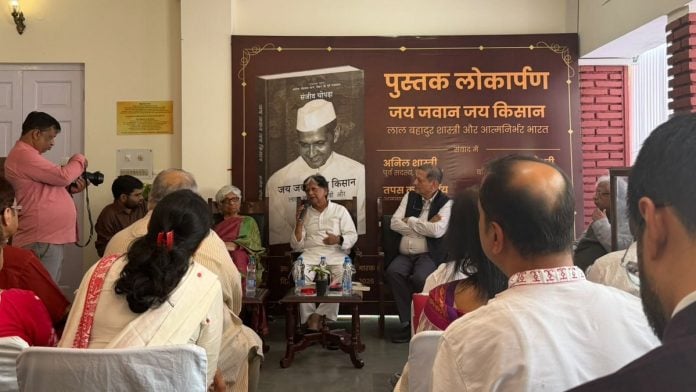
This was one of several anecdotes about Shastri that came up at the launch of the Hindi translation of retired IAS officer and author Sanjeev Chopra’s book The Great Conciliator: Lal Bahadur Shastri and the Transformation of India. For the debut of the Hindi edition, titled Jai Jawan Jai Kisan: Lal Bahadur Shastri Aur Atmanirbhar Bharat, a panel discussion took place at the Lal Bahadur Shastri Museum and Library.
With an audience of around 80 people, most of them Shastri admirers, the panel—including Chopra, former Union minister and Shastri’s son Anil Shastri, author Neerja Chaudhary, and translator Tapas Rai—discussed both the man and his legacy.
One part of the discussion looked at the institutions Shastri built for a food-scarce India in the 1960s and how they need to change. The other looked at the former PM beyond his austere image. For Chopra, Shastri’s “English sense of humour”, ability to build personal relationships and instinct for finding common ground were equally noteworthy.
“We all think that Shastri ji was a very serious person. He had a great sense of humour,” said Chopra.
Beyond the banquet anecdote from Yugoslavia, Chopra had another story from Nepal to illustrate Shastri’s humorous streak. On his first visit to the country, Shastri met the king, visited Pashupatinath and travelled around the country before being asked how he had found his first foreign visit.
Chopra said Shastri replied that he was “very disappointed”. Asked why, the leader said: “I don’t feel like I’m in a foreign country.” According to Chopra, this remark showed the close relationship Shastri had developed with Nepal and the personal rapport he sought with leaders in neighbouring countries.
Also Read: Why the Tashkent Declaration was both a moral and semantic victory for Shastri
Shortages to surplus
Another focus of the discussion was the institutions Shastri built during his brief tenure as PM and their relevance in India today. These included the Food Corporation of India (FCI) and the Commission for Agricultural Costs and Prices (CACP), set up in the 1960s when India was struggling with food shortages.
For Chopra, the “form of these institutions has to be changed with time”. The FCI was one example.
“FCI was made to deal with shortages. An institution that deals with shortages may not be able to deal with surplus. So we have to make adjustments in that,” he added.
He argued that agricultural policy also needs to account for the ecological costs of farming, particularly groundwater depletion and water-intensive cultivation in states such as Punjab and Haryana.
The Commission for Agricultural Costs and Prices, he suggested, could therefore be reimagined as a “Commission on Ecology, Agriculture, Costs and Prices”.
“We cannot divorce ecology from agriculture,” he said.
Institutions with ‘dentures’, not teeth
Chopra also spoke about the Central Vigilance Commission and CBI, both of which Shastri had had a hand in setting up. But he said neither had lived up to its potential.
He compared the CVC to “dentures” rather than teeth—something that looks like it should do the job but does not have the same bite.
Chopra noted that systems should be designed to reduce opportunities for corruption instead of relying only on individual morality or a watchdog.
He cited agricultural procurement as an example. Chopra recalled efforts involving the CVC, NDDB and FCI to make procurement more transparent. At milk collection centres, he said, farmers can see the quantity and quality of their milk being measured and the value calculated. A similar approach could be applied when wheat, rice or other crops are procured, with parameters such as moisture content measured in front of the farmer.
“Our systems have to be so good that there is no scope for corruption, especially where large dealings are taking place,” he said.
Also Read: Indira Gandhi gets credit for Punjab formation. It was Lal Bahadur Shastri who paved the way
‘The backbone’
While Shastri was PM for only 18 months—from June 1964 until his death in January 1966—his political impact on India began much before that, Chopra pointed out.
He cited the 1952 general election, the first in India, when Shastri was the party’s general secretary and worked closely with Nehru on the campaign.
“I was thinking today, what does Lal Bahadur Shastri’s life mean for India?” Chopra said. Nehru ji had the charm, charisma, meetings. But [Shastri] was essentially the backbone. He was in every state. He worked with everyone. He won the elections. He made Congress win. He made all of this happen.”
(Edited by Asavari Singh)