



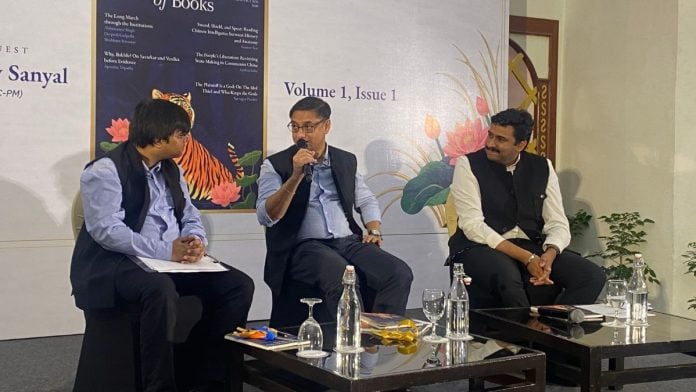
New Delhi: Economist and member of the Economic Advisory Council to the Prime Minister of India, Sanjeev Sanyal addressed a modest yet starry eyed audience of young graduates, budding political scientists and public policy professionals, at Delhi’s Ambassador Hotel on Friday.
“To be a great power, we need to first imbibe the idea of being a great power. And that means you’re allowed to have opinions about other people and be unapologetic about it,” Sanyal said, directing his comments to “the next generation.”
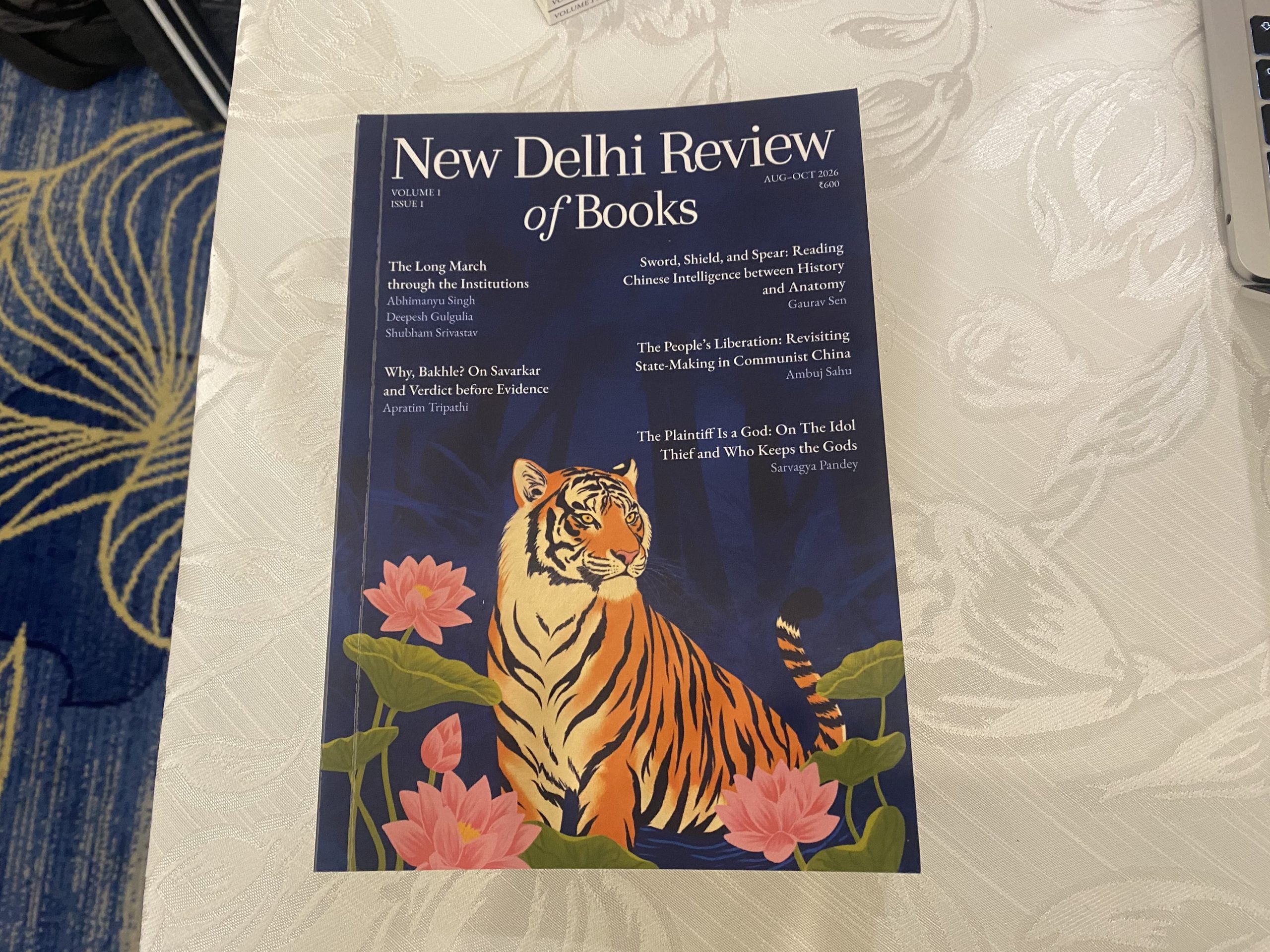
Sanyal’s address was part of the launch of the New Delhi Review of Books, a quarterly magazine which sees itself as carrying forward “the older tradition of the critical essay.” He commended the magazine team on their inclusion of two essays about China and its internal and foreign policies. He claimed the essays were integral to “reversing the gaze” that has traditionally looked at India as a site to be studied and dissected.
“Dissecting them [foreign nations] on our terms creates the architecture for our own soft power,” Sanyal added.
The magazine is the brainchild of editor-in-chief Prem Ansh Sinha, a graduate of Political Science from Ramjas College, Delhi University. Sinha was previously editor of the Ramjas Political Review, and had later worked on the Indic Perspectives Programme, an initiative founded by Sinha devoted to reading and criticism of diverse texts related to politics. The magazine grew out of the latter initiative.
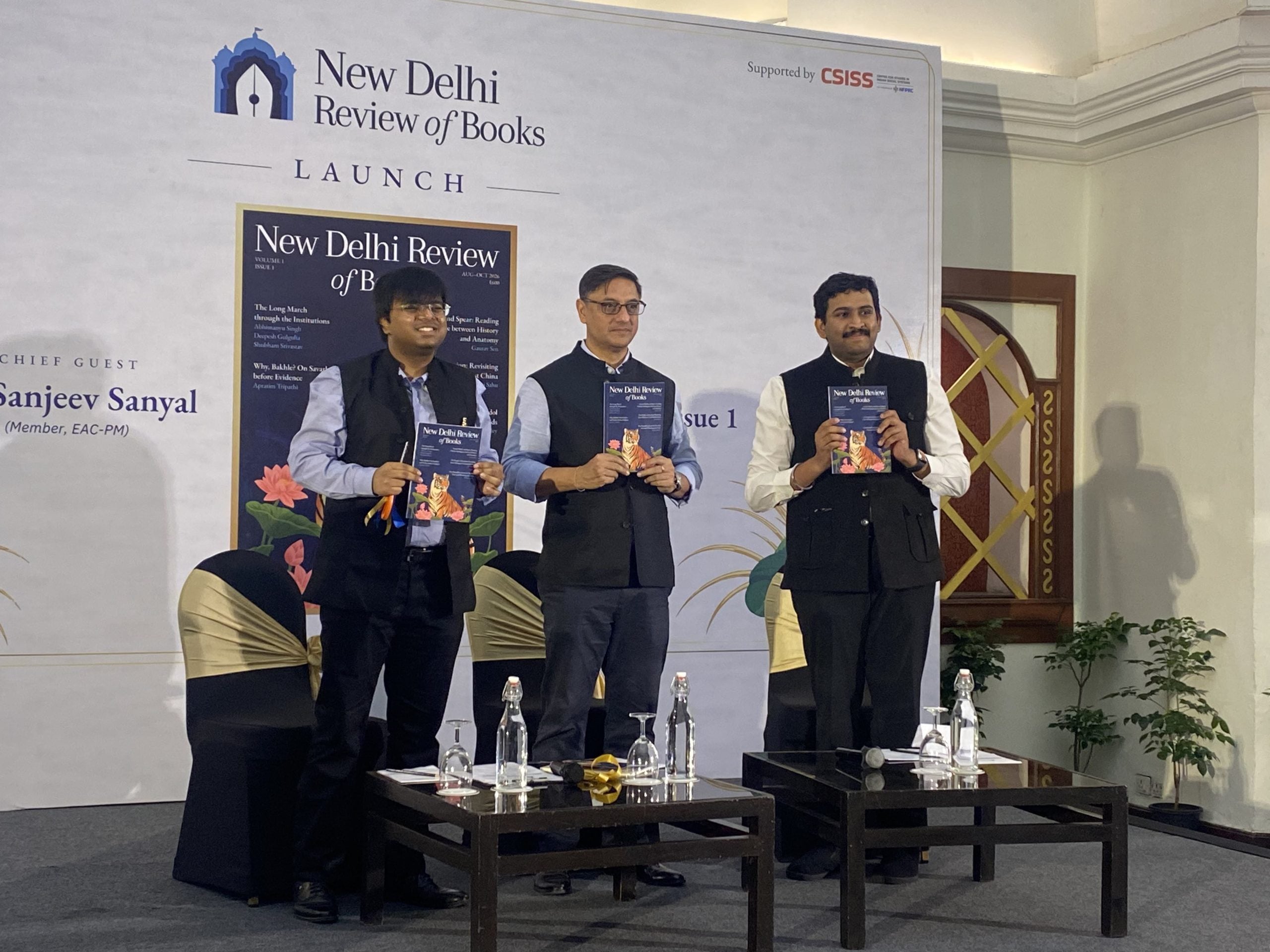
Describing the quarterly as an “acquired taste,” Sinha clarified the politics underlying the venture.
“My politics is not a disagreement that needs rioting on the streets. My politics is not undeterred calls for violence against the state and its apparatus,” Sinha said. He went on to call the present moment a “turning point in history,” where the young are poised to build the institutions they wish to live with.
“I hope that those sitting in the hall will understand that democracy does not imply obstruction, but participation…and for me that begins with the New Delhi Review of Books” the editor-in-chief added.
The magazine is published by the Nation First Policy Research and Change Foundation (NFPRC), a Delhi-based policy research institution. Apart from two essays on China’s external and internal policies, its first issue includes a critique of Savarkar’s biography by Janki Bakhle, an examination of America’s legal conservative institutions, and a scrutiny of recent attempts at the repatriation of Hindu idols.
Also read: Paar laid bare caste oppression in 1984. Four decades later, its truth still stings
Intellectual spaces captured by the ‘ultra-left’
A recurring phrase both in private conversations, as well as from speakers on stage, was India’s lack of “intellectual diversity.” There seemed to be a consensus in the room that certain ideological positions had long captured the country’s intellectual spaces.
The magazine positioned itself as an attempt to right this historical wrong.
“A democracy as complex, layered, and argumentative as India cannot afford an intellectual monoculture,” said Ananth Krishna, Research Director at NFPRC. He saw his organisation’s support for the magazine as a “long-term investment” in promoting “serious intellectual engagement.”
Sanyal doubled down on this need for intellectual diversity. Academic and cultural spaces, he said, “have ended up essentially captured by the ultra-left.”
“I won’t even call them left-of-centre anymore,” he added.
He had experienced this “capture” of institutions firsthand as an undergraduate student of Economics at Delhi’s Shri Ram College of Commerce in the 1990s. The world had just witnessed major economic and political shifts, he claimed. The collapse of the Berlin Wall, the fall of the USSR. As well as India’s economic liberalisation. Their textbooks, however, failed to reflect this shift.
“(The textbooks)… were all going on and on about how 5-year plans were wonderful,” he said, pointing to the continued emphasis on a socialist framework that had “already collapsed.”
Sanyal found companionship in thinkers you were less likely to find at bookstores, or hear of in intellectual circles. He read works by libertarian economist Freidrich Hayek, and classical liberal economist B R Shenoy. Their books, he said jokingly, were “hidden away (in bookstores) as if they were pornography.”
Later he went on to Oxford University, which he found to be less “ideologically cleansed” than Delhi University.
According to Sanyal, the hegemony of the left in the “literature producing industry” ends up serving foreign powers, which then dictate the nature of academic work that comes out of India. Pointing to the near total absence of Indian names from the ABDC’s list of the top ranked social science journals, he claims that the country’s academic system is heavily dependent on “foreign validation.”
“There is no greater form of colonisation. They can decide who gets promoted in our academic system, with no effort at all,” said Sanyal.
Today, Sanyal is also involved in rewriting NCERT textbooks for high-school students. He called the existing social studies booklet “basically a povertarian’s wet dream,” and said he was introducing images of modern agriculture to economics textbooks, in a bid to update their depiction of the country. Libertarian thinkers such as Hayek and Shenoy, along with Kautilyan ideas of economics will also find a place in his version of these books, he added.
The exercise of revising NCERT textbooks is mired in controversy. While some teachers have claimed a lack of transparency in the revision process, opposition parties have criticised it for following a ‘saffronisation’ agenda.
‘Forward looking thought for a modern India’
A sense of optimism pervaded the room. Audience members gathered in small clusters spoke informally about reviving ‘Indic knowledge systems,’ the flaws of the country’s past nuclear programmes, and about the emergence of newer modes of knowledge production.
Shrouded in talks of intellectual diversity, and economic liberalisation, was the burning desire for nation building. Some even highlighted the centrality of war in attaining national prosperity.
Editor-in-chief Prem Ansh Sinha pointed out that “for far too long,” India’s foreign policy has placed “disproportionate rhetorical faith in Buddha, peace and ahimsa.” Contributor to the magazine, Ambuj Sahu, reiterated this position, with reference to the process of state-making in China between 1949 and 1956.
“If we go over Weber’s definition of a state, which says that the state is a political entity which has a monopoly over violence. Then, there has to be some outlet through which a state establishes its legitimacy by inflicting violence,” he explained, describing the central argument for his piece.
Still, Sinha maintained that the magazine doesn’t “subscribe to any particular ideology or stream of thought”.
“It is not conservative. It is more towards having a forward looking thought for a modern India and a prosperous country,” he said.
(Edited by Janaki Pande)