



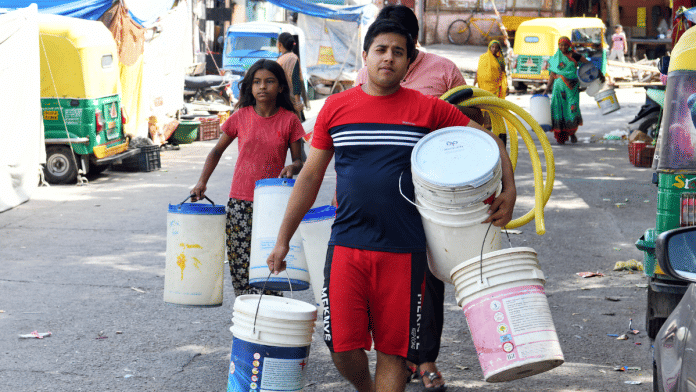
Hyderabad: Hyderabad’s 1.5 crore residents are facing an acute drinking water shortage owing to uneven regional water availability, competing agricultural and industrial demand, and a monsoon deficit attributed to El Niño. More than 330 of Telangana’s 600-plus mandals are drought-hit, while only around 500 of the state’s 6,000-plus lakes have water, according to data shared by the state irrigation department.
In Hyderabad, only three of the 16 mandals have received sufficient rainfall, leaving residents in several areas scrambling to buy water through tankers. The situation is reminiscent of a similar crisis 25 summers ago, when plummeting reservoir levels pushed the city close to running out of water.
Tanker bookings in the state capital have surged to between 6,000 and 8,000 a day. Hyderabad Metropolitan Water Supply and Sewerage Board (HMWSSB) Managing Director (MD) Ashok Reddy has directed officials to onboard additional tanker operators and begin the registration process.
Several areas in Secunderabad Cantonment and Hyderabad’s outskirts have reported acute shortages, with drinking water supplied only once every three to four days.
“With water in the Singur Dam and Nagarjuna Sagar Dam dropping to precarious levels because of sparse rainfall, the HMWSSB is actively shifting its standard alternate-day supply schedule to a restricted routine of once every three days for major parts of the city to conserve what remains,” Reddy said at a review meeting earlier this week.
Water for the Core Urban Region Economy (CURE), which spans 2,053 sq km within Hyderabad’s Outer Ring Road (ORR) limits, is sourced from the Osman Sagar and Himayat Sagar reservoirs, the Singur dam and the Nagarjuna Sagar dam. These sources draw on water supplied from the Krishna and Godavari basins.
According to the Irrigation & CAD Department, water level in Osman Sagar has fallen from its full capacity of 3.5 thousand million cubic feet (TMC) to 2.2 TMC while Himayat Sagar has 2.1 TMC left against a capacity of 2.5 TMC. Singur has about 3.4 TMC remaining against its full capacity of 29.9 TMC and Nagarjuna has 184.2 TMC of water against a capacity of 312 TMC. The HMWSSB has declared a water emergency, with some reservoirs expected to run dry between mid-December and the end of the month.
“We are exploring alternative water arrangements, including additional supplies through the Godavari Drinking Water Scheme and the possibility of drawing more Krishna water. Proposals for additional filter beds at Himayat Sagar and Osman Sagar are also under consideration, as is the use of treated wastewater for construction, landscaping and industrial activities,” Reddy said.
The HMWSSB is conducting a water audit to assess groundwater resources across all 16 mandals. Hyderabad Metropolitan Area Special Chief Secretary Jayesh Ranjan has directed officials to take precautionary measures to conserve water and reduce electricity consumption.
With the crisis intensifying as the drier months approach, Chief Minister Revanth Reddy and senior cabinet members called an emergency meeting Friday to review contingency plans for maintaining drinking water supplies in the coming months. Power and Finance Minister Bhatti Vikramarka is also expected to review coal stocks at the state-owned Singareni Collieries.
Senior architect Chinmayee Mokshagundam, who works at Akarmaa Foundation to restore stepwells in Hyderabad, described the situation as alarming.
“The numbers are scary, but the irony is that there is water. It is just that we have not been able to understand how to manage water effectively. There are more than 150 stepwells in the Hyderabad ORR limits, and they are replenished through underground aquifers. Sadly, these have now become garbage dumpyards,” she told ThePrint. She added that if the stepwells built nearly 400 years ago are revived, Hyderabad’s water crisis would be down by at least 50 per cent.
Water conservation measures
The HMWSSB and the Telangana government have introduced measures to conserve water and avert shortages in the coming months.
In a first-of-its-kind initiative for Hyderabad, the water board will launch green water tanker services from 1 November to promote the reuse of treated wastewater for non-drinking purposes. The tankers will supply treated water to the real estate sector and for landscaping and other activities that do not require drinking water.
The board has also launched a public participation initiative to allow volunteers to report water issues through its PAANI (Promote Awareness And Nurture Initiatives for saving water) app.
Revanth Reddy, who also holds the municipal administration and urban development (MA&UD) portfolio, has directed officials to restrict permissions for borewells intended for construction and other non-drinking purposes. Existing borewells may be deepened for the same purposes.
Last week, the chief minister appealed to farmers to defer an entire crop cycle, citing the government’s inability to provide adequate water for agriculture. With Telangana facing a delayed winter, government sources expect the crisis to persist for another eight months, until next June.
The government has also announced fines for residents found misusing drinking water. First-time offenders will face a penalty of Rs 1,000, while resident welfare associations (RWAs) and individual homeowners who allow overhead tanks or motor pump sets to overflow will face heavier penalties. Violations could also attract escalating financial penalties and permanent disconnection of water and sewerage connections under the HMWSSB Act, 1989, the body’s MD said at a conference last Friday.
Resident welfare associations have stepped up conservation efforts alongside the government. The United Federation of Resident Welfare Associations (UFERWAS) has launched its ‘Every Drop Counts’ initiative across Hyderabad and Cyberabad, with a seven-point plan to prevent localised shortages in residential communities. Measures include reducing water use for landscaping and switching to recycled water for car washing and cleaning front yards.
M. Srinivas, head of the Urban Development Forum, said the measures had come too late, and the government had not been able to inspire confidence among residents. “Back in September, during the Ganesh Chaturthi celebrations, there was no water in Karimnagar to immerse the idols. They were using tankers back then to fill the ponds and immerse the idols. The government should have put together an action plan to address the shortage. With little coordination between the irrigation, agriculture, industries, and the municipal departments, all the constituents are suffering,” he told ThePrint.
(Edited by Chingkheinganbi Mayengbam)
Also Read: Hyderabad’s trees were cut for flyovers that won’t be built. Who pays for the destruction?