


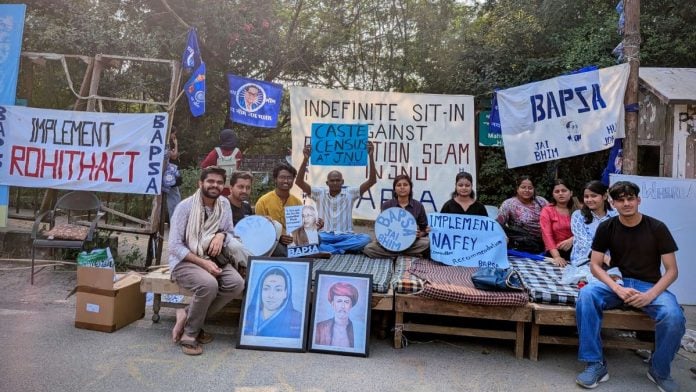
New Delhi: The Jawaharlal Nehru University (JNU) is facing allegations of irregularities in the implementation of reservation norms in its PhD admissions. Various student groups claim that seats meant for Scheduled Caste (SC) and Scheduled Tribe (ST) candidates have fallen short of their mandated quotas, triggering a 21-day-long protest on campus.
The controversy began when student organisations, the Students’ Federation of India (SFI) and the Birsa Ambedkar Phule Students’ Association (BAPSA), raised complaints alleging irregularities in JNU’s implementation of reservation norms in its 2026-27 PhD admissions. They questioned the distribution of reserved seats across individual PhD programmes and different admission routes.
The university then constituted a five-member committee headed by Vivek Kumar, dean of the School of Social Sciences, to examine the allegations.
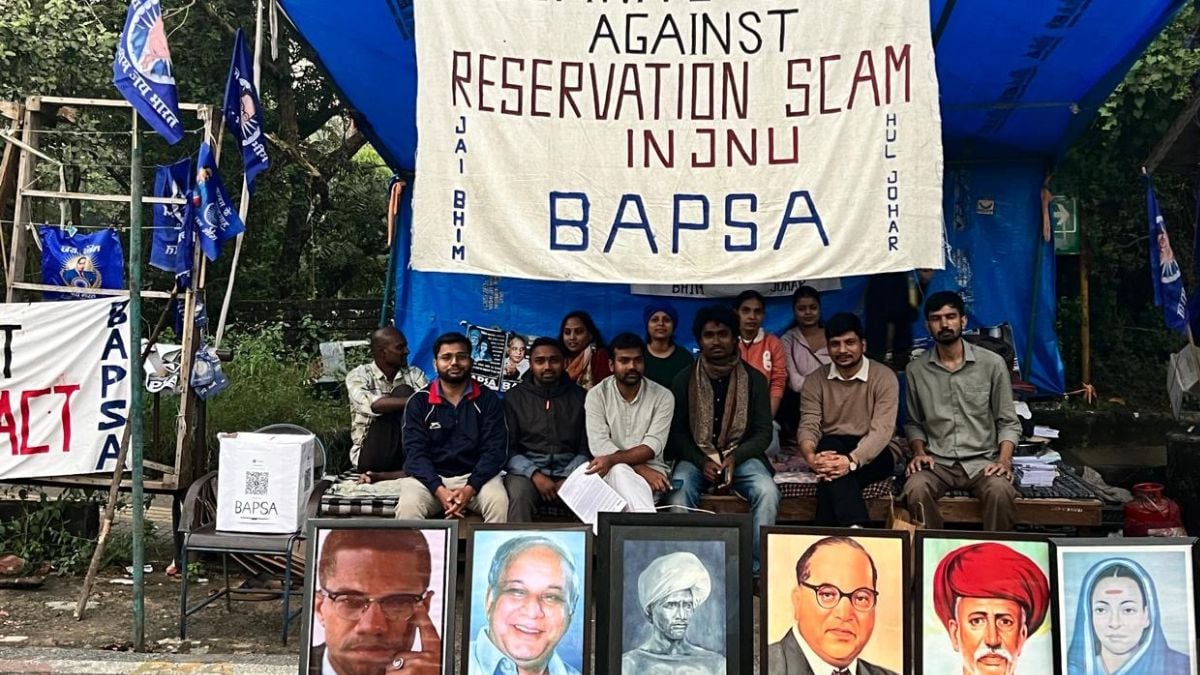
The committee has so far held one meeting. However, it did not bring the protests to a close, with BAPSA continuing its indefinite sit-in on the JNU campus since 23 October, demanding that 15 ST and four SC seats be re-notified in the 2026-27 PhD admissions.
ThePrint has sent a detailed questionnaire to the Vice-Chancellor and the Registrar’s office but is yet to receive a response. This report will be updated if a response is received.
What triggered the controversy?
At the heart of the controversy is the central government’s reservation policy which mandates that centrally-funded educational institutions reserve 15 percent of seats for Scheduled Castes (SC), 7.5 percent for Scheduled Tribes (ST), 27 percent for Other Backward Classes (OBC) and 10 percent for Economically Weaker Sections (EWS).
Besides, a separate 5 percent reservation is provided horizontally for Persons with Benchmark Disabilities (PwBD).
The controversy began when BAPSA questioned JNU’s allocation of ST seats in its 2026-27 PhD admission prospectus on 24 October. SFI had earlier complained to the National Commission for Scheduled Castes (NCSC) and National Commission for Scheduled Tribes (NCST) on 29 September and later held a press conference on 28 October.
In a statement titled ‘EWS but no ST’ issued on 24 October, BAPSA alleged: “A quota for the Economically Weaker Sections (EWS) among the unreserved is being filled before the constitutional guarantee to Scheduled Tribes (ST).”
Its analysis found that 56 of the 84 PhD programmes had no ST seats, while 24 of these offered EWS seats. BAPSA said this pattern had persisted across admission rounds from 2021-22 to 2026-27.
JNU admits PhD students through three routes: University Grants Commission (UGC)/Council of Scientific and Industrial Research (CSIR)–National Eligibility Test (NET), Junior Research Fellowship (JRF) and GATE.
BAPSA has questioned JNU’s practice of calculating reserved seats separately across individual PhD programmes and admission routes, rather than considering the combined intake.
The issue, according to the association, is that smaller seat allocations may not be large enough to generate a reserved seat under the applicable percentage. For instance, under the 7.5 percent ST quota, six seats in a programme or admission category would not yield an ST seat. But when two such groups are considered together, their combined intake of 12 would account for an ST seat under BAPSA’s calculation.
“Since the ST quota is 7.5 percent, a programme needs at least seven seats to yield one ST seat. When a larger intake is divided into smaller programmes or separate admission routes, individual groups may fall below this threshold, leaving no ST seat,” Avichal Warke, former BAPSA president and research scholar at JNU’s Centre for Political Studies, told ThePrint.
The association cited the School of Sanskrit and Indic Studies as an example. It said the school advertised 12 PhD seats in 2026-27: six under the NET route and six under JRF. While the combined intake of 12 would account for an ST seat under BAPSA’s calculation, neither group of six had one.
Across 711 advertised PhD seats in 2026-27, JNU allocated 38 to ST candidates, against approximately 53 expected under the 7.5 percent quota, according to BAPSA, adding that EWS seats accounted for 10.27 percent of the total intake, marginally above the prescribed 10 percent.
Also Read: Faculty hired under reservation policies match peers in teaching despite fewer PhDs, says new study
SFI, AISA, JNU teachers flag reservation concerns
The allegations have since widened with other student organisations questioning the implementation of reservation norms in the 2026-27 PhD admission cycle. JNU’s teachers’ association (JNUTA) has also flagged concerns about the broader representation of marginalised communities at the university.
At a press conference on 28 October, SFI alleged that in the 2026-27 PhD admission cycle, the university had allocated 103 seats to SC candidates against approximately 107 required under the 15 percent quota. It also said only 17 seats had been earmarked for Persons with Benchmark Disabilities (PwBD), against around 36 required under the 5 percent provision.
Gopika Babu, vice-president of the Jawaharlal Nehru University Students’ Union (JNUSU) and an SFI member, told ThePrint that the SFI plans to write to the NCSC again.
“Our demand is that the university issue a fresh prospectus with a revised seat matrix and then conduct the interviews again for PhD admissions in this cycle. The university has formed a committee to buy itself time, but that will not help unless the revised seat matrix is implemented in this year’s admissions,” she said.
She alleged that JNU, in its response to the NCSC, had not denied the allegations. “If there has been no violation of the policy, why can’t the university state that explicitly?” she asked.
AISA, in a letter to the Ministry of Education on 31 October, sought an independent inquiry. Its analysis of 4,288 PhD seats advertised between 2022 and 2026 alleged a shortfall of 42 SC and 44 ST seats.
JNUTA, meanwhile, flagged a decline in marginalised community representation, saying SC enrolment fell from 1,500 in 2021-22 to 1,143 in 2024-25, while ST enrolment dropped from 741 to 545.
Citing JNU’s 2025-26 annual report, presented at the Executive Council meeting on November 2, JNUTA said EWS representation was nearly 15 percent, while SC, ST and OBC representation remained below their respective quotas.
“This blatant administrative lapse is the direct result of a culture of impunity that the current university administration believes it enjoys,” JNUTA said in a statement.
(Edited by Anupama Yadav)
Also Read: SFI alleges reservation violations in JNU PhD admissions, seeks correction of seat allocation