


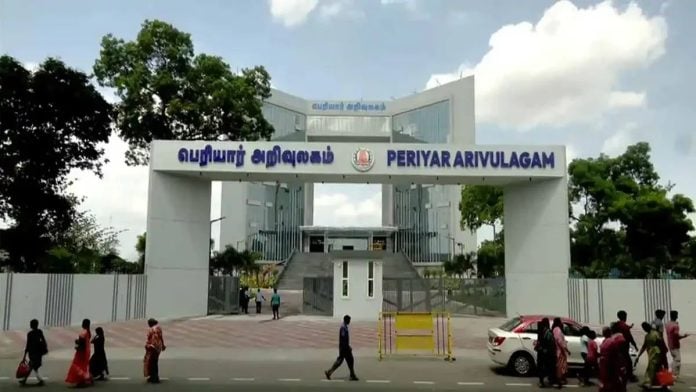
If scandals are measured in jaw-drops, and not merely in terms of money made, then this one has come close to hitting the floor. The Rs 300-crore Periyar Arivulagam (world of knowledge) in Coimbatore, which houses a massive library, has become the centre of a most unusual political storm.
The library, which the former DMK government in Tamil Nadu projected as an important knowledge-infrastructure achievement, was hit by what is touted as the country’s first AI publishing scam. Of the nearly Rs 20 crore (of an allocated budget of Rs. 50 crore) spent on purchasing a little over 60,000 titles for Periyar Arivulagam, a number of them were found to be AI-generated, written by fictitious authors, replete with false information, heavily overpriced, and printed with fake International Standard Book Numbers.
The contentious books, possibly as many as 2,000, published by a couple of unknown imprints (Agal Vilakku and Phoenix Publications) with the same letter-box address, were clearly purchased before the DMK lost the Assembly election. Unsurprisingly, the ruling TVK lost no time in implicating the DMK in yet another scam.
Is it a conspiracy?
As corruption scandals go, this one pulls at many sensitive chords. In fact, an entire symphony. Chief Minister Vijay accused the DMK of using the name of the Dravidian icon Periyar and the Tamil language, the ideological frames on which its planks of social justice and political identity are built, to further its corrupt practices.
The accusation stung harder because it wasn’t the ruling government that cracked open this scandal, but the celebrated writer Perumal Murugan. This was a man whom the DMK leader MK Stalin had supported, and very commendably, some years ago after the novelist was subject to a nasty casteist attack. This was also a man on the inside of the book selection process, having been appointed by the DMK government to the committee to recommend books on modern literature and criticism.
This is where the story begins to get somewhat fuzzy about processes, a little lost in a labyrinth of committees. A book recommendation committee (137 members, split into groups on the basis of their expertise) was to recommend books subject-wise or department-wise. A book selection committee (13 members) was set up to evaluate the list provided by the recommendation committee and finalise a list of books, priority-wise.
Several distinguished people – academics, writers, journalists and others – were appointed to these two committees. While it is no surprise that a fair number of them were well disposed to, even cosy with the DMK government, it is impossible to believe that they could have conspired en masse to perpetrate this tawdry scam.
Two other committees, manned by government officials, sat on top of this process. One to negotiate the prices and the other, headed by the principal secretary of the school education department, to conduct the final scrutiny and approve the procurement.
As things stand, it is not clear where the process broke down. Were the fake AI-generated books introduced at the governmental level, bypassing the book recommendation and book selection committees? If so, this would have been a blatant violation of the process laid down in the government order of 5 November 2025. Could some members of the two expert committees that recommended and selected the books have affixed their signatures on book lists without due diligence? This cannot be ruled out, but only a proper investigation will unearth the full truth.
It is interesting that every Tamil Nadu political party of note, including the DMK, has sought a criminal investigation into this scandal, which is much too shocking to sit on the fence or remain silent about. But party functionaries, who claimed that the irregularities couldn’t have happened under DMK rule and that the problem began only after the TVK took power in June, sounded hollow and will have a lot of explaining to do.
Also read: What Sonia Gandhi said in her 1998 Sriperumbudur speech. ‘Our people being used and misled’
Lies & misinformation in print
It is now clear that the AI slop isn’t confined to the Coimbatore library alone, but has contaminated bookshelves in public libraries, the Connemara in Chennai, the Kalaingar Centenary in Madurai, and reportedly, also in places such as Cuddalore, Tiruchi and Tirunelveli. The New Indian Express has reported that hundreds of overpriced books published by Phoenix Publications with fake ISBNs are stocked in the Kalaingar Centenary Library in Madurai, conceived and built under the DMK government at something like Rs 150 crore.
Even worse, it now appears that the AI book scam was perpetrated earlier. A social media post revealed that the same library had stocked a book attributed to Jean Dreze, which the economist and social activist did not author. The timestamp on this fake book, also a Phoenix Publications imprint, suggests it was procured in 2023. Tamil Nadu’s school education minister A. Rajmohan held up books at a press conference in the Connemara Public Library, one of the country’s oldest, that were purchased in 2025.
One of the many astonishing things about this scam is that it wasn’t outed earlier. Could everyone connected with the acquisition process and those working for public libraries have really been unaware that such books were being sold and stocked under their noses? If true, what does it say about the libraries and the people who man them?
Remember, these books were quite unlike the odd, carefully curated AI-generated novel that managed to fool judges into giving it an award. This was gormless AI slop, riddled with lies and distortions. Among the books Perumal Murugan flagged were those that talked of a Tamil Nadu Chief Minister who never existed, used a fake photo of a Nandi statue linked to the Keeladi excavations, and spoke of a collection of Tamil Jain poetry as if it was a single poet.
As corruption scandals go, this was cretinous in both conception and execution. The success of organised crime depends on wiping away the traces. This one has left bookshelves lined with slop, a list of purchase orders, and quite possibly a list of embarrassing signatures from high-profile people that, at the very least, suggests a colossal failure of oversight.
With the Madras High Court directing the Directorate of Vigilance and Anti-Corruption to register an FIR and immediately freeze the bank accounts of the proprietor of Agal Vilakku, the book procurement process has been placed under welcome judicial scrutiny. Hopefully, this will reduce the political noise and focus attention on what really matters in this book scam — the particulars of the plot or, if you will, the fine print.
Mukund Padmanabhan is a Professor of Philosophy at Krea University and was the former Editor of The Hindu and The Hindu BusinessLine. He is the author of The Great Flap of 1942, a narrative history of India and World War II. Views are personal.
(Edited by Ratan Priya)