


New Delhi: Global oil prices have fallen sharply following the US midterm election results, with investors betting that the Democratic Party’s takeover of the Senate and the House will increase pressure on President Donald Trump to find a diplomatic exit from the war with Iran.
However, energy analysts caution that the decline may prove to be short-lived, with risks to oil supplies from West Asia far from resolved.
Brent crude, the global benchmark, plunged 8.7 percent on 4 November to settle at $94.62 a barrel, while US West Texas Intermediate (WTI) fell 8.3 percent to $88.12, according to Reuters. Both benchmarks closed at their lowest levels since 31 August.
Brent had fallen from $113 a barrel at the end of October to settle at around $98 on Friday, 6 November, as concerns over renewed military action limited further losses.
Much of the decline reflects a reduction in the geopolitical risk premium rather than an improvement in the physical availability of crude oil, Umud Shokri, an energy strategist and geopolitical analyst based in the US told ThePrint.
“The market interpreted the results as increasing pressure on Washington to pursue a diplomatic settlement with Iran rather than prolong the conflict,” he said.
Escalation window remains open
Natalia Katona, a commodity analyst based in Abu Dhabi, said the optimism following the election results could be premature, warning that the next two months could be particularly dangerous for West Asia.
Trump may have an incentive to act before the new Congress takes office in January, while he still has greater political freedom to pursue military action, she said.
“The oil market’s initial optimism already appears to be fading,” Katona said, pointing out that Brent grew from around $94 a barrel after the election-related fall to close at around $98 on Friday.
She cited the recent US attacks on Iran’s Qeshm Island as an indication of how isolated military strikes could develop into a wider confrontation. The movement of the USS Theodore Roosevelt towards the Middle East could also create another window for escalation. Assuming a sailing time of 9 to 10 days, its arrival in the Gulf of Oman could fall in mid-to-late November.
Shokri cautioned that a breakdown in negotiations, renewed US military strikes or further Iranian attacks on tankers and energy infrastructure could quickly reverse the decline in crude oil prices.
“Brent could quickly move back above $100, potentially towards $110 if significant supplies are disrupted,” he said.
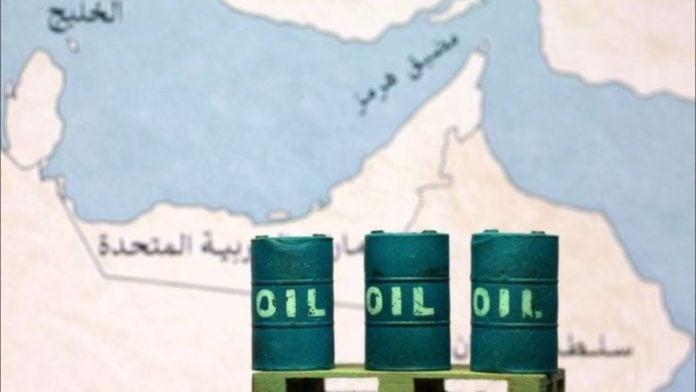
The Strait of Hormuz remains the biggest immediate concern for oil markets. The narrow waterway is a critical route for global crude and petroleum product shipments, and any serious interruption would raise concerns about supply availability.
Katona said the Gulf was far from being more stable than before the US elections. The continuing exchanges of fire between the Houthis and Saudi Arabia are adding to uncertainty, while the threat of Iranian retaliation against further US strikes remains significant.
She pointed out that crude flows from the Gulf had recovered to an estimated 13-14 million barrels per day in October, but remained around 3 million barrels per day below pre-conflict levels.
The recovery remains vulnerable because several major oil producers depend on a limited number of export facilities.
Saudi Arabia’s Ras Tanura and Yanbu terminals are among the key export points. Iraq and Kuwait too face vulnerabilities because of their dependence on a single major terminal each – Basrah for Iraq and Mina al Ahmadi for Kuwait.
“Any attack on a major facility could disrupt millions of barrels a day,” Katona said, adding that the risk of future supply disruptions remains significant.
She also pointed to tanker freight rates as an indicator of continuing security concerns. Very Large Crude Carrier (VLCC) rates on routes from the Gulf to China and Japan remain around $1.3 million per day, broadly unchanged from before the midterm elections.
Shipowners’ continued reluctance to send vessels through the Strait of Hormuz suggests that the shipping industry is not yet convinced that the security situation has improved, she said.
What could bring prices down sustainably?
For oil prices to decline towards $90 a barrel and remain there, markets would need evidence of lasting improvements in security and supply, rather than simply expectations of diplomatic progress.
Shokri said a credible ceasefire, safer passage through the Strait of Hormuz and a sustained recovery in Gulf oil exports would be necessary for Brent to move towards $90 or below.
Lower oil demand after months of high prices could further push prices down. If supplies recover but demand remains weak, the market could shift from fearing a shortage to expecting excess oil supplies, he said.
OPEC+ (Organisation of the Petroleum Exporting Countries and its partner oil-producing nations) could play a bigger role in determining oil prices once Gulf supplies return to normal. However, its immediate influence remains limited by the ongoing conflict.
On 1 November, seven OPEC+ members agreed to maintain their September production targets through December. But the production targets do not necessarily mean the agreed volumes will reach global markets, particularly when producers face disruptions to production and exports, Shokri said.
Katona pointed out that several major producers are already pumping below their production targets. Saudi Arabia’s output is around 8 million barrels per day against a quota of approximately 10.5 million barrels per day, while Iraq, Kuwait and Russia are also underproducing.
Consequently, even if OPEC+ adjusts production targets, the immediate impact on available supplies could remain limited.
For now, analysts believe the market is likely to remain volatile, with developments in the US-Iran conflict determining its direction.
“My assessment is that Brent’s recent decline reflects growing expectations of de-escalation, not the disappearance of supply risks,” Shokri said.
A sustained decline towards $90 a barrel will depend on an actual recovery in oil flows and reduced security risks. Until then, renewed military escalation or disruptions to Gulf exports could quickly reverse the post-election price correction.
(Edited by Anupama Yadav)
Also Read: EXCLUSIVE: Post-midterm US policy on Iran, Russia to shape energy markets—S&P India Content head